During atmospheric entry the heat shield does not heat up from "friction with the air", as is often said, but because the air ahead of the vehicle is suddenly compressed in a shock wave and raised to thousands of degrees. Part of that heat reaches the wall by conduction through the boundary layer (convective heating) and part by emission from the gas itself (radiative heating). This lesson explains the physics of the shock layer, derives the Fay-Riddell equation for the stagnation point, reduces it to the Sutton-Graves correlation used to size heat shields, adds radiation and wall chemistry effects, and ends with communications blackout. By the end you will be able to estimate the heat flux on a capsule and understand why the shape and radius of the nose are the first design decisions. The trajectory equations that feed these calculations are in atmospheric entry dynamics.
Where the heat comes from
A vehicle at 7.8 km/s carries V²/2 ≈ 30 MJ/kg of kinetic energy relative to the air. Seen from the vehicle, it is the air that arrives with that energy. On crossing the shock wave, the air is slowed almost to the vehicle's velocity and that kinetic energy is converted into enthalpy. If air were a perfect gas with c_p = 1,005 J/(kg·K), the stagnation temperature would be:
T₀ = T∞ + V² / (2·c_p) = 250 K + 7,800² / 2,010 ≈ 30,500 K
Nothing like that is reached, because air stops being a perfect gas. Above about 2,500 K oxygen begins to dissociate; above about 4,000 K, nitrogen; and above about 9,000 K the atoms ionize. Each of these reactions absorbs a great deal of energy (dissociating O₂ costs about 15.6 MJ per kilogram of oxygen; N₂, about 33.7 MJ/kg), so the energy goes into chemistry rather than temperature. The actual equilibrium temperature of the shock layer is of the order of 6,000-8,000 K for a return from LEO and about 10,000-11,000 K for a lunar return.
What saves the vehicle is the geometry proposed by Allen and Eggers in 1953: a blunt body creates a strong, detached shock, separated from the wall by a layer of gas. Almost all of the energy stays in the air that crosses the shock and flows around the vehicle into the wake. Only a small fraction, of the order of 1 % or less of the kinetic energy dissipated by a capsule, reaches the wall. A slender body, by contrast, would have a shock attached to its tip and a very thin boundary layer: its tip would receive enormous heat fluxes.
The shock layer
The distance between the shock and the wall at the stagnation point, Δ, scales with the nose radius and with the shock density ratio ε = ρ∞ / ρ_s. For a sphere, a classical approximation is Δ / R_n ≈ 0.78·ε. In a perfect gas with γ = 1.4 at high Mach number, ε → 1/6; with dissociated real gas, compression reaches 10-15 times (ε ≈ 0.07-0.1), and the shock moves closer to the wall. On a capsule with a nose radius of several meters, the shock layer is of the order of tens of centimeters thick: it is that thickness of gas at 10,000 K that emits the radiation.
Two further effects complicate the picture:
- Nonequilibrium: just behind the shock, the gas has not had time to dissociate and its translational temperature can far exceed the equilibrium value over a few millimeters or centimeters. At high altitude, where density is low and collisions are rare, this zone occupies a large part of the shock layer.
- Chemical boundary layer: in the boundary layer, near the colder wall, atoms tend to recombine and release their dissociation energy. Where they recombine (in the gas or at the wall) matters a great deal for the heat flux.
The Fay-Riddell equation
In 1958 James Fay and Frederick Riddell solved the laminar boundary layer at the stagnation point of a blunt body in dissociated air. Their result, the equation that still serves as the reference, is:
q_w = 0.763 · Pr^(−0.6) · (ρ_w·μ_w)^0.1 · (ρ_e·μ_e)^0.4 · √(du_e/dx)
      · (h_0e − h_w) · [ 1 + (Le^0.52 − 1) · h_D / h_0e ]
- Subscript
e: outer edge of the boundary layer (gas behind the shock); subscriptw: wall. Pr: Prandtl number (~0.71);μ: viscosity;ρ: density.h_0e: stagnation enthalpy of the gas;h_w: enthalpy of the gas at the wall temperature. The difference is the "potential" that drives heat toward the wall.Le: Lewis number (species diffusion relative to thermal diffusion, ~1.4 for dissociated air);h_D: the part of the enthalpy stored as dissociation. The bracket accounts for the heat that atoms bring when they recombine. The exponent 0.52 corresponds to an equilibrium boundary layer; for a "frozen" boundary layer with a fully catalytic wall, Fay and Riddell give 0.63.du_e/dx: velocity gradient at the stagnation point, which according to Newtonian theory is:
du_e/dx = (1/R_n) · √( 2·(p_e − p∞) / ρ_e )
From this follows the most important dependence in the whole lesson: since q_w ∝ √(du_e/dx) and du_e/dx ∝ 1/R_n, the convective heat flux at the stagnation point is proportional to 1/√R_n. A large nose, with a generous radius, receives less heat. This is the quantitative justification for the blunt shape.
The Sutton-Graves correlation
Sizing does not require solving the boundary layer at every point of the trajectory. Sutton and Graves (NASA, 1971) fitted the results of the full solutions for arbitrary gas mixtures and obtained a formula that depends only on the freestream density, the velocity and the nose radius:
q_conv = k · √(ρ∞ / R_n) · V³        (cold wall, W/m²)
k = 1.7415·10⁻⁴ kg^0.5/m  (Earth air)
k = 1.9027·10⁻⁴ kg^0.5/m  (Mars atmosphere, CO₂/N₂)
The form can be understood through dimensional analysis: the energy flux reaching the vehicle per unit area is ρ∞·V·(V²/2), and the fraction that crosses the boundary layer falls as 1/√Re, that is, as 1/√(ρ∞·V·R_n). The product gives √(ρ∞/R_n)·V^2.5; the somewhat stronger actual dependence, of the order of V³, captures real-gas effects.
With the trajectory from atmospheric entry dynamics one obtains the heat-flux curve as a function of time; its maximum is the peak heat flux q_max, and its integral, the heat load Q = ∫q·dt (in J/m², usually in kJ/cm²). The peak decides which material can be used; the load, how much thickness is needed.
Scaling with velocity: from LEO to the Moon and beyond
With the Allen-Eggers solution, the peak convective heating of a ballistic entry follows from substituting ρ = β·sin γ/(3H) and V = 0.85·V_E:
q_max ∝ √(β · sin γ / R_n) · V_E³
| Entry | Velocity | Specific energy | Relative flux (V³) | Dominant heating |
|---|---|---|---|---|
| Return from LEO (Soyuz, Dragon) | ~7.8 km/s | ~30 MJ/kg | 1 | convective |
| Lunar return (Apollo, Orion) | ~11 km/s | ~60 MJ/kg | ~2.8 | convective + significant radiative |
| Comet sample return (Stardust) | 12.9 km/s | ~83 MJ/kg | ~4.5 | convective, with radiation |
| Jupiter entry (Galileo probe, 1995) | ~47 km/s | ~1,100 MJ/kg | ~200 | radiative |
The Galileo probe is the extreme case: it received heat fluxes of the order of tens of thousands of W/cm², almost all radiative, and its carbon-phenolic heat shield was about half the mass of the probe.
Radiative heating
Above about 10 km/s, the gas in the shock layer is so hot that it emits intensely (molecular bands of N₂⁺ and CN and atomic lines of N and O in the ultraviolet). The radiative flux to the wall depends on the temperature of the gas, its density and the thickness of the emitting layer. Tauber and Sutton (1991) proposed a correlation of the form:
q_rad = C · R_n^a · ρ∞^b · f(V)
with a positive exponent a, from a few tenths to 1 depending on velocity and density, b ≈ 1.2 and a tabulated function f(V) that grows very rapidly: at Earth, roughly as V to the power of 8 or more in the 10-16 km/s band.
The key is the sign of the exponent of R_n: radiative heating grows with nose radius, because a larger nose has a thicker shock layer. That is the great shape trade-off for fast entries:
- Convective heating falls as
1/√R_n: a large nose is preferable. - Radiative heating rises as
R_n^a: a small nose is preferable.
For a return from LEO convection dominates and the bluntest possible nose is chosen. For a lunar return, as with Apollo or Orion, radiation is already a significant part of the total at the stagnation point, and the optimum shifts. For a return from Mars (about 12-14 km/s depending on the trajectory) or an entry into a giant planet, radiation dominates and there is an optimum nose radius that minimizes the sum.
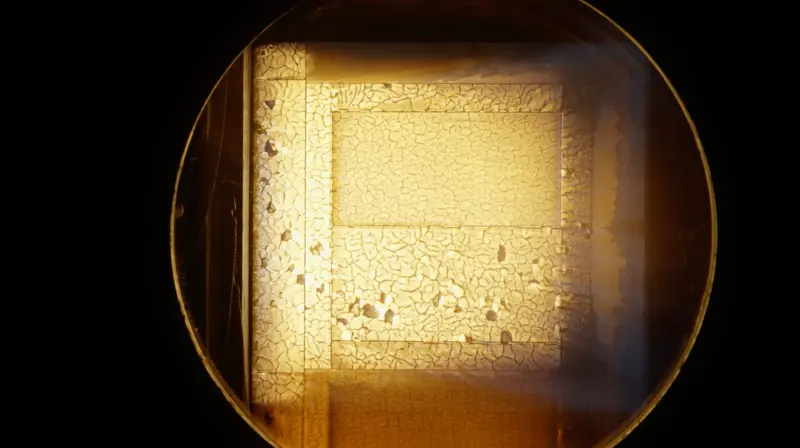
The wall: catalysis, roughness and transition
Catalytic and non-catalytic walls
The oxygen and nitrogen atoms reaching the wall carry their stored dissociation energy. If the wall catalyzes their recombination (O + O → O₂), that energy is released at the surface and added to the heat flux. If the wall is non-catalytic, the atoms bounce off without recombining and take the energy with them. In the boundary layer of a return from LEO, the chemical part can be of the order of a third or more of the total flux, so the choice of coating matters. The black borosilicate glass (RCG) of the Space Shuttle tiles had low catalycity, and in flight the tiles heated up less than predicted by fully catalytic calculations. Design analyses usually assume, on the conservative side, a fully catalytic wall.
Transition to turbulence
The boundary layer starts out laminar at the stagnation point and may become turbulent downstream. A turbulent boundary layer transfers several times more heat than a laminar one and also removes more material through shear. Transition criteria depend on a Reynolds number based on momentum thickness (Re_θ) and on surface roughness, which on an ablator changes during the entry itself. On large capsules such as Curiosity, Perseverance or Orion, transition occurs on the heat shield itself, and the design is done with turbulent heating on the windward side. It was precisely a test under high turbulent shear conditions that ruled out the SLA-561V ablator for the Curiosity heat shield (see ablative heat shields).
Wall temperature: radiative equilibrium
If the wall is neither consumed nor conducts heat inward (a good insulator), it has to reradiate all the flux it receives:
q_w = ε · σ · T_w⁴ → T_w = (q_w / (ε·σ))^(1/4)
with σ = 5.67·10⁻⁸ W/(m²·K⁴) and ε the surface emissivity (0.8-0.9 for a good black coating).
Since radiated flux grows as T⁴, a hot wall is self-regulating: doubling the heat flux only raises the absolute temperature by 19 %. And since the equilibrium temperature depends on ε, a high-emissivity coating is as important as the material underneath.
Game
The heat shield
Beyond the stagnation point
The stagnation point is the most heavily loaded point on a blunt body, but not always the one that drives the design:
- Capsule shoulder: at the edge of the heat shield, the flow accelerates and the local radius of curvature is small; on capsules flying at an angle of attack, the maximum can shift toward the windward shoulder.
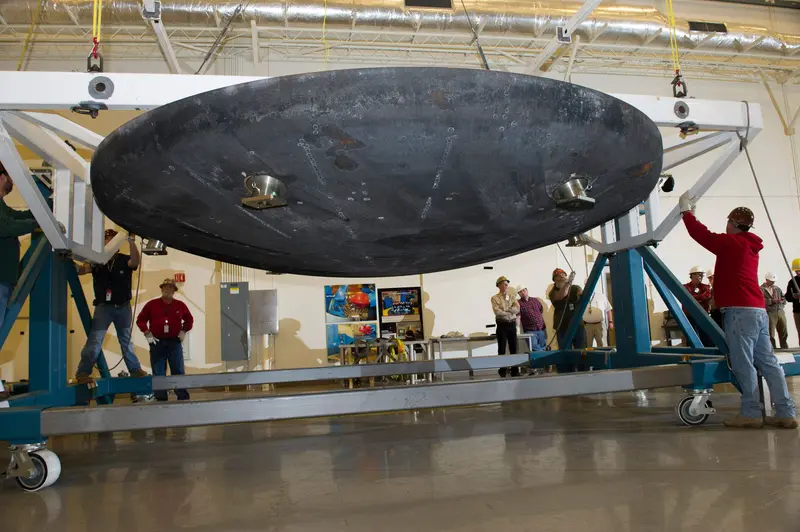
- Backshell: in the wake it receives of the order of a few percent of the forebody heat flux, enough to need its own protection (on Orion, tiles similar to those of the Space Shuttle; on Dragon, a SpaceX proprietary material).
- Leading edges of a glider: a wing has a small leading-edge radius, tens of centimeters, and receives heat fluxes similar to those on the nose. On the Space Shuttle they were made of reinforced carbon-carbon. Where a shock wave impinges on another surface (shock-shock interaction), the local heat flux can be multiplied several times: this is the classic problem of leading edges and hypersonic inlets.
For detailed design, nonequilibrium computational fluid dynamics is used (codes such as DPLR or LAURA at NASA), coupled to radiation codes (such as NEQAIR), and validated in arc-jet facilities and in flight.
Radio blackout
Behind the shock, the gas at thousands of degrees is partially ionized. An electromagnetic wave cannot pass through a plasma if its frequency is below the plasma frequency:
f_p ≈ 8.98 · √n_e Hz (n_e in electrons per m³)
There are three solutions: go up in frequency (Ka-band or higher, less blocked), place the antenna where the plasma is thinnest, or transmit upward, through the wake, to a relay satellite. With the TDRS satellite network, the Space Shuttle maintained much of its link thanks to the latter; capsules still have several minutes of blackout. The link calculation itself is in communications link.
Key points
- Entry heating comes from air compressed by the shock wave; the blunt shape diverts almost all the energy and only a small fraction reaches the wall.
- Fay-Riddell gives the heat flux at the stagnation point; its practical consequence is
q_conv ∝ 1/√R_n. - Sutton-Graves:
q_conv = k·√(ρ∞/R_n)·V³, with k = 1.7415·10⁻⁴ at Earth; the peak heat flux selects the material and the integrated heat load sets the thickness. - Above ~10 km/s radiative heating appears, and it grows with nose radius: there is an optimum radius.
- Wall catalysis, transition to turbulence and radiative equilibrium
q = εσT⁴decide whether reradiation is enough or ablation is required.
Further reading
- J. A. Fay, F. R. Riddell, "Theory of Stagnation Point Heat Transfer in Dissociated Air", Journal of the Aeronautical Sciences 25(2), 73-85 (1958).
- K. Sutton, R. A. Graves, "A General Stagnation-Point Convective-Heating Equation for Arbitrary Gas Mixtures", NASA TR R-376 (1971).
- M. E. Tauber, K. Sutton, "Stagnation-Point Radiative Heating Relations for Earth and Mars Entries", Journal of Spacecraft and Rockets 28(1), 40-42 (1991).
- J. D. Anderson, Hypersonic and High-Temperature Gas Dynamics, 2nd ed., AIAA Education Series (2006).
- H. J. Allen, A. J. Eggers, NACA Report 1381 (1958).
Test yourself
According to the Sutton-Graves correlation, if the nose radius is doubled and everything else is kept the same, the convective heat flux at the stagnation point:
Why does radiative heating change the nose-radius trade-off?
A surface with an emissivity of 0.85 receives 150 kW/m² and reradiates all of it. At approximately what temperature does it reach equilibrium?
What is a "non-catalytic" wall?
What causes radio blackout during atmospheric entry?