An ablative heat shield works once; a vehicle meant to be reused needs a heat shield that comes out of entry the same as it went in. The solution is to give up absorbing the heat and send it back: a high-emissivity surface that heats up to 1,000-1,600 °C reradiates almost all the heat flux it receives, and underneath it a very light insulator keeps the heat from reaching the structure. This lesson explains the radiative equilibrium that makes this possible, goes through the thermal protection system of the Space Shuttle (the largest and best documented), the high-temperature materials (carbon-carbon, ceramic matrix composites, TUFROC, ultra-high-temperature ceramics), Starship's tiles and how an insulator is sized. The physics of entry heating is in aerodynamic heating and the single-use alternative in ablative heat shields.
Three ways to manage heat without consuming material
| Strategy | Principle | Examples | Limit |
|---|---|---|---|
| Heat sink | A metal mass absorbs heat through its heat capacity | Early missile warheads, the X-15's Inconel skin | Short pulses only; very heavy |
| Insulated structure | Reradiating surface + insulator + cold structure | Space Shuttle tiles, Buran, Starship | Surface temperature and brittleness |
| Hot structure | The structure itself withstands the temperature and reradiates | RCC leading edges, IXV C/SiC flaps | Expensive materials; thermal expansion |
| Active cooling | A fluid carries the heat away (film, transpiration) | Engine nozzles; proposals for hypersonic vehicles | Complexity, coolant mass |
For an orbital entry, the dominant strategy is the insulated structure on large surfaces and the hot structure at the points of highest heat flux. The heat sink does not scale: absorbing 30 MJ/kg would take tonnes of metal. Active cooling is common in nozzles (see liquid rocket engines) but has rarely been applied to a fuselage.
Radiative equilibrium
If the surface of a tile receives a heat flux q and conduction inward is negligible, it reaches equilibrium at the temperature at which it reradiates the same amount:
q = ε · σ · T_w⁴
Emissivity ε is the key player. The Space Shuttle tiles carried a black borosilicate glass coating (RCG, reaction cured glass) with an emissivity of the order of 0.85-0.9 at high temperature. With ε = 0.85 and a heat flux of 15 W/cm², the surface reaches equilibrium at about 1,050 °C; with 50 W/cm², at about 1,520 °C. Above about 1,260 °C silica starts to lose its properties (it shrinks and devitrifies), which is why the black tile was limited to areas that did not exceed that value.
Besides reradiating, the coating must have low catalycity so that oxygen and nitrogen atoms do not recombine at the surface and release their energy. RCG did, and in flight the tiles heated up less than in fully catalytic calculations.
An on-orbit detail: the white tiles on top of the Shuttle looked that way because their coating had a low solar absorptivity, to keep the vehicle cool during the days in orbit with the payload bay open, while their infrared emissivity remained high. It is the same problem as the thermal control of a satellite.
The Space Shuttle system
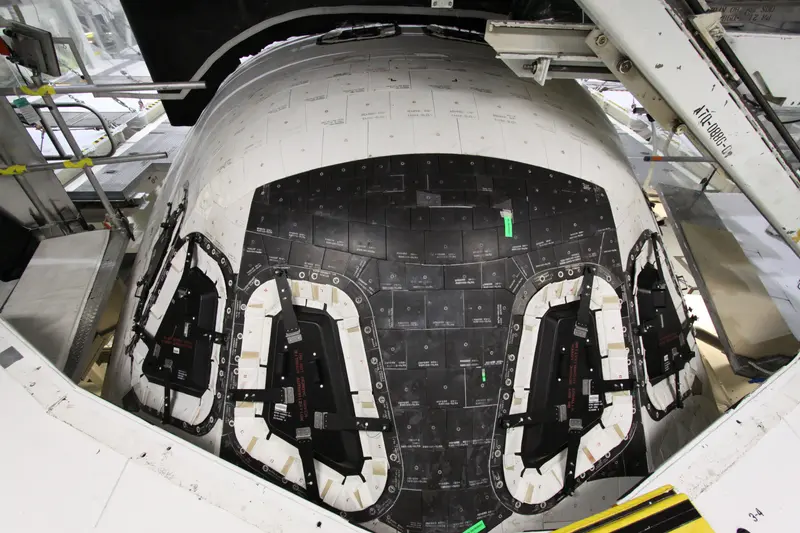
The Space Shuttle carried about 24,300 tiles, plus blankets, carbon-carbon panels and seals. Each zone of the vehicle had the material its maximum temperature called for:
| Material | Maximum use temperature | Where | Density |
|---|---|---|---|
| RCC (reinforced carbon-carbon) | ~1,650 °C | Nose cap and wing leading edges | ~1.6 g/cm³ |
| HRSI: black LI-900 and LI-2200 tiles | ~1,260 °C | Belly, windward areas | 0.144 and 0.35 g/cm³ |
| FRCI-12 (fibrous refractory composite insulation tiles) | ~1,260 °C | Replaced LI-2200 in many areas | ~0.19 g/cm³ |
| LRSI: white tiles | ~650 °C | Sides, parts of the upper surface | 0.144 g/cm³ |
| AFRSI: quilted silica blankets | ~650 °C | Replaced many white tiles | light |
| FRSI: coated Nomex felt | ~370 °C | Payload bay doors, cold areas | very light |
The structure was aluminum and could not exceed about 175 °C. Silica and aluminum expand very differently, and a tile bonded directly to the skin would have broken under the structure's deformations. The solution was to bond them with silicone (RTV) to a Nomex felt pad (strain isolation pad), which decouples the two expansions, and to leave gaps between tiles with gap fillers. After every flight the tiles had to be rewaterproofed by injecting a water-repellent compound, because a tile that absorbs water weighs much more and can crack when the water freezes in orbit.
Inside an LI-900 tile
LI-900 is sintered high-purity silica fiber with a density of only 144 kg/m³ (9 pounds per cubic foot, hence the name): 94 % of its volume is air. It conducts heat very poorly, of the order of 0.05 W/(m·K) at room temperature and a tenth of a W/(m·K) at high temperature in partial vacuum, and its thermal expansion is almost zero, so it withstands brutal thermal shocks: it can be taken out of a furnace at 1,200 °C and held by the edges with bare hands a moment later. Its weak point is mechanical strength: it is brittle under impact and can barely withstand tension.
Reinforced carbon-carbon
The nose cap and the 22 panels of each Space Shuttle leading edge were made of RCC: layers of graphitized rayon fabric impregnated with phenolic resin, pyrolyzed several times until a carbon matrix remained. Carbon retains its strength at temperatures at which all metals melt, but it oxidizes in air above about 400-500 °C. To prevent this, the outer layer was converted into silicon carbide (SiC) and the cracks that form on cooling were sealed with an impregnant (TEOS) and glass. RCC worked as a hot structure: it carried the wing loads and reradiated at up to about 1,650 °C, with insulation inside to protect the aluminum spar.
Trade-offs of a reusable thermal protection system
- Maximum temperature versus mass: every material has a ceiling (silica ~1,260 °C, RCC ~1,650 °C); above it the material must change, and the higher-temperature ones are denser and more expensive.
- Robustness versus insulation: a very porous insulator is light but brittle. More modern tiles have a hardened outer layer, such as TUFI (toughened unipiece fibrous insulation), developed at NASA Ames, which penetrates a few millimeters into the tile and makes it much more impact resistant.
- Gaps: every gap between tiles is a potential heat leak and a place where something can protrude. On mission STS-114 (2005), astronaut Stephen Robinson removed during a spacewalk two gap fillers protruding from the belly, because they could trip the boundary layer to turbulence and increase heating downstream. NASA later measured that effect with an instrumented protuberance on several Space Shuttle flights (the BLT experiment, from 2009 to 2011).
- Maintenance: the Space Shuttle tiles required one-by-one inspection, rewaterproofing and replacement of dozens on every flight. It was one of the reasons the vehicle never reached its planned flight rate and cost. A reusable system is only cheap if the maintenance between flights is.
- Shape: a winged vehicle has far more surface to protect than a capsule, and small-radius leading edges, with higher heat flux. The lift-to-drag ratio gained in atmospheric entry dynamics is paid for here.
Beyond the Space Shuttle: CMCs, TUFROC and UHTCs
Ceramic matrix composites
CMCs (ceramic matrix composites) such as carbon-silicon carbide (C/SiC) and silicon carbide reinforced with silicon carbide fibers (SiC/SiC) are the evolution of RCC: more resistant to oxidation and with better mechanical properties. ESA's IXV (Intermediate eXperimental Vehicle), which flew on 11 February 2015, had a C/SiC nose and belly and flaps of the same material as a hot structure, and demonstrated in flight the thermal protection and control of a European lifting body.
TUFROC
TUFROC (toughened uni-piece fibrous reinforced oxidation-resistant composite), developed at NASA Ames, is a two-piece tile: an outer cap of treated carbon with an oxidation-resistant coating, able to withstand temperatures of the order of those of RCC, on top of a fibrous insulating base. It weighs much less than RCC and is much faster to manufacture. Since 2010 it has protected the leading edges of the X-37B, the US Air Force's small reusable spaceplane.
Ultra-high-temperature ceramics
Zirconium and hafnium borides and carbides (ZrB₂, HfB₂, HfC) melt above 3,000 °C. They are being studied for sharp leading edges, which reduce drag and increase the lift-to-drag ratio of hypersonic vehicles but, by Fay-Riddell (q ∝ 1/√R_n), receive very high heat fluxes. NASA flew samples in the SHARP B-1 (1997) and B-2 (2000) experiments. Their problem is brittleness and thermal shock resistance.

Starship: tiles on steel
Starship (SpaceX) changes a fundamental variable: the structure is stainless steel, which retains its strength up to several hundred degrees, compared with the ~175 °C of the Space Shuttle's aluminum. With a structure that tolerates higher temperature, the insulation can be thinner, and the leeward side, which receives little heat, can go without tiles. The windward side carries of the order of 18,000 hexagonal silica tiles on the ship, attached with mechanical pins instead of bonded, so that they can be installed and replaced quickly. All of them have the same shape except at the edges, the opposite of the Space Shuttle's unique tiles.
Test flights since 2023 have shown the usual problems: lost tiles, plasma entering through gaps, damage to the flap hinges. SpaceX has been adding an ablative backup layer under the tiles, so that the loss of one does not compromise the structure, and has tested several types of tiles. The goal, full reuse with minimal maintenance between flights, is precisely the one the Space Shuttle did not achieve; first-stage reusability is covered in its own lesson.
How it is designed
Sizing a reusable thermal protection system follows these steps:
- Environment: heat fluxes and pressures at each point of the vehicle along the design trajectory, with margins for uncertainty (CFD and wind-tunnel tests).
- Material selection by zone, according to the radiative equilibrium temperature and the mechanical loads (pressure, vibration, launch acoustics, impacts).
- Thickness: 1D transient calculation (and 2D or 3D at gaps and edges) so that the structure does not exceed its limit, including the post-landing phase.
- Testing: in arc-jet facilities (heating), in radiant heating furnaces (thermal cycling), in acoustic chambers (launch) and impact tests.
- Service life: the number of cycles each material withstands before degrading, with inspection and replacement criteria.
The variable that drives life-cycle cost is not the material, but operations: how long inspection and repair take, and how much margin has been left so that they need not be done on every flight.
Game
The heat shield
Key points
- Reusable thermal protection reradiates: with
q = εσT⁴, a high-emissivity surface at 1,000-1,600 °C sends back almost all the heat flux. - LI-900 tiles (94 % air, 144 kg/m³) insulate so well that of the order of 1 % of the heat reaches the structure, but they are brittle and the structure heats up after landing.
- RCC (~1,650 °C) protects the hottest areas as a hot structure; it is protected from oxidation with SiC and its weak point is impact (Columbia, 2003).
- The evolution goes through toughened tiles (TUFI), CMCs (IXV), TUFROC (X-37B), UHTCs for sharp leading edges and steel structures that tolerate higher temperatures (Starship).
- A reusable system only makes access to space cheaper if maintenance between flights is short.
Further reading
- D. R. Jenkins, Space Shuttle: The History of the National Space Transportation System, 3rd ed. (2001), chapter on the thermal protection system.
- Columbia Accident Investigation Board, Report Volume I, NASA (August 2003).
- P. A. Cooper, P. F. Holloway, "The Shuttle Tile Story", Astronautics & Aeronautics 19(1), 24-34 (1981).
- P. Fortescue, G. Swinerd, J. Stark (eds.), Spacecraft Systems Engineering, 4th ed., Wiley (2011).
- J. D. Anderson, Hypersonic and High-Temperature Gas Dynamics, 2nd ed., AIAA Education Series (2006).
Test yourself
What is the physical principle of a reusable tile such as the Space Shuttle's LI-900?
A 5 cm tile with a conductivity of 0.1 W/(m·K) has its outer face at 1,260 °C and its inner face at 175 °C. What heat flux crosses the tile at steady state?
Where did the Space Shuttle use reinforced carbon-carbon (RCC)?
Why can a small gap filler protruding between two tiles be dangerous?
What advantage does Starship's stainless steel structure have over the Space Shuttle's aluminum as far as thermal protection is concerned?