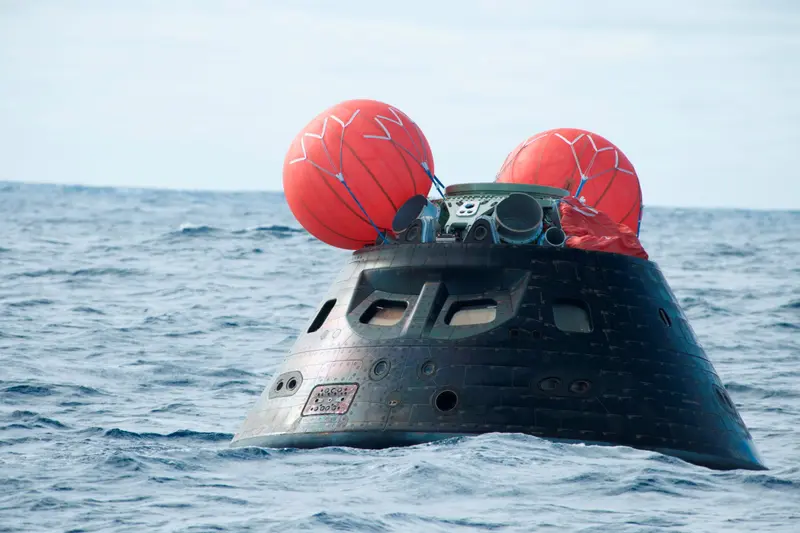
When the hypersonic phase of entry ends, the vehicle has lost more than 95 % of its energy, but it is still descending at several hundred meters per second. The last leg remains: going from Mach 1.5-2 to touching the water or the ground at under 10 m/s (or under 1 m/s, if what is arriving is a rover), with loads within what the crew and the structure can withstand. This lesson covers the physics of terminal velocity, the types of parachute and how their opening shock is calculated, the actual sequences of Apollo, Orion, Dragon and Soyuz, impact attenuation, Perseverance's descent on Mars and powered landing. The preceding phase is in atmospheric entry dynamics.
Terminal velocity
A body falling under a parachute ends up in equilibrium when drag equals weight:
m·g = ½ · ρ · v_t² · C_D·S → v_t = √( 2·m·g / (ρ · C_D·S) )
S: nominal area of the parachute (that of the canopy laid out flat);C_D: drag coefficient referred to that area. The productC_D·Sis called the drag area.ρ: air density at the point considered. Since density grows as the vehicle descends, the terminal velocity decreases during the descent.
The design consequence is direct: halving the velocity requires four times the area, and the parachute mass grows roughly with it.
Types of parachute
| Type | Typical C_D (nominal area) | Advantages | Use |
|---|---|---|---|
| Flat circular | ~0.75-0.8 | Simple, high drag | Cargo, people |
| Conical ribbon | ~0.5 | Very stable, withstands high speeds and abrupt openings | Drogues of Apollo, Orion, Dragon |
| Ringsail | ~0.75-0.9 | High drag per kilogram of fabric | Apollo and Orion mains |
| Disk-gap-band (DGB) | ~0.5-0.6 | Works in the supersonic regime | Viking, Mars Pathfinder, Curiosity, Perseverance |
| Parafoil | L/D ~2-3 | Can be steered and can glide | Cargo recovery, the X-38 in testing |
The drogue parachutes open first, at high speed: they have to be small, robust and stable, because the capsule, which is stable in hypersonic flight, becomes unstable as it approaches Mach 1 and oscillates. The ribbons of the conical parachute let part of the air through, reduce the load and damp the oscillations. The mains, much larger, open when the velocity is already low, and their job is to provide maximum drag per kilogram.
All of this is sized with the classical methods of Knacke's Parachute Recovery Systems Design Manual, which compiles decades of US Navy and NASA testing.
Opening shock and reefing
A parachute does not open gradually: in less than a second it goes from folded fabric to an inflated canopy, and the force has a peak far above the steady-state drag. It is estimated with:
F_opening = C_x · q · C_D·S, q = ½ · ρ · v²
with q the dynamic pressure at the moment of deployment and C_x an opening shock factor, of the order of 1-1.8 depending on the type of parachute and the ratio between the vehicle mass and the mass of air the parachute sets in motion. If the vehicle is very heavy compared with the displaced air (the "infinite mass" case, as in a wind tunnel), C_x is larger; if it is light, the vehicle slows down while the parachute opens and the peak is smaller.
The tool for controlling that peak is reefing: a line runs around the mouth of the parachute and keeps it constricted, with a smaller effective area. Timed pyrotechnic cutters sever the line after a few seconds, once the velocity has dropped. The Apollo and Orion mains open with two-stage reefing: three moderate load peaks instead of one enormous one. Opening loads size the capsule attachment points, the risers (Kevlar on Orion) and the fabric itself.
Actual descent sequences
Apollo and Orion
| Phase | Apollo | Orion |
|---|---|---|
| Forward cover jettison | yes, with its own parachute | yes, with 3 parachutes of its own |
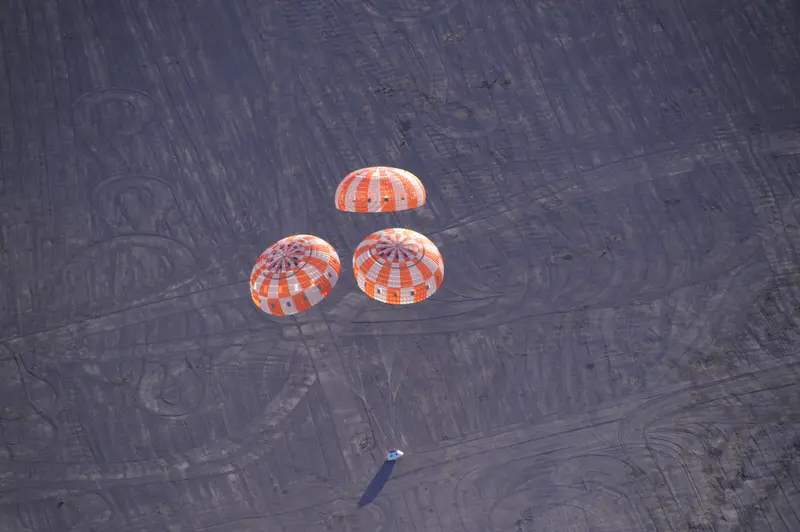
| Drogue parachutes | 2, about 5 m, at about 7,300 m | 2, about 7 m, at about 7,600 m |
| Pilot parachutes | 3 | 3 |
| Mains | 3, 25.4 m, at about 3,000 m | 3, 35 m, at about 2,900 m |
| Splashdown velocity | of the order of 9-10 m/s | of the order of 8 m/s |
Orion carries eleven parachutes in total. Its sequence begins below Mach 1, when the dynamic pressure is already manageable. Each Orion main has of the order of 1,000 m² of fabric, as much as the single main of the Soyuz.
Dragon
Crew Dragon (SpaceX) opens two drogue parachutes at about 5.5 km altitude and four mains at about 1.8 km. Four mains instead of three give more margin against a failure. SpaceX originally planned for Dragon to land on land with its SuperDraco engines, but in 2017 abandoned that plan because of the cost of certifying it for crews, and kept splashdown.
Soyuz: parachutes, retrorockets and seats
Soyuz lands on land, on the steppes of Kazakhstan. After opening two pilot chutes and a 24 m² drogue, it deploys a single main of about 1,000 m² (it has a smaller reserve) that brings it to about 6-7 m/s. That is too much for touchdown: just before, at less than a meter, a gamma-ray altimeter fires six small solid-propellant soft-landing retrorockets, which slow it to a few m/s. The crew seats, custom-molded to each astronaut's body, have shock absorbers that are armed before landing.
Starliner
Starliner (Boeing) descends under three mains and, after jettisoning the heat shield, inflates six airbags under the capsule to land in the desert of the western US. It is the solution used by the Mars Pathfinder (1997), Spirit and Opportunity (2004) rovers, which bounced across the Martian surface inside a ball of airbags.
Water or land: the trade-off
| Option | For | Against |
|---|---|---|
| Splashdown (Apollo, Orion, Dragon) | Needs no retrorockets or airbags; more tolerant of velocity | Recovery ships, saltwater corrosion, risk of capsizing (capsules with uprighting bags) |
| Land with retrorockets (Soyuz) | Fast recovery on land; less corrosion | Requires one more system that must work; harder impacts |
| Land with airbags (Starliner) | Reusable; land recovery | Mass and complexity of the airbags; sensitivity to wind |
| Powered landing (Falcon 9, New Shepard, Starship) | Accuracy of meters; full reuse | Reserved propellant and engine reliability; a lot of guidance |
The choice affects the whole mission: splashdown requires keeping ships and helicopters at sea, but it forgives errors; land requires the whole final system to work the first time.
Mars: Perseverance's descent
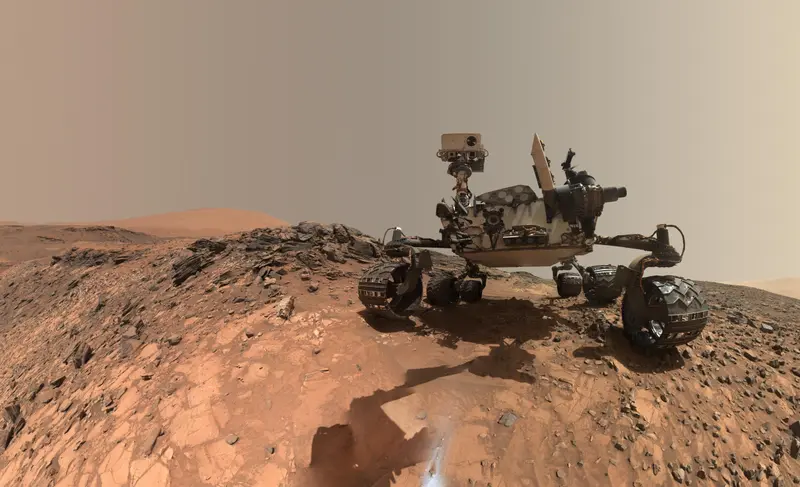
On Mars the problem changes scale. Air density near the surface is of the order of 0.015-0.02 kg/m³, little more than 1 % of Earth's. Terminal velocity grows as 1/√ρ: about ten times higher with the same parachute. Perseverance's landing, on 18 February 2021 in Jezero crater, can be summarized as follows:
- Entry at about 5.4 km/s (19,500 km/h) at the entry interface, at about 125 km. The heat shield reaches about 1,300 °C.
- Supersonic parachute: a 21.5 m diameter DGB is deployed by a mortar at about 11 km altitude, near Mach 1.7. The moment is decided by the Range Trigger, which waits according to position in order to get closer to the chosen point.
- Heat shield separation about 20 seconds later: the radar starts measuring altitude and the camera starts photographing the ground.
- Terrain-Relative Navigation (TRN): the images are compared on board with a map taken from orbit, and the vehicle chooses a safe point within the ellipse. It was the first time it had been used on Mars.
- Backshell separation at about 2.1 km altitude and about 320 km/h (about 89 m/s).
- Powered descent: the descent stage, with eight throttleable hydrazine engines, diverts away from the parachute and brakes almost to a stop.
- Sky crane: about 20 m above the ground, the stage lowers the rover on cables and sets it down at about 0.75 m/s. On detecting touchdown, it cuts the cables and flies off to crash at a distance.
It all takes about seven minutes, the "seven minutes of terror", with no intervention from Earth: the signal takes more than ten minutes to arrive. Perseverance's landing ellipse, thanks to guided entry and TRN, was about 7.7 × 6.6 km.
Powered landing
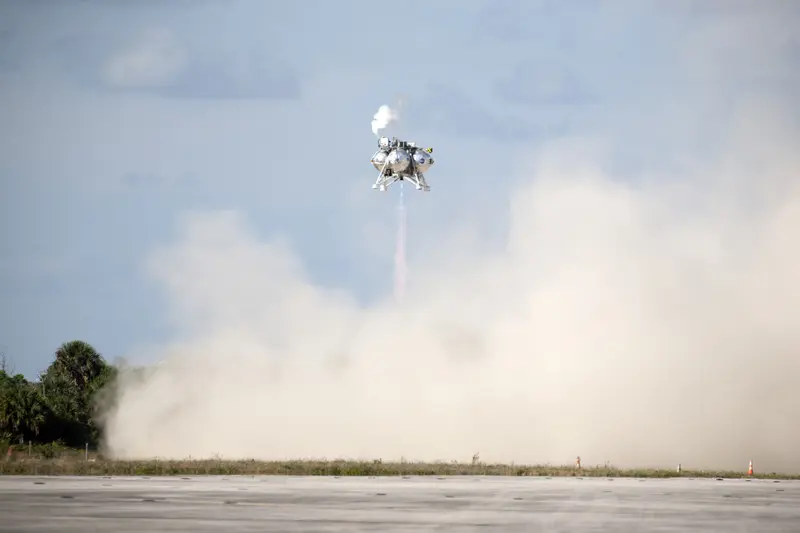
An engine provides something no parachute does: accuracy, and the possibility of landing where there is no atmosphere. The price is propellant. To brake vertically from a velocity v₀ with a constant thrust acceleration a_T:
Burn time:            t = v₀ / (a_T − g)
Δv expended:          Δv = a_T · t = v₀ · a_T / (a_T − g)
Altitude required:    h = v₀² / (2·(a_T − g))
The difference between Δv and v₀ is the gravity loss: while the engine brakes, gravity keeps accelerating the vehicle. The higher the thrust-to-weight ratio, the smaller the losses, but the more abrupt the braking.
On Earth, the Falcon 9 first stage cannot throttle its thrust below its weight even with a single engine, so it cannot hover: it ignites at the last moment so as to reach zero velocity just as it touches the droneship (the "suicide burn", or hoverslam), with guidance by convex optimization solved on board. This is covered in reusability and propulsive landing. On the Moon, with no atmosphere, the entire descent is powered, as with the Apollo lunar module (see travelling to the Moon).
Game
Land the lunar module
Accuracy and dispersions
The touchdown point is not a point but a dispersion ellipse: the region where the vehicle would land with 99 % probability, computed with thousands of Monte Carlo simulations in which the atmosphere, wind, mass, aerodynamic coefficients and navigation errors are varied. The ellipse determines where the recovery ships must be for a splashdown, which areas must be clear for a landing on land, or which Martian terrain has to be safe.
What enlarges it most on Earth is the wind during the descent under parachutes: a capsule descending 3 km at 8 m/s takes about six minutes, and with a 10 m/s wind it drifts about 3.7 km. On Mars, what shrank it most was hypersonic guidance. Accuracy is improved with guidance during entry, steerable parachutes or, in the limit, powered landing.
Key points
- Terminal velocity is
v_t = √(2mg/(ρ·C_D·S)): half the velocity requires four times the area. - First small, stable drogue parachutes, then large mains; reefing spreads the opening shock over several stages.
- Orion splashes down at about 8 m/s under three 35 m mains and is designed to do so with two; Soyuz uses retrorockets and shock-absorbing seats to touch down on land.
- On Mars the parachute only brings the vehicle down to about 80-90 m/s: Perseverance needed powered descent, image-based navigation and a sky crane to touch down at 0.75 m/s.
- Powered landing provides accuracy and reusability, at the cost of propellant and gravity losses.
Further reading
- T. W. Knacke, Parachute Recovery Systems Design Manual, Para Publishing (1992); original version, Naval Weapons Center, NWC TP 6575 (1991).
- R. D. Braun, R. M. Manning, "Mars Exploration Entry, Descent, and Landing Challenges", Journal of Spacecraft and Rockets 44(2), 310-323 (2007).
- NASA/JPL, Mars 2020 Perseverance Launch Press Kit (July 2020) and Landing Press Kit (February 2021).
- A. Steltzner et al., "Mars Science Laboratory Entry, Descent, and Landing System", IEEE Aerospace Conference (2006).
- B. Açıkmeşe, S. R. Ploen, "Convex Programming Approach to Powered Descent Guidance for Mars Landing", Journal of Guidance, Control, and Dynamics 30(5), 1353-1366 (2007).
Test yourself
If a capsule descending under three main parachutes loses one, by how much does its terminal velocity increase?
What is the purpose of parachute reefing?
Why is a parachute not enough to land on Mars?
A capsule touches the ground at 6.5 m/s and its seat stops the astronaut over 25 cm. What average deceleration does the astronaut experience?
What is Perseverance's touchdown velocity under the sky crane?