Returning from space is a problem of energy and of time. A vehicle in low Earth orbit carries about 30 MJ per kilogram; one returning from the Moon, about 60 MJ/kg. The atmosphere is the brake, but a brake that cannot be released or modulated at will: density grows exponentially with decreasing altitude, and the chosen trajectory simultaneously decides how many g the crew endures, how much heat reaches the shield and where the vehicle lands. This lesson sets up the equations of motion for entry, derives the classical Allen and Eggers solution, applies it to real cases and shows why a little lift changes everything. By the end you will be able to estimate by hand the peak deceleration, the altitude at which it occurs, the width of the entry corridor and the range of a glider. The expert lesson getting to orbit and back gives the final formulas; here they are derived and put to work.
The equations of motion
Take a spherical, non-rotating planet, a vehicle treated as a point mass and motion in the plane of the trajectory. The variables are the velocity V, the flight-path angle γ (negative when the vehicle is descending), the altitude h and the angle travelled over the surface, which gives the range s. The forces are weight, drag D = ½ρV²·C_D·A and lift L = ½ρV²·C_L·A:
dV/dt = −D/m − g · sin γ
V · dγ/dt = L/m − (g − V²/r) · cos γ
dh/dt = V · sin γ
ds/dt = V · cos γ · R/r
m: mass;A: reference area (the frontal cross-section of the capsule);C_D,C_L: aerodynamic coefficients.r = R + h: distance to the center of the planet;g = g₀·(R/r)².- The
V²/rterm is the "centrifugal force" of curved motion: at orbital velocity it exactly balances gravity andγdoes not change. As the vehicle slows down, that relief disappears and the trajectory bends downward.
Earth's rotation adds Coriolis terms that matter for guidance, not for understanding the physics. Everything hinges on two numbers of the vehicle:
- Ballistic coefficient
β = m / (C_D · A), in kg/m²: how much mass each square meter of drag has to decelerate. With a low β the vehicle slows down high up, in thin air. - Lift-to-drag ratio
L/D = C_L / C_D: how much side force is obtained per unit of drag.
| Vehicle | Entry mass | Diameter | Approximate β | Hypersonic L/D |
|---|---|---|---|---|
| Stardust capsule (2006) | 45.8 kg | 0.81 m | ~60 kg/m² | 0 (ballistic) |
| Apollo command module | ~5.5 t | 3.9 m | ~350 kg/m² | ~0.3 |
| Orion | ~9 t | 5.0 m | of the order of 350-400 kg/m² | ~0.25-0.3 |
| Mars 2020 (Perseverance) | ~3.4 t | 4.5 m | of the order of 130 kg/m² | ~0.24 |
| Space Shuttle | ~90-100 t | winged | — | ~1 (at 40° angle of attack) |
The β values in the table were computed with C_D ≈ 1.3-1.6, typical of a capsule or blunt cone in the hypersonic regime. They are not catalogue figures, but they are of the right order.
The exponential atmosphere
Solving by hand requires a density model. In hydrostatic and isothermal equilibrium, dp/dh = −ρg with p = ρ·R_g·T gives:
ρ(h) = ρ₀ · e^(−h/H), H = R_g · T / g
H is the scale height: every H meters the density is divided by e ≈ 2.718. For Earth one uses ρ₀ = 1.225 kg/m³ and H ≈ 7.2 km in the 40-80 km band where the important part of entry happens; for Mars, ρ₀ ≈ 0.02 kg/m³ and H ≈ 11 km. The real atmosphere is not isothermal (see layers of the atmosphere), but the error of this model is small compared with the uncertainty on any given day: density at 100 km can vary by a factor of two with solar activity.
Game
Climb through the atmosphere
By convention, the entry interface at Earth is set at 122 km (400,000 feet): there the density is so low that the trajectory is still Keplerian, but from that point on drag can no longer be ignored. At Mars a radius of 3,522 km is used, about 125 km above the surface.
The Allen-Eggers solution: ballistic entry
In 1953, H. Julian Allen and Alfred Eggers, of the NACA Ames laboratory, solved analytically the entry of a missile warhead. Their assumptions are three, and it is worth knowing when they hold:
- No lift (
L = 0). - Drag is much larger than weight:
g·sin γis neglected in the first equation. - The flight-path angle is constant:
γ = γ_E. This holds for steep entries, where the trajectory has no time to bend.
With these, and changing the time variable to altitude (dt = dh / (V·sin γ)), the first equation becomes:
dV/V = −ρ / (2β · sin γ) · dh    →    with dρ = −(ρ/H)·dh:
V = V_E · exp[ −ρ·H / (2β · |sin γ_E|) ]
The velocity barely changes while ρH is small compared with β·sin γ, and then drops abruptly over a few H of altitude. The deceleration is a = D/m = ρV²/(2β). Differentiating with respect to ρ and setting it to zero:
ρ* = β · |sin γ_E| / H        V* = V_E · e^(−1/2) ≈ 0.61 V_E
n_max = a_max / g₀ = V_E² · |sin γ_E| / (2 · e · H · g₀)
h* = H · ln[ ρ₀·H / (β·|sin γ_E|) ]
Three consequences that every entry engineer knows by heart:
- Peak deceleration does not depend on β. A heavy vehicle and a light one experience the same g if they enter equally fast and at the same angle; the heavy one experiences them lower down.
- It grows with V_E² and with sin γ. Doubling the angle doubles the g.
- The altitude of the peak does depend on β: a small β decelerates high up, in thin air, and therefore heats less.
Where it heats up: the peak heat flux
The convective heat flux at the stagnation point scales, according to the Sutton-Graves correlation derived in aerodynamic heating, as q ∝ √ρ · V³. Substituting the Allen-Eggers solution and maximizing:
ρ_q = β · |sin γ_E| / (3H) V_q = V_E · e^(−1/6) ≈ 0.85 V_E
Peak heating comes earlier and higher up than peak deceleration, when the vehicle still retains 85 % of its velocity (and 72 % of its kinetic energy). In the previous example, peak heating would be at about 51 km and peak deceleration at about 43 km. The integrated heat load Q = ∫q·dt, which is what sets the thickness of the shield, depends mainly on √β and on how fast the entry is: a steep entry heats strongly for a short time; a shallow one, mildly for a long time. That is the first design trade-off of any entry mission, and it is developed in ablative heat shields.
The entry corridor
Not every arrival trajectory is acceptable. The entry corridor is the band of flight-path angles at the entry interface between two limits:
- Upper limit (overshoot): the shallowest entry with which the vehicle is still captured. If it enters too shallow it does not lose enough energy and leaves the atmosphere; coming from the Moon, at almost escape velocity, that means an enormously eccentric orbit or being lost altogether.
- Lower limit (undershoot): the steepest entry that does not exceed the g limit (for a crew, of the order of 10-12 g for a short time) or the maximum heat flux of the shield.
| Mission | Velocity at the interface | Nominal angle | Corridor width |
|---|---|---|---|
| Return from LEO (Soyuz, Dragon) | ~7.5-7.8 km/s | ~−1° to −2° | wide: set by the deorbit burn |
| Lunar return (Apollo) | ~11 km/s | ~−6.5° | of the order of 2° |
| Lunar return (Orion, Artemis I) | ~11 km/s | — | of the order of 1-2° |
A two-degree corridor seems generous until it is translated into distance: the "vacuum" perigee has to fall within a band a few tens of kilometers high after a 380,000 km journey, which is why lunar-return spacecraft correct their trajectory in the final days with very precise orbit determination (see navigation and orbit determination). Lift widens the corridor: if the entry is somewhat shallow, the capsule points its lift downward and stays inside.
Lifting entry: capsules
A capsule is symmetric, but if its center of mass is moved off the axis it flies in equilibrium at a non-zero trim angle of attack, of the order of 20° for Apollo. At that angle the total aerodynamic force is no longer parallel to the velocity: it has a perpendicular component, lift, with L/D ≈ 0.3. It seems little, but it is enough to change the problem.
The capsule has no ailerons. The only thing it controls is the bank angle σ: it rolls about the velocity vector with its attitude-control thrusters, and thereby orients its lift. Only the vertical component, L·cos σ, arrests the descent; the horizontal one, L·sin σ, shifts the trajectory sideways. To avoid drifting to one side, the guidance performs periodic bank reversals (it changes the sign of σ) within a crossrange error deadband.
Apollo guidance, which Orion inherits in modern form (PredGuid), works in two phases: in the first dive it regulates the descent so as not to exceed the maximum g; then it predicts where it would land with the current bank angle and corrects it to reach the splashdown point. The result: actual Apollo lunar entries with peaks of the order of 6-7 g, compared with the ~36 g of an equivalent ballistic entry, and a splashdown accuracy of a few kilometers.
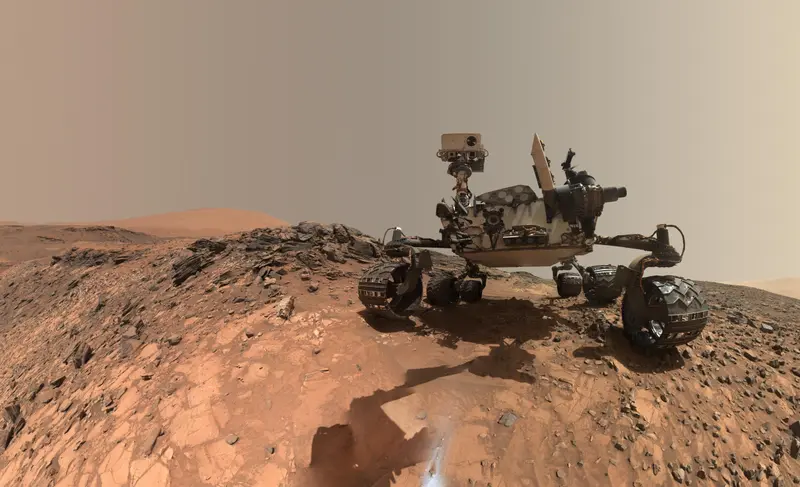
Spacecraft returning from low orbit also fly with lift. A nominal Soyuz stays at about 3-4 g; Dragon, at similar or lower values. In the case of Mars, the Curiosity and Perseverance aeroshell carries tungsten ballast masses that are jettisoned before entry to shift the center of mass and obtain L/D ≈ 0.24; with it, guided entry shrank Perseverance's landing ellipse to about 7.7 × 6.6 km, whereas those of the first robots were measured in hundreds of kilometers.
Skip entry
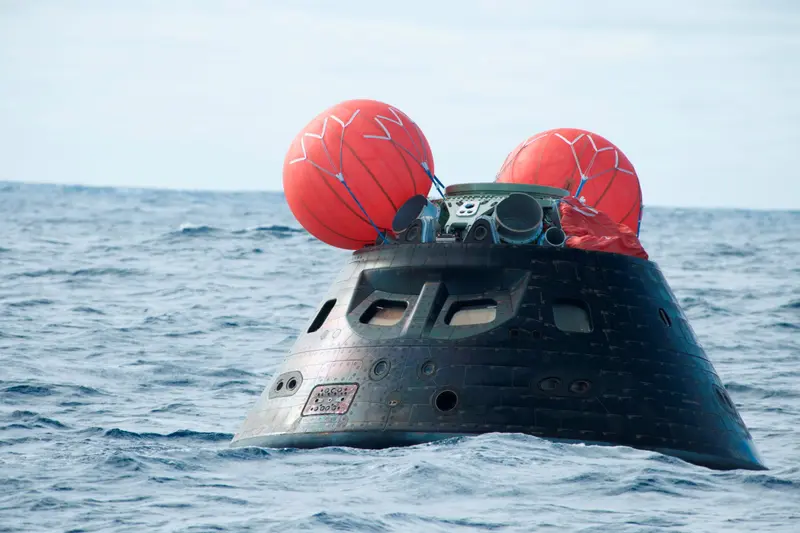
Orion can perform a skip entry: after a first dive that removes part of its velocity, it points its lift upward, climbs back out of the dense layers, follows a ballistic trajectory above them and re-enters for the final dive. The idea was already studied for Apollo, but its computer lacked the capacity to guide the second phase safely. Orion flew it for the first time on Artemis I (December 2022).
What it gains:
- Range: the segment outside the atmosphere can add thousands of kilometers. This allows the splashdown point to be chosen near the California coast regardless of the arrival geometry from the Moon.
- Lower loads in each dive.
- Heating spread over two pulses.
What it risks: the second entry is more sensitive to errors (being slower, the vehicle has less aerodynamic authority), and the shield partially cools between the two pulses only to heat up again. On Artemis I that sequence of heating, cooling and reheating was the cause of the loss of fragments of charred Avcoat: the gases produced inside the material were trapped in a material of low permeability and cracked it. For Artemis II NASA kept the shield and modified the entry trajectory to shorten that phase. The physics of the material is in ablative heat shields.
Lifting entry: equilibrium glide
For a vehicle with L/D of the order of 1, such as the Shuttle, the trajectory is almost horizontal (γ ≈ 0, dγ/dt ≈ 0). The second equation of motion becomes an equilibrium condition: lift plus "centrifugal force" support the weight.
L/m = g · (1 − V²/V_c²),     V_c = √(g·r)  (local circular velocity)
D/(m·g) = (1 − V²/V_c²) / (L/D)
The deceleration is small while flying near orbital velocity and tends to 1/(L/D) at the end. With L/D ≈ 1, the Shuttle returned with peaks of the order of 1.5 g: important for crews who had spent two weeks in weightlessness, and for fragile payloads. Integrating ds = V·dt with dV/dt = −D/m gives the equilibrium glide range:
s = (r/2) · (L/D) · ln[ 1 / (1 − V_E²/V_c²) ]
The Shuttle flew at about 40° angle of attack during the peak-heating phase (to present its tile-protected belly to the flow) and modulated drag with bank angle, like a capsule, with bank reversals that showed up as large S-turns. Below about Mach 10 it progressively reduced its angle of attack until it flew like an airplane. That choice couples the dynamics with the thermal protection, which is covered in reusable thermal protection.
Comparison of strategies
| Strategy | L/D | Typical peak g | Landing accuracy | Mass and complexity |
|---|---|---|---|---|
| Ballistic (Stardust, emergency Soyuz) | 0 | 8-9 g from LEO; tens from the Moon | tens of km | minimal |
| Guided capsule (Apollo, Soyuz, Dragon, Orion) | 0.2-0.4 | 3-4 g from LEO; 4-7 g from the Moon | a few km | low |
| Skip-entry capsule (Orion) | 0.25-0.3 | lower per dive | a few km, with a range of thousands | more demanding guidance |
| Glider (Shuttle, Dream Chaser) | ~1-1.5 | ~1.5 g | runway | wings, tiles, a lot of structural mass |
The trade-off is almost always the same: every tenth of L/D costs mass (wings, structure, more surface to protect), and it only pays off if the vehicle has to land on a runway or be reused.
Mars entry: little atmosphere, a lot of mass
Mars is the hardest case, and not because of heating: its atmosphere is about 60 times less dense than Earth's at the surface. The deceleration of a vehicle with β ≈ 130 kg/m² is not enough to slow down before reaching the ground. Applying Allen-Eggers with H ≈ 11 km and ρ₀ ≈ 0.02 kg/m³ to Perseverance (V_E ≈ 5.4 km/s, angle of the order of −15°), the peak deceleration comes out at the order of 10-13 g (in Earth g), but it occurs at only about 20-30 km altitude and, at the end of the hypersonic phase, the vehicle is still travelling at Mach 1.5-2 about 10 km above the ground. That is why on Mars the supersonic parachute and powered descent are not a luxury but part of entry, as shown in descent and landing.
With Viking technology (a 70° aeroshell and a disk-gap-band parachute), payloads much larger than one tonne cannot be landed; the tens of tonnes of a crewed mission require inflatable shields (such as NASA's HIAD, tested in 2022 with LOFTID) or supersonic retropropulsion.
Key points
- All of the behavior of an entry hinges on the ballistic coefficient
β = m/(C_D·A), the lift-to-drag ratioL/D, and the entry velocity and angle. - In a ballistic entry,
n_max = V_E²·sin γ / (2·e·H·g₀): it does not depend on β, which only sets the altitude; peak heating comes earlier, at 0.85 v_E. - The entry corridor is bounded above by capture and below by g and heating; for a lunar return it is of the order of two degrees wide.
- A capsule steers by rolling its lift vector with the bank angle; with L/D ≈ 0.3 a lunar return goes from about 36 g to 6-7 g.
- Equilibrium glide gives low deceleration and long range (
s ∝ L/D), at the cost of wings and heavy thermal protection.
Further reading
- H. J. Allen, A. J. Eggers, "A Study of the Motion and Aerodynamic Heating of Ballistic Missiles Entering the Earth's Atmosphere at High Supersonic Speeds", NACA Report 1381 (1958).
- F. J. Regan, S. M. Anandakrishnan, Dynamics of Atmospheric Re-Entry, AIAA Education Series (1993).
- R. D. Braun, R. M. Manning, "Mars Exploration Entry, Descent, and Landing Challenges", Journal of Spacecraft and Rockets 44(2), 310-323 (2007).
- N. X. Vinh, A. Busemann, R. D. Culp, Hypersonic and Planetary Entry Flight Mechanics, University of Michigan Press (1980).
- W. Ley, K. Wittmann, W. Hallmann (eds.), Handbook of Space Technology, Wiley (2009), chapter on re-entry.
Test yourself
In the Allen-Eggers solution for a ballistic entry, at what fraction of the entry velocity does peak deceleration occur?
According to Allen-Eggers, what does the peak deceleration of a ballistic entry NOT depend on?
A capsule enters ballistically at 7.5 km/s with γ = 3°. With H = 7.2 km, what is the approximate peak deceleration?
What happens if a capsule returning from the Moon enters at too shallow an angle, beyond the corridor limit?
How does a capsule such as Apollo or Orion control its range during entry?