Changing the size of an orbit is cheap if it is done in the right place. Changing its plane is another matter: the point is not to gain energy but to rotate the velocity vector, and a spacecraft at 7.7 km/s has a lot of vector to rotate. That is why an orbit's inclination is decided, whenever possible, at launch, and why mission design spends a great deal of ingenuity on avoiding plane changes or doing them where they are cheapest. This lesson derives the cost, solves the optimal combined maneuver for reaching geostationary orbit from different launch sites, explains the supersynchronous transfer, the node change and three-impulse maneuvers, and shows how Earth's oblateness (J2) can rotate planes almost for free if there is time. It builds on the Hohmann transfer and on orbital elements.
The cost of rotating the velocity
An impulse that changes the direction of the velocity by an angle θ, and its magnitude from v₁ to v₂, costs, by the law of cosines:
Δv = √(v₁² + v₂² − 2·v₁·v₂·cos θ)
If the magnitude does not change (v₁ = v₂ = v), we are left with the pure plane change:
Δv = 2 · v · sin(θ/2)
For small angles, Δv ≈ v · θ (θ in radians): each degree costs 1.75% of the orbital velocity.
| Orbit | Velocity | Cost of 1° | Cost of 10° | Cost of 28.5° |
|---|---|---|---|---|
| LEO 200 km | 7.78 km/s | 136 m/s | 1.36 km/s | 3.83 km/s |
| LEO 400 km | 7.67 km/s | 134 m/s | 1.34 km/s | 3.78 km/s |
| GEO | 3.07 km/s | 54 m/s | 0.54 km/s | 1.51 km/s |
| GTO apogee | 1.60 km/s | 28 m/s | 0.28 km/s | 0.79 km/s |
A 60° plane change in LEO costs exactly v: as much as putting the spacecraft into orbit in the first place. That is why there are no "space planes" hopping from one inclination to another.
Where to do it: nodes and minimum speed
Two orbital planes that share the Earth's center intersect along a line. An out-of-plane impulse can only take the spacecraft from one plane to the other if it is applied on that line. For a pure inclination change, the line is the line of nodes: the impulse is applied when crossing the equator. For a change of Ω, or of i and Ω together, the intersection points lie at another latitude and are computed with spherical trigonometry.
Of the two possible points, the one with lower speed is chosen: in an elliptical orbit, the one closer to apoapsis. It is the opposite of the Oberth-effect rule: energy is best gained where you are fast; direction is best changed where you are slow. Almost everything that follows comes from this.
Going to GEO: the combined maneuver
The minimum inclination a launch vehicle reaches without a plane maneuver is the latitude of the launch site (see launch sites and windows and getting to orbit). A geostationary satellite needs i ≈ 0°. With the Hohmann transfer from 200 km to GEO (v_c1 = 7.784 km/s, v_p = 10.239 km/s at GTO perigee; v_a = 1.597 km/s at apogee, v_c2 = 3.075 km/s):
Option 1: everything at apogee, combined with circularization. The second impulse turns through θ = Δi and at the same time raises the speed from 1.597 to 3.075 km/s:
Δv₂ = √(1.597² + 3.075² − 2 · 1.597 · 3.075 · cos Δi)
Combining is much cheaper than doing the two things separately. For Δi = 28.5°: circularizing (1.477 km/s) and then turning in GEO (1.514 km/s) adds up to 2.99 km/s; turning at GTO apogee and then circularizing, 0.786 + 1.477 = 2.26 km/s; combined, 1.836 km/s.
Option 2: split between perigee and apogee. A small turn at perigee costs very little, because it adds in quadrature to a large impulse (2.46 km/s). Optimizing the split numerically:
That is why launch vehicles flying from high latitudes offer "reduced" GTOs (GTO −1,500 m/s, −1,800 m/s), in which the upper stage performs part of the turn at apogee with an additional burn after hours of coasting.
The supersynchronous transfer
If the turn is best made where the spacecraft is slow, it pays to put the apogee above GEO, where it is even slower, turn there and, at the same time, raise the perigee to the geostationary radius; finally, at that perigee, brake to circularize.
Changing the plane of a circular orbit: one impulse or three
If there is no transfer to exploit, one can be manufactured: raise the apoapsis, turn at the top and come back down. The cost in units of the circular velocity v:
Δv_3imp = 2·(v_p − v) + 2·v_a·sin(Δi/2) versus Δv_1imp = 2·v·sin(Δi/2)
| Δi | One impulse | Best three-impulse | Optimal apoapsis (in initial radii) |
|---|---|---|---|
| 30° | 0.518 v | — (not worth it) | — |
| 40° | 0.684 v | 0.684 v (practical tie) | ~1.1 |
| 50° | 0.845 v | 0.794 v | ~2.7 |
| 60° | 1.000 v | 0.828 v | → ∞ (bi-parabolic) |
| 90° | 1.414 v | 0.828 v | → ∞ |
The threshold is at Δi ≈ 38.9°, and above about 60° the theoretical optimum is to climb "to infinity", where turning costs nothing: Δv = 2(√2 − 1)·v ≈ 0.828 v. In practice the limit is set by time and by the Moon, which stops being negligible at hundreds of thousands of kilometers.
Changing the node: the rotation nobody wants to pay for
Changing Ω while keeping i rotates the plane about the polar axis. The actual angle between the two planes, θ, comes from spherical trigonometry:
cos θ = cos i₁·cos i₂ + sin i₁·sin i₂·cos ΔΩ
With i₁ = i₂ = i and small ΔΩ, θ ≈ ΔΩ · sin i: in near-polar orbits, one degree of Ω is almost one degree of actual rotation; in low-inclination orbits, much less.
Keeping the plane: inclination in GEO
Once in GEO, the Sun and the Moon, whose orbits do not lie in the equator, exert a torque that tilts the plane. The inclination vector drifts by about 0.75-0.95° per year, depending on the phase of the 18.6-year lunar nodal cycle. Correcting it requires north–south maneuvers of about 45-50 m/s per year, versus a few m/s per year for the east–west maneuvers that correct longitude drift. Over 15 years, that is of the order of 700-750 m/s: most of the propellant of a chemical geostationary satellite.
The real alternatives:
| Strategy | Saving | Price |
|---|---|---|
| North–south maneuvers with electric propulsion (Isp 1,500-2,000 s) | Propellant mass 4 to 6 times lower | More electrical power and burn time |
| Letting the inclination grow at end of life | Additional years of life | Ground antennas must track the daily figure eight |
| A "biased" initial inclination so that nature takes it to 0 and then to the other side | Half the budget on certain missions | Only if some inclination is tolerable |
Without control, the inclination of an object in GEO oscillates between 0° and about 15° with a period of about 53 years: that is how retired satellites move in the graveyard orbit.
Plane change starts on the launch pad
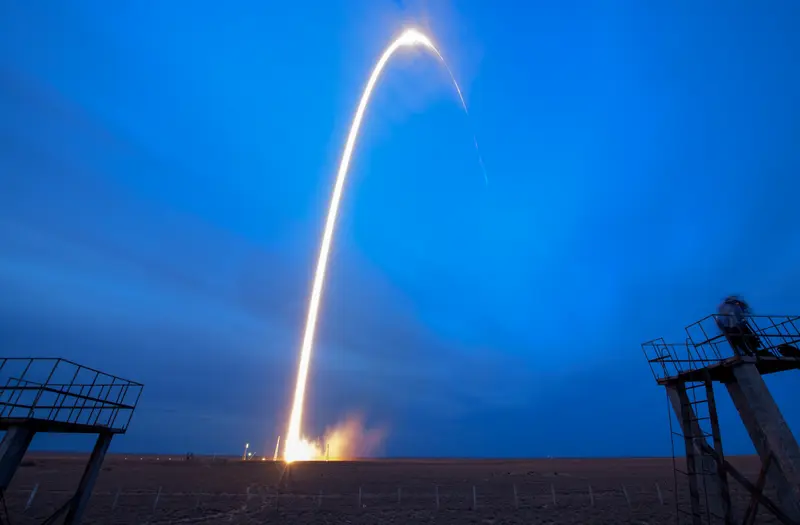
The cheapest option is not to have to turn at all: choose the launch azimuth to enter the desired plane directly. The inclination satisfies cos i = cos φ · sin β, with φ the latitude of the launch site and β the azimuth. For the ISS (51.64°) from Cape Canaveral, β ≈ 45°; from Baikonur, β ≈ 62.5°. Launching due east from Florida and then turning 23.1° in LEO would cost about 3.1 km/s: more than the whole trip from LEO to GEO. To reach a specific plane (a given Ω), one must also launch when the site passes beneath it: two windows a day if i > φ, one if i = φ and none if i < φ, unless a dog-leg maneuver is paid for during ascent.
Design trade-offs
- Launch into the plane rather than turning afterwards; if that is not possible, turn at the highest available apoapsis.
- Combine the turn with a large velocity change (circularization, injection) instead of doing it separately: the vectors add in quadrature.
- Split a few degrees into the perigee impulse: almost free.
- Shift the cost to the launch vehicle with a supersynchronous transfer if it has spare capacity, because every kilogram the satellite does not burn is service life.
- Wait for J2 for node changes in LEO when there are weeks available; use the Moon when there are months and the geometry allows it.
Key points
- Pure plane change:
Δv = 2v·sin(Δi/2); 1° costs 134 m/s in LEO and 54 m/s in GEO. - It is done at the intersection of the planes and at the slowest point; for combined Δv, use the law of cosines.
- From GTO to GEO, Δv₂ ≈ 1.49 km/s from Kourou and ≈ 1.79 km/s from Florida with the optimal split; the supersynchronous transfer lowers it further.
- For a circular orbit, three impulses beat one above about 39°; the Moon can do the turn for free.
- Changing Ω with the engine is extremely expensive; with the differential J2 drift, almost free if there is time.
Further reading
- H. D. Curtis, Orbital Mechanics for Engineering Students, Butterworth-Heinemann (4th ed., 2020), chapter 6 (plane change sections).
- D. A. Vallado, Fundamentals of Astrodynamics and Applications, Microcosm Press (4th ed., 2013), chapter 6 (inclination and node changes).
- E. M. Soop, Handbook of Geostationary Orbits, Springer (1994).
- J. R. Wertz, D. F. Everett, J. J. Puschell (eds.), Space Mission Engineering: The New SMAD, Microcosm Press (2011).
- J. E. Prussing, B. A. Conway, Orbital Mechanics, Oxford University Press (2nd ed., 2013).
Test yourself
How much does a pure 1° plane change cost in a low circular orbit at 7.66 km/s?
Where should a pure inclination change be performed?
For a GTO launched from Cape Canaveral (28.5°), what is gained by splitting the plane change between perigee and apogee?
To change the plane of a circular orbit without changing its radius, above roughly what angle does a three-impulse maneuver (raise, turn at the top, lower) start to pay off?
Why do LEO constellations prefer to distribute satellites among planes by waiting at a different altitude rather than changing Ω with the engine?