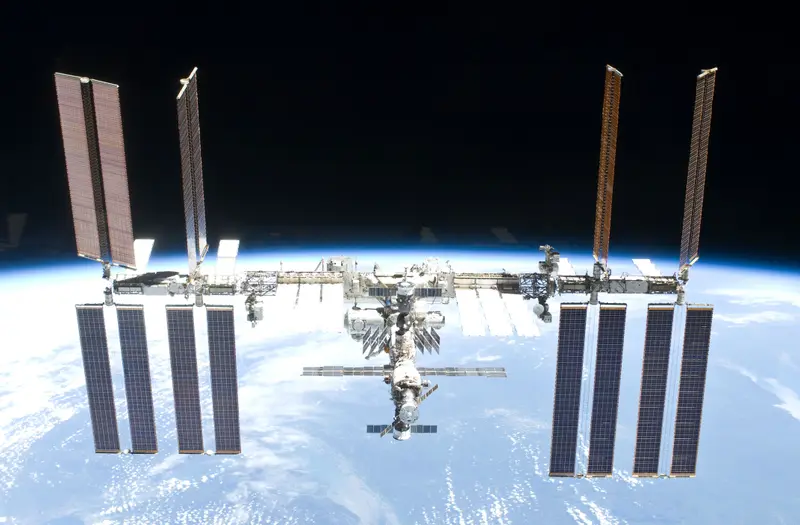
For a cargo ship to reach the International Space Station, three chained problems must be solved: being in the same plane, being at the same point of the orbit at the same time, and nulling a relative velocity that starts at hundreds of m/s until it is down to a few centimeters per second right at contact. The first is solved at launch and with plane changes; the second, with phasing maneuvers; the third, with relative-motion dynamics, which have an intuition of their own — and a treacherous one. This lesson walks through the phases of a real rendezvous, derives and solves the Clohessy–Wiltshire equations with numerical examples around the ISS, compares V-bar and R-bar approaches, reviews sensors and docking systems, and explains the safety rules. The introduction is in expert-level orbital mechanics; here we compute.
The phases of a rendezvous
Terminology varies between agencies, but the scheme is the same for Soyuz, Progress, Dragon, Cygnus or the retired European ATV:
| Phase | Typical distance to target | What is done | Navigation |
|---|---|---|---|
| Launch and insertion | Thousands of km | Enter the target's plane with the right phase offset | Inertial and absolute GNSS |
| Phasing | Thousands to tens of km | Adjust a, e and phase to catch up with the target | Ground tracking, GNSS |
| Far-range approach (homing) | Tens of km to a few km | Reach a hold point on the V-bar | Relative GNSS, radar |
| Close-range approach | A few km to ~200 m | Enter the approach ellipsoid, hops between hold points | Relative GNSS, lidar |
| Final approach | ~200 m to contact | Advance along a corridor at decreasing speed | Lidar, cameras with optical targets |
| Docking or capture | Contact | Capture by the mechanisms or by the robotic arm | — |
Phasing: catching up with the target
In nearly identical orbits, the difference in period decides who overtakes whom. For circular orbits with Δa ≪ a, Kepler's third law (see Kepler's laws) gives:
ΔT/T = (3/2)·Δa/a → relative advance per revolution ≈ 3π · Δa
The launch window for a rendezvous combines two conditions: the launch site must pass under the target's plane (see launch sites and windows), and the target must be at a phase that allows it to be reached with the available Δv. That is why launches to the ISS have instantaneous windows or windows of a few minutes.
Relative motion: the Clohessy–Wiltshire equations
Close to the target, what matters is the chaser's relative position in the target's local LVLH frame, which rotates with it: x radial upwards (R-bar, from the Earth's center towards the target), y along-track in the direction of the velocity (V-bar), z normal to the orbital plane (H-bar). Linearizing gravity about a circular orbit of mean motion n yields the Hill–Clohessy–Wiltshire equations (Clohessy and Wiltshire, 1960):
ẍ − 3n²·x − 2n·ẏ = a_x
ÿ + 2n·ẋ         = a_y
z̈ + n²·z         = a_z
The −2nẏ and +2nẋ terms are Coriolis terms; the −3n²x term combines the gravity gradient with the centrifugal force. With no thrust (a = 0) they have a closed-form solution:
x(t) = (4 − 3c)·x₀ + (s/n)·ẋ₀ + (2/n)(1 − c)·ẏ₀
y(t) = 6(s − nt)·x₀ + y₀ − (2/n)(1 − c)·ẋ₀ + ((4s − 3nt)/n)·ẏ₀
z(t) = z₀·c + (ż₀/n)·s                        with s = sin nt, c = cos nt
Written in matrix form, [r; v](t) = Φ(t) · [r; v](0) is the state transition matrix of relative motion, with blocks Φ_rr, Φ_rv, Φ_vr and Φ_vv. Three particular solutions explain almost everything:
- Any point on the V-bar (x₀ = 0, ẋ₀ = ẏ₀ = 0) is an equilibrium: a vehicle ahead of or behind the target in the same orbit stays there. That is why hold points are placed on the V-bar.
- A lower vehicle (x₀ < 0) in a circular orbit has ẏ₀ = −(3/2)·n·x₀ > 0: it drifts forward, as in phasing.
- Out-of-plane motion is a harmonic oscillator with the orbital period: an error in z cancels itself every half revolution.
Intuition turned upside down: the two basic impulses
Along-track impulse (ẏ₀ = Δv_y, everything else zero):
x(t) = (2Δv_y/n)·(1 − cos nt)
y(t) = (4Δv_y/n)·sin nt − 3·Δv_y·t
The chaser rises (x up to 4Δv_y/n) and falls behind by 6π·Δv_y/n per revolution. For the ISS, a 0.1 m/s forward impulse lifts it up to 355 m and sets it back 1.67 km per revolution. This is the local version of "to overtake, brake".
Radial impulse (ẋ₀ = Δv_x, everything else zero):
x(t) = (Δv_x/n)·sin nt
y(t) = (2Δv_x/n)·(cos nt − 1)
The chaser traces half of a 2:1 ellipse and, after half a revolution, returns to x = 0 displaced by −4Δv_x/n along the V-bar, with no secular drift. This is the basis of the V-bar hop.
Two-impulse rendezvous: the targeting problem
In general, one wants to go from an initial relative state to a final position in a given time. Solving for the required initial velocity with the transition matrix:
v₀⁺ = Φ_rv(t)⁻¹ · [r_f − Φ_rr(t) · r₀]          Δv₁ = v₀⁺ − v₀
v_f⁻ = Φ_vr(t) · r₀ + Φ_vv(t) · v₀⁺              Δv₂ = −v_f⁻   (to stop at r_f)
This is the local equivalent of Lambert's problem, and it is what onboard guidance solves on each leg.
V-bar or R-bar: how the final approach is flown
| Approach | How | Advantages | Drawbacks | Who |
|---|---|---|---|---|
| V-bar | From ahead or behind, along the velocity | Natural equilibrium: if the thrusters stop, the vehicle stays almost still; forward and aft docking ports | Braking requires thrusters pointing towards the station (plume impingement) | Soyuz, Progress, Dragon, Starliner, ATV |
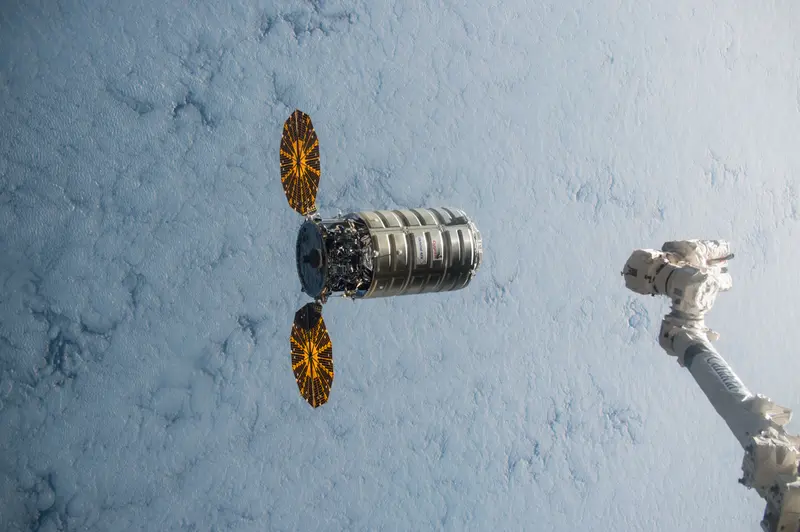
| R-bar | From below, along the radius | Natural braking: you must thrust upwards to advance; if the thrusters stop, the vehicle drifts away downwards and forwards | Station-keeping requires continuous thrust | HTV, Cygnus, original cargo Dragon (arm capture) |
On the R-bar, holding 10 m below the ISS requires an acceleration of 3n²·10 ≈ 3.8·10⁻⁵ m/s²: tiny, but continuous. It is the hold point where Japan's HTVs and the Cygnus vehicles sat in free drift so that Canadarm2 could capture them and berth them to a port on the Harmony or Unity module. Docking, by contrast, is active: the vehicle drives itself into the mechanism with a contact velocity of the order of 0.1 m/s.
Relative navigation sensors
| Sensor | Typical range | Measures | Examples |
|---|---|---|---|
| Relative GNSS (differencing the two GPS solutions) | Tens of km to hundreds of m | Relative position and velocity, meter-level accuracy | ATV, Dragon, HTV |
| Rendezvous radar | Of the order of a hundred km to contact | Range, range rate, angles | Kurs (Soyuz, Progress) |
| Scanning or flash lidar | A few km to contact | Range and relative orientation | Dragon, Cygnus, HTV |
| Cameras with optical targets (videometer) | Hundreds of m to contact | High-accuracy relative position and attitude | ATV, Soyuz (TORU manual piloting) |
The early phases are navigated with ground tracking; from tens of km, guidance moves on board and information is fused with Kalman filters (see navigation and orbit determination). In the final approach the relative attitude also matters: the ports must be aligned to a fraction of a degree, which requires fine control with high-precision actuators and attitude sensors.
Safety: designing so that a failure is not a collision
A vehicle of tens of tonnes a few meters from a crewed station is the most dangerous scenario in orbital flight. The ISS rules:
- Approach ellipsoid of 4 × 2 × 2 km centered on the station (major axis along the V-bar). Entering it requires authorization from the control centers.
- Keep-out sphere of 200 m radius: it may only be entered through an approved approach corridor, along the axis of the destination port.
- Passive trajectory safety: each leg is designed so that, if the engine stops working at any instant, the natural CW drift does not cross the keep-out sphere for at least a specified time. That is why hops pass below or above the V-bar, never through the station.
- Precomputed escape maneuvers, executed autonomously by the vehicle or commanded by the crew, which always move it away in a safe direction.
- Mandatory hold points (on Dragon, at about 220 m and about 20 m) where everything is verified before proceeding.
Docking and berthing systems
| System | Type | Use |
|---|---|---|
| SSVP (probe and drogue) | Docking, non-androgynous | Soyuz, Progress; Russian ISS modules |
| APAS-89/95 | Androgynous | Space Shuttle with Mir and with the ISS |
| IDSS / NDS (IDA adapters) | Androgynous, low impact energy | Crew Dragon, Cargo Dragon 2, Starliner |
| CBM (Common Berthing Mechanism) | Berthing with the arm | HTV, Cygnus, original Dragon; US segment modules |
The IDSS (International Docking System Standard) defines a common interface so that spacecraft from different countries can dock with one another, with future rescues and commercial stations in mind. Low-impact systems control the contact forces with active mechanisms, which is critical when the vehicles have very different masses.
Rendezvous beyond the ISS
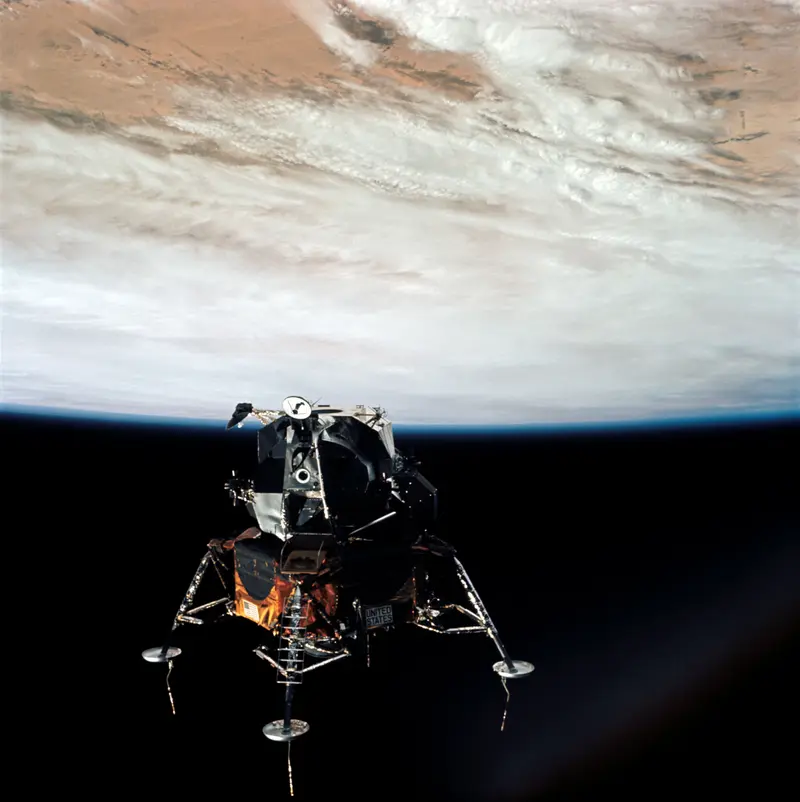
The same mechanics apply to Apollo's lunar-orbit rendezvous, to in-orbit refueling of Starship HLS for Artemis (see travelling to the Moon), to on-orbit servicing (Northrop Grumman's MEV-1 docked in 2020 with an Intelsat geostationary satellite that had not been designed for it, and extended its life) and to active debris removal, such as ESA's upcoming ClearSpace-1 mission or Astroscale's ADRAS-J, which in 2024 approached within about 15 m of an abandoned Japanese upper stage. With non-cooperative targets — no optical targets, tumbling — relative navigation and trajectory planning are far harder. The challenge of the space environment begins here.
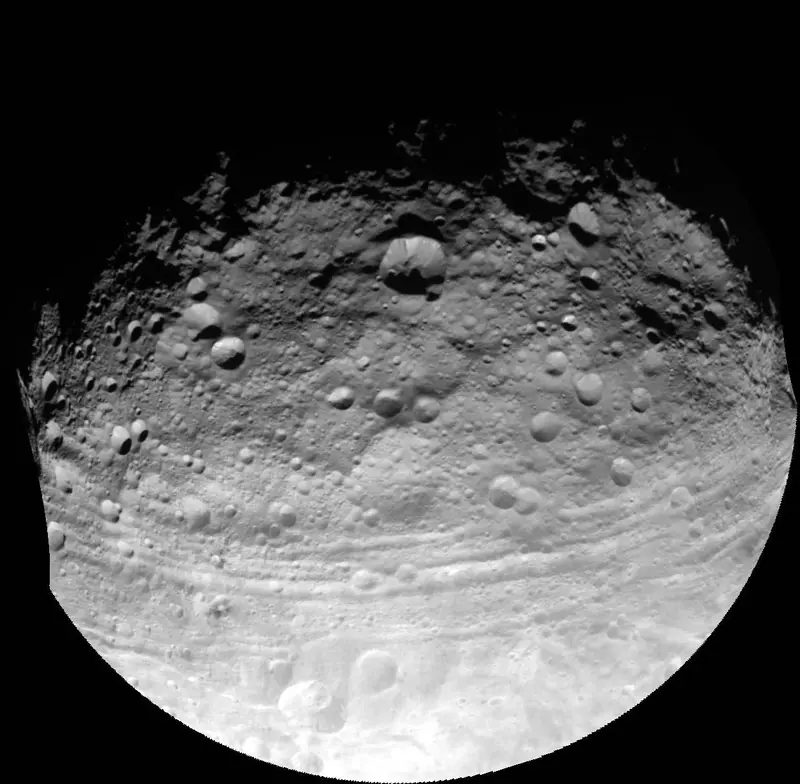 ActivityGamoras 3D MissionLand a damaged ship on a 220 km asteroid, search for water with a hopping robot, make propellant and a glass-ceramic nozzle, and fly back up to dock with your ship in orbit. With real physics.Play the mission
Key points
- Phasing: lower is faster; in neighboring circular orbits, the chaser gains 3π·Δa per revolution (188 km for a 20 km difference near the ISS).
- The Clohessy–Wiltshire equations describe relative motion in LVLH; the V-bar is an equilibrium, the R-bar is not.
- Forward impulse = rise and fall behind by 6π·Δv/n per revolution; radial impulse = a V-bar hop of 4Δv/n in half a revolution.
- The duration of each leg drives the cost: with two impulses, a quarter revolution can cost four times as much as a half.
- Safety rules: 4 × 2 × 2 km ellipsoid, 200 m keep-out sphere, passively safe trajectories and hold points.
Further reading
- W. Fehse, Automated Rendezvous and Docking of Spacecraft, Cambridge University Press (2003).
- W. H. Clohessy, R. S. Wiltshire, "Terminal Guidance System for Satellite Rendezvous", Journal of the Aerospace Sciences 27(9), 653-658 (1960).
- H. D. Curtis, Orbital Mechanics for Engineering Students, Butterworth-Heinemann (4th ed., 2020), chapter 7.
- D. A. Vallado, Fundamentals of Astrodynamics and Applications, Microcosm Press (4th ed., 2013), chapter 6.
- International Docking System Standard (IDSS) Interface Definition Document, Revision E (2016), internationaldockingstandard.com.
Test yourself
A vehicle is in a circular orbit 20 km below the ISS. What happens to it relative to the station?
In the Clohessy–Wiltshire equations, what does a small forward impulse (along the velocity) by the chaser produce?
How much Δv does a 1 km forward hop along the V-bar with two radial impulses cost near the ISS (n ≈ 1.126·10⁻³ rad/s)?
Why is an R-bar approach (from below) attractive for cargo vehicles captured by a robotic arm?
What is the ISS keep-out sphere?