Reaching low Earth orbit is not about climbing 400 km: it is about gaining some 7.8 km/s of horizontal velocity while crossing the atmosphere and fighting gravity. Coming back is the inverse problem: getting rid of about 30 MJ for every kilogram of vehicle without burning it up. This page covers the ascent, the delta-v budget that shapes every mission, reentry, and reuse, which is what has truly changed access to space over the last decade.
The delta-v budget
In astronautics, distances are measured in delta-v. Reference values per leg (impulsive, approximate; real ones depend on inclination, trajectory and losses):
| Leg | Approximate Δv | Comment |
|---|---|---|
| Earth's surface → LEO (~200-400 km) | 9.3-9.8 km/s | Includes gravity, drag and steering losses |
| LEO → GTO | ~2.45 km/s | Perigee burn |
| GTO → GEO | ~1.5 km/s (equatorial launch) / ~1.8 km/s (from 28.5°) | Circularization and plane change |
| LEO → escape (C3 = 0) | ~3.2 km/s | From 200 km |
| LEO → trans-lunar injection (TLI) | ~3.1-3.2 km/s | See traveling to the Moon |
| Lunar orbit insertion (LOI) into low lunar orbit | ~0.8-0.9 km/s | Depends on trajectory |
| Low lunar orbit → surface | ~1.7-2.0 km/s | With powered descent margins |
| LEO → trans-Mars injection (TMI) | ~3.6 km/s | In the optimal window |
The table shows the most surprising paradox: the most expensive leg is the first one. Once in LEO you are, in energy terms, "halfway to anywhere", as Heinlein put it. And delta-v adds up: with the rocket equation (see how a rocket works) every extra km/s multiplies the initial mass.
Breaking down the ascent
Δv_total = v_orbital + Δv_gravity + Δv_drag + Δv_steering − v_rotation · cos φ · sin β
v_orbital: about 7.8 km/s at 200 km.Δv_gravity = ∫ g · sin γ dt: typically 1.0-1.5 km/s. This is the largest loss.Δv_drag = ∫ D/m dt: 0.1-0.3 km/s; small, because the vehicle leaves the dense atmosphere before it gets fast.Δv_steering: thrust is not always aligned with velocity; on the order of 0.1-0.2 km/s.- Earth rotation: 465 m/s eastward at the equator, scaled by latitude φ and azimuth β.
| Launch site | Latitude | Usable rotation (eastward) |
|---|---|---|
| Kourou (French Guiana) | 5.2° N | ~463 m/s |
| Wenchang (China) | 19.6° N | ~438 m/s |
| Cape Canaveral (USA) | 28.5° N | ~409 m/s |
| Baikonur (Kazakhstan) | 45.6° N | ~325 m/s |
The minimum inclination reachable without a plane change is the site's latitude: cos i = cos φ · sin β. Polar and sun-synchronous orbits are launched southward or northward and get no benefit from rotation (or pay for it, if retrograde).
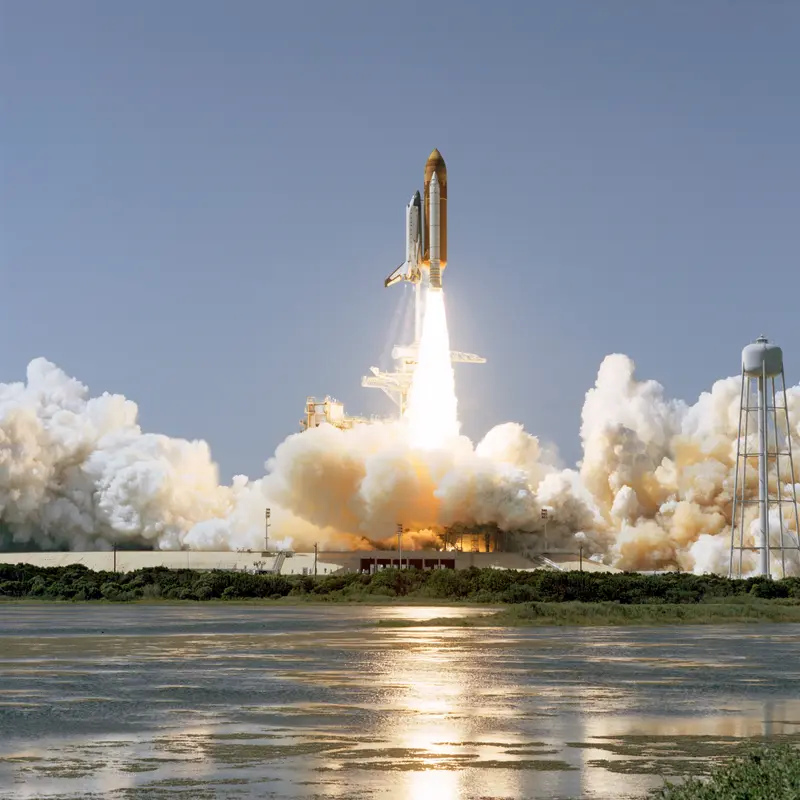
Epic moment · November 16, 2022
Artemis I Launch
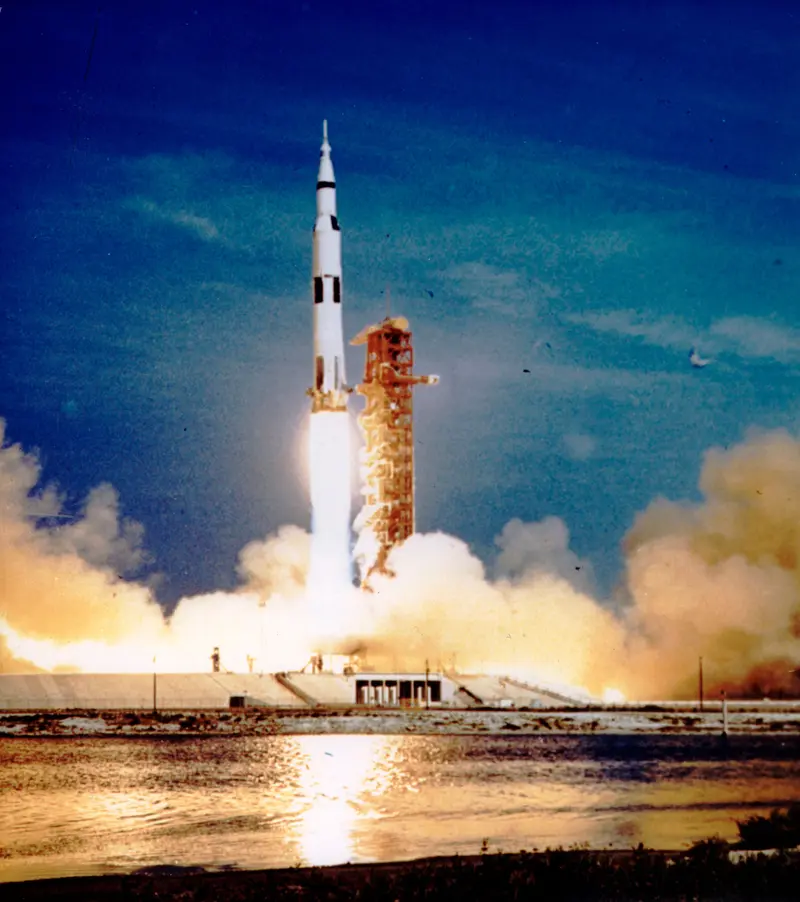
At 1:47 a.m. Eastern Time (7:47 a.m. in Spain), in the dead of night in Florida, the SLS rocket ignites its four engines and its two side boosters and turns darkness into day. With about 39 million newtons of thrust, it was then the most powerful rocket ever launched. It carried the uncrewed Orion capsule on a 25-and-a-half-day trip around the Moon: the dress rehearsal for sending people back there.
Watch the full moment, with soundNASA · Public domainClimb, then turn: the ascent profile
- Vertical ascent for a few seconds, to clear the tower.
- Pitch kick: a small initial rotation toward the desired azimuth.
- Gravity turn: from then on the vehicle flies at near-zero angle of attack and gravity itself gradually tilts the trajectory toward the horizon. This minimizes lateral loads on the structure, which is slender and cannot take bending.
- Max-Q: dynamic pressure
q = ½ρv²peaks, typically at 25-35 kPa, at around 11-14 km altitude and one minute into flight. Many launchers throttle down around this point. - Stage separation at around 60-80 km and 2-3 minutes.
- Fairing jettison when free molecular heating drops below a threshold on the order of 1 kW/m² (a common value is 1,135 W/m²), at around 100-120 km.
- Upper stage: gains mostly horizontal velocity; the trajectory may even dip slightly before insertion. Total duration: about 8-10 minutes.
Modern guidance uses closed-loop algorithms (such as the Shuttle's Powered Explicit Guidance and its successors) that recompute the optimal steering law toward insertion conditions in flight.
Insertion: parking and transfer orbits
The upper stage usually drops the payload first into a parking orbit (LEO at 180-200 km), where it coasts to the right point for the next burn: GTO perigee over the equator, or trans-lunar injection. Restarts after hours of coasting require managing cryogen boil-off and settling the propellants with small ullage burns before ignition. "Supersynchronous" transfer orbits (apogee above GEO) let the plane change be combined where it is cheapest.
Coming back: atmospheric reentry
A vehicle returning from LEO carries ½v² ≈ 30 MJ/kg; from the Moon, at ~11 km/s, about 60 MJ/kg. Just 2.6 MJ/kg is enough to turn room-temperature water into steam: if all that energy went into the spacecraft, it would vaporize several times over. The trick, formulated by Allen and Eggers (NACA, 1953), is the blunt body: a blunt body creates a detached shock wave, and almost all the energy is dissipated heating the shocked air, which flows away. Only a small fraction reaches the vehicle.
Stagnation-point convective heat flux is estimated with the Sutton-Graves correlation:
q_conv ≈ k · √(ρ / R_n) · v³, k ≈ 1.74·10⁻⁴ kg^0.5/m (Earth air)
ρ: freestream air density;R_n: nose radius;v: velocity.
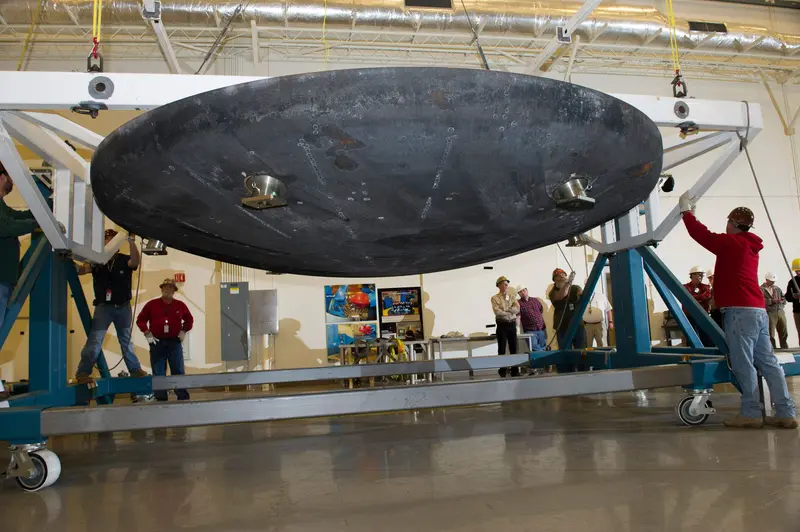
Two direct conclusions: a large nose radius reduces the flux, and velocity rules (v³). Above ~10 km/s the shocked gas is so hot that it radiates, and radiative heating, which grows even faster with v, becomes comparable to convective heating. That is why lunar return demands ablative heat shields: Orion's withstood surface temperatures on the order of 2,800 °C on Artemis I.
Corridor, deceleration and lift
For a ballistic entry into an exponential atmosphere (Allen-Eggers model), peak deceleration is:
n_max = v_E² · sin|γ_E| / (2 · e · H · g₀)
with v_E and γ_E the entry velocity and flight path angle and H the scale height. Peak heating occurs at v ≈ 0.85 v_E and peak deceleration at v ≈ 0.61 v_E. The ballistic coefficient β = m / (C_D · A) sets the altitude at which this happens: a low β decelerates higher up, in thinner air, with less heat.
Lift widens the corridor and reduces loads. Capsules fly with an offset center of mass, at an angle of attack of about 20°, with an L/D on the order of 0.3, and control their range by rolling the lift vector around the velocity vector. Result: about 3-4 g on a nominal Soyuz, against 8-9 g in its ballistic emergency mode; the Shuttle, with a hypersonic L/D on the order of 1, stayed below ~1.5 g. The entry corridor for a lunar return is barely a couple of degrees wide in flight path angle: too shallow and the vehicle skips out; too steep and loads and heating soar. Orion adds skip entry, which splits the heating into two dips and provides the range to choose a splashdown zone.
Between about 40 and 90 km, the shock-layer plasma blocks radio communications (a blackout of a few minutes), unless the link goes via satellite through the wake.
Heat shields
| Type | Examples | Principle | Use |
|---|---|---|---|
| Phenolic resin ablator | Avcoat (Apollo, Orion), PICA and PICA-X (Stardust, Dragon) | Pyrolysis and charring: it is consumed and the pyrolysis gas blocks the heat | Fast returns, single or few uses |
| Ceramic tiles | Shuttle LI-900 silica; Starship tiles | Highly porous, high-emissivity insulation; re-radiates at high temperature | Reusable, LEO |
| Reinforced carbon-carbon (RCC) | Shuttle leading edges | Structural material up to ~1,650 °C | Hottest zones |
| Flexible blankets | FRSI, silica blankets | Lightweight insulation | Cool zones |
Materials are detailed in materials for space.
Game
The heat shield
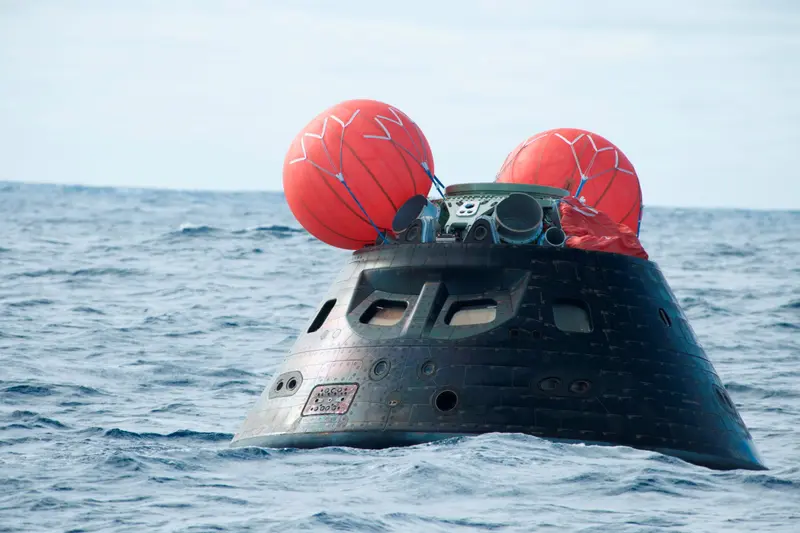
Final descent
Below roughly Mach 2 capsules deploy drogue parachutes and then mains; they splash down at about 7-9 m/s (Orion, Dragon) or fire retrorockets a meter above the ground (Soyuz). Winged gliders land on a runway.
Reusable rockets
The first stage of a two-stage launcher separates at about 2 km/s and 70 km: far from orbit, with manageable energy. Recovering it means reserving propellant for:
- Boost-back burn, if it returns to the launch site; if it lands on a drone ship offshore, this is skipped and propellant is saved.
- Entry burn, to limit heating and dynamic pressure during entry.
- Landing burn: with a single engine at minimum throttle, thrust exceeds the weight of the empty stage, so it cannot hover; the braking is calculated to reach zero velocity exactly at the ground (a "hoverslam").
Descent guidance is a convex optimization problem solved on board in real time (G-FOLD and successors, Açıkmeşe and colleagues). Grid fins control attitude in the atmospheric phase.
The price is payload: landing the stage on a drone ship costs, in the Falcon 9 family, on the order of a quarter to a third of the payload compared with expendable mode; returning to the launch site costs more. What is gained is the most expensive stage of the vehicle. Falcon 9 boosters now fly dozens of times each. Starship (SpaceX) aims at full reuse, with the catch of the first stage by the launch tower demonstrated since 2024; New Glenn (Blue Origin) recovered its first stage in 2025.
The effect on cost has been large. According to Jones's analysis (NASA, 2018), in constant dollars the cost per kilogram to LEO went from about $54,500/kg for the Shuttle to about $2,700/kg with Falcon 9 and about $1,400/kg with Falcon Heavy (list prices).
Taking off from another body
On a body with no atmosphere the ascent is cleaner: without drag, the vehicle can turn almost horizontal from the start. The figures scale with size. On an asteroid 220 km across with g = 0.092 m/s², circular velocity at ground level is √(g·R) ≈ 100 m/s and escape velocity about 142 m/s: orbit can be reached with a low-power engine and a small tank, as in the Gamoras 3D Mission, where the propellant is made on the asteroid itself. On the Moon, ~1.7 km/s; on Mars, about 4 km/s plus atmospheric losses.
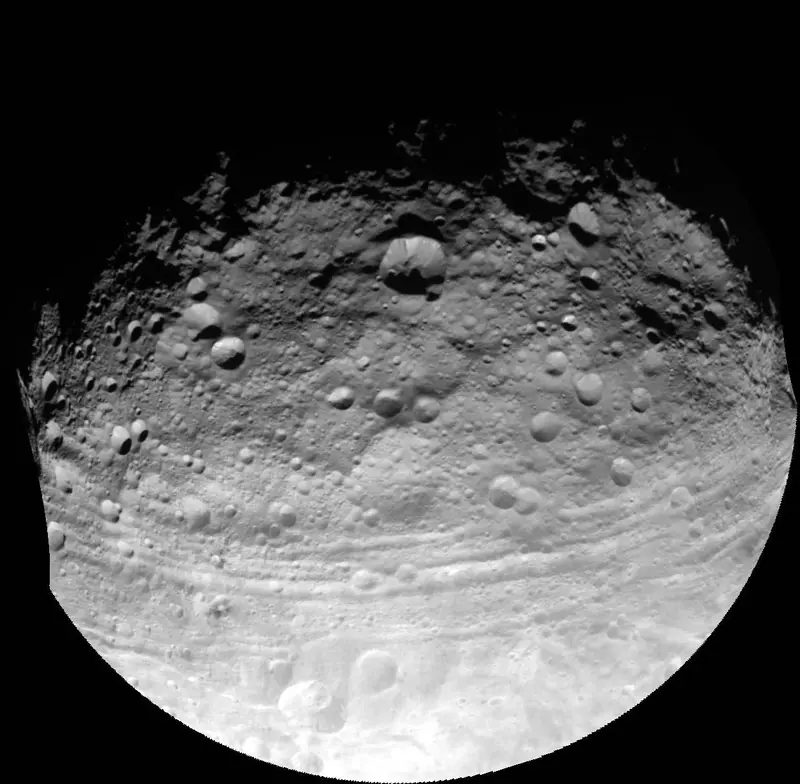 ActivityGamoras 3D MissionLand a damaged ship on a 220 km asteroid, search for water with a hopping robot, make propellant and a glass-ceramic nozzle, and fly back up to dock with your ship in orbit. With real physics.Play the mission
Key points
- LEO costs 9.3-9.8 km/s, more than it then costs to go from LEO to the Moon.
- The largest ascent loss is gravity loss; hence a thrust-to-weight of 1.2-1.5 and the gravity turn.
- Launching eastward and close to the equator gives up to ~465 m/s for free and saves plane changes.
- Reentry: blunt shape, ablators for fast returns, lift to lower the loads; q ∝ v³.
- Reuse costs payload, but makes the kilogram in orbit cheaper.
Further reading
- H. J. Allen, A. J. Eggers, "A Study of the Motion and Aerodynamic Heating of Ballistic Missiles Entering the Earth's Atmosphere at High Supersonic Speeds", NACA Report 1381 (1958; 1953 version as RM A53D28).
- H. W. Jones, "The Recent Large Reduction in Space Launch Cost", 48th International Conference on Environmental Systems, ICES-2018-81 (2018).
- K. Sutton, R. A. Graves, "A General Stagnation-Point Convective-Heating Equation for Arbitrary Gas Mixtures", NASA TR R-376 (1971).
- B. Açıkmeşe, S. R. Ploen, "Convex Programming Approach to Powered Descent Guidance for Mars Landing", Journal of Guidance, Control, and Dynamics 30(5), 1353-1366 (2007).
- W. Ley, K. Wittmann, W. Hallmann (eds.), Handbook of Space Technology, Wiley (2009).
Test yourself
How much delta-v, including losses, does it take to reach low Earth orbit?
How much velocity does Earth's rotation give an eastward launch from Kourou (5.2° N)?
What does the Allen and Eggers criterion propose for reentry capsules?
According to the Sutton-Graves correlation, how does stagnation-point convective heat flux scale with velocity?
Why is the payload fairing jettisoned at around 100-120 km and not earlier?
Go deeper: engineering subjects
If you want to go beyond this lesson, these subjects develop it at university level.
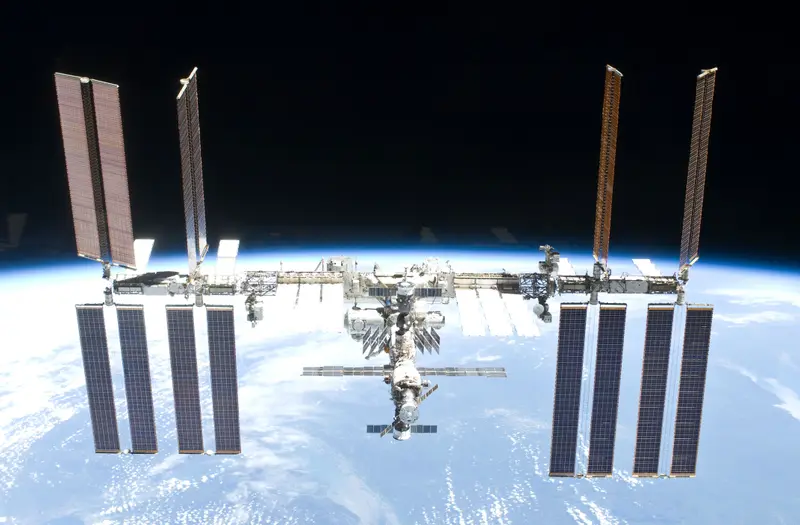 Subject · 5 lessonsOrbital mechanicsKepler, orbital elements and the manoeuvres used to change orbit, travel between planets and dock one spacecraft with another.Kepler · Elements · Hohmann · Plane change · Docking
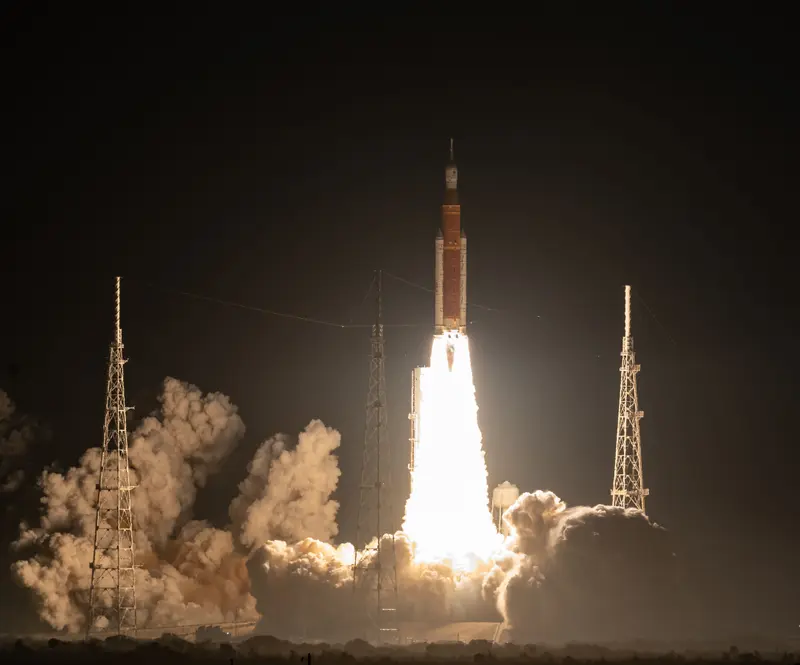 Subject · 5 lessonsLaunch vehicle designHow many stages and how big, how the ascent is flown, what loads the rocket must take, how it is reused, and where and when to launch.Staging · Ascent · Max-Q · Reuse · WindowsSubject · 5 lessonsAtmospheric entryHow spacecraft come home: entry trajectories, the heat they generate, the shields that survive it and the descent down to land or water.Dynamics · Heating · Ablators · Reusable · Landing
More to practise
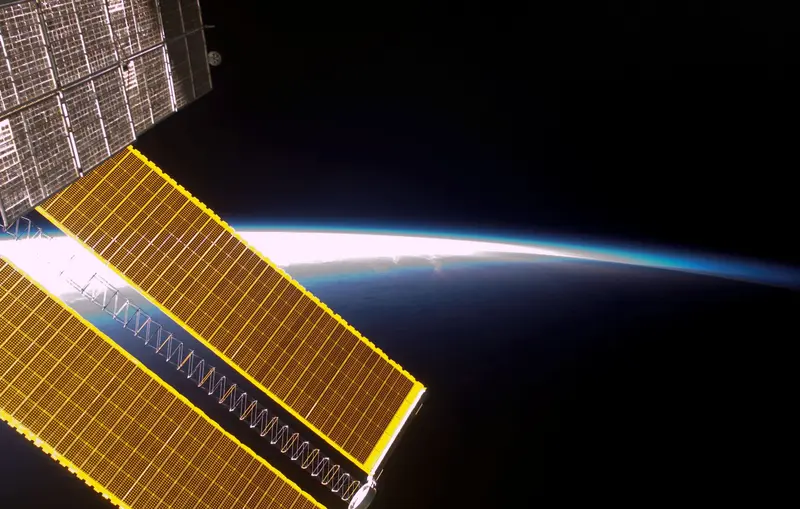 GameClimb through the atmosphereRise from the ground to 1,000 km: clouds, airliners, balloons, the Kármán line, the auroras and the Space Station.
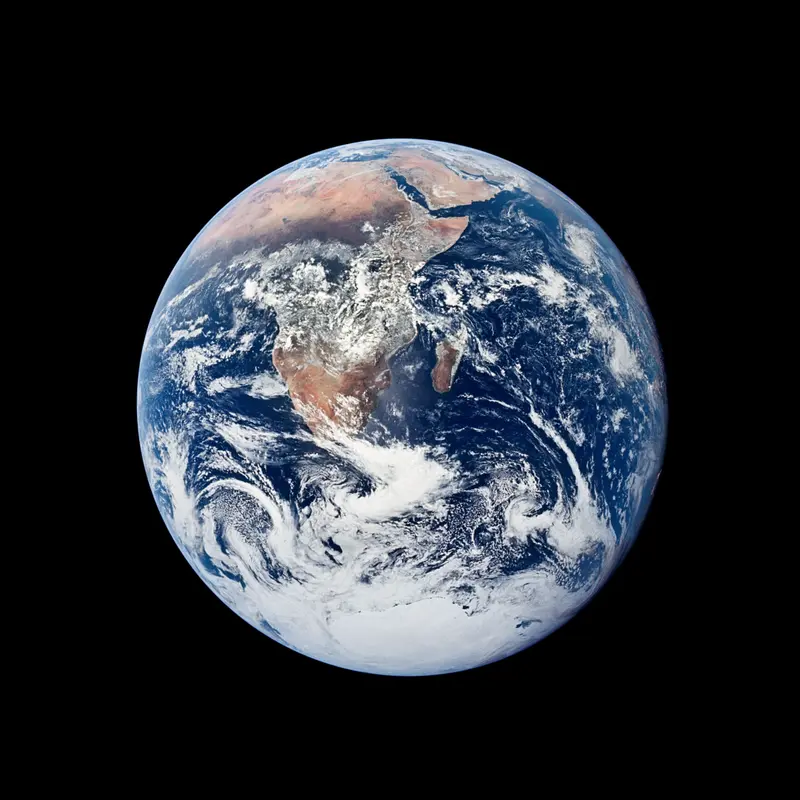 GameNewton’s cannonFire a cannonball from an impossibly tall mountain at the speed you choose: does it fall, circle the Earth or escape forever?
 GameDesign your rocketChoose the propellant, the stages and the payload, and see whether your rocket reaches orbit or the Moon. The rocket equation in action.