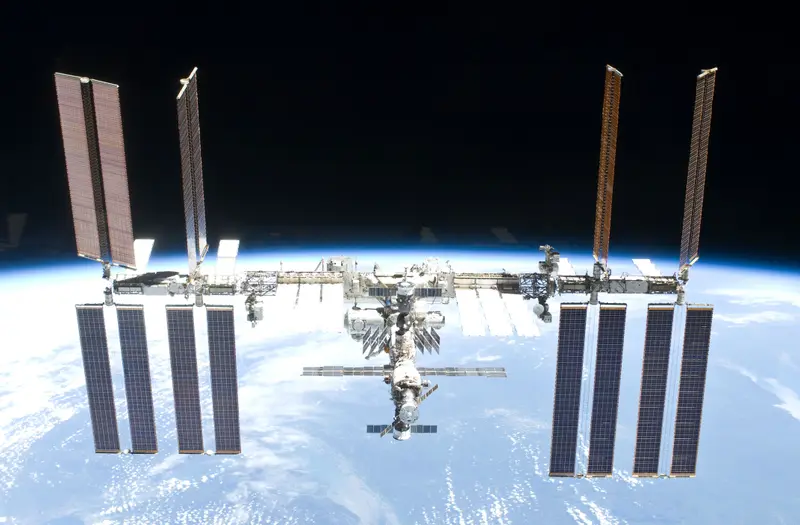
Almost every mission begins by changing orbit: from the parking orbit to geostationary, from Earth to Mars, from one altitude to another to dodge debris or make up for drag. The Hohmann transfer (1925) is the classic answer: two tangential impulses, half an ellipse, and the minimum delta-v between two coplanar circular orbits in almost every practical case. This lesson derives it, shows why it is so efficient, works it through numerically for GEO, for a small ISS reboost and for Mars, and above all explains where it stops being the best option: bi-elliptic transfers, finite thrust, electric propulsion and fast trajectories. The basic formula and LEO-GEO example are in expert-level orbital mechanics; here we go to what actually drives a design.
The impulsive maneuver and why we thrust tangentially
In preliminary analysis the engine is assumed to act instantaneously: the position does not change and the velocity jumps by Δv. This is reasonable when the burn is short compared with the orbital period (minutes versus an hour and a half).
The reason for thrusting along the velocity comes from the energy: dε = v · dv · cos α, where α is the angle between the impulse and the velocity. For a given Δv, the energy gained is greatest with α = 0 and the larger v is. Two conclusions govern the whole of maneuver design:
- Tangential impulses: any radial or normal component is "wasted" from the energy point of view.
- Impulses where the spacecraft is fast (Oberth effect): to gain energy, thrust at periapsis; to change the plane, on the other hand, thrust where it is slow (see plane change).
Derivation
Consider two coplanar circular orbits of radii r₁ < r₂. The transfer ellipse has its periapsis at r₁ and its apoapsis at r₂:
a_t = (r₁ + r₂) / 2                          e_t = (r₂ − r₁) / (r₂ + r₁)
v_p = √(μ · (2/r₁ − 1/a_t)) = v_c1 · √(2r₂/(r₁ + r₂))
v_a = √(μ · (2/r₂ − 1/a_t)) = v_c2 · √(2r₁/(r₁ + r₂))

Δv₁ = v_p − v_c1          Δv₂ = v_c2 − v_a          t_H = π · √(a_t³ / μ)
with v_c = √(μ/r) the circular velocities. The time of flight is half the period of the ellipse, and it cannot be shortened without leaving the Hohmann solution. Hohmann proposed it in 1925 without proof; the proof that it is the global optimum among two-impulse maneuvers came in the 1960s (Lawden, Barrar).
Small changes: the linearized formula
For Δa ≪ a, expanding the square roots:
Δv_total ≈ v · Δa / (2a) = (n/2) · Δa
The bi-elliptic transfer
With three impulses one can do better when r₂/r₁ is large: raise the apoapsis to an intermediate radius r_b > r₂, where the spacecraft is moving very slowly, raise the periapsis there to r₂ (cheap) and brake at r₂ to circularize.
a₁ = (r₁ + r_b)/2,   a₂ = (r₂ + r_b)/2
Δv₁ = √(μ(2/r₁ − 1/a₁)) − √(μ/r₁)
Δv₂ = √(μ(2/r_b − 1/a₂)) − √(μ(2/r_b − 1/a₁))
Δv₃ = √(μ(2/r₂ − 1/a₂)) − √(μ/r₂)
| r₂/r₁ | Best option |
|---|---|
| < 11.94 | Hohmann, always |
| 11.94-15.58 | Bi-elliptic if r_b is large enough |
| > 15.58 | Bi-elliptic with any r_b > r₂ |
| r_b → ∞ | Limit: bi-parabolic |
Finite thrust: losses and split burns
A real burn lasts a finite time, and during that time the spacecraft moves: part of the impulse is applied away from periapsis and at a non-zero flight-path angle. The maneuver's gravity loss grows with the burn duration relative to the period. Orders of magnitude:
| Initial thrust-to-weight ratio | Duration of a 2.5 km/s burn in LEO | Typical loss |
|---|---|---|
| ~0.5-1 (cryogenic upper stage) | Minutes | Small, of the order of 1% |
| ~0.05 (satellite apogee engine) | Tens of minutes | Significant if done in one go |
| ~10⁻⁴ (electric propulsion) | Months | The impulse concept no longer applies |
The solution with weak engines is to split the impulse: several short burns on successive perigee passes, each close to the optimum. That is how India's Chandrayaan-3 raised its apogee in 2023, with several maneuvers around the Earth before trans-lunar injection, and how geostationary satellites with 400-500 N engines raise their apogee, in three to five burns.
Low thrust: the Edelbaum spiral
With electric propulsion the thrust is continuous and the orbit grows in a spiral. For a slow spiral between coplanar circular orbits, always thrusting tangentially, the delta-v is simply:
Δv ≈ v_c1 − v_c2            (Edelbaum, 1961, no plane change)
Δv ≈ √(v_c1² + v_c2² − 2·v_c1·v_c2·cos(π·Δi/2))    (with plane change Δi, in radians)
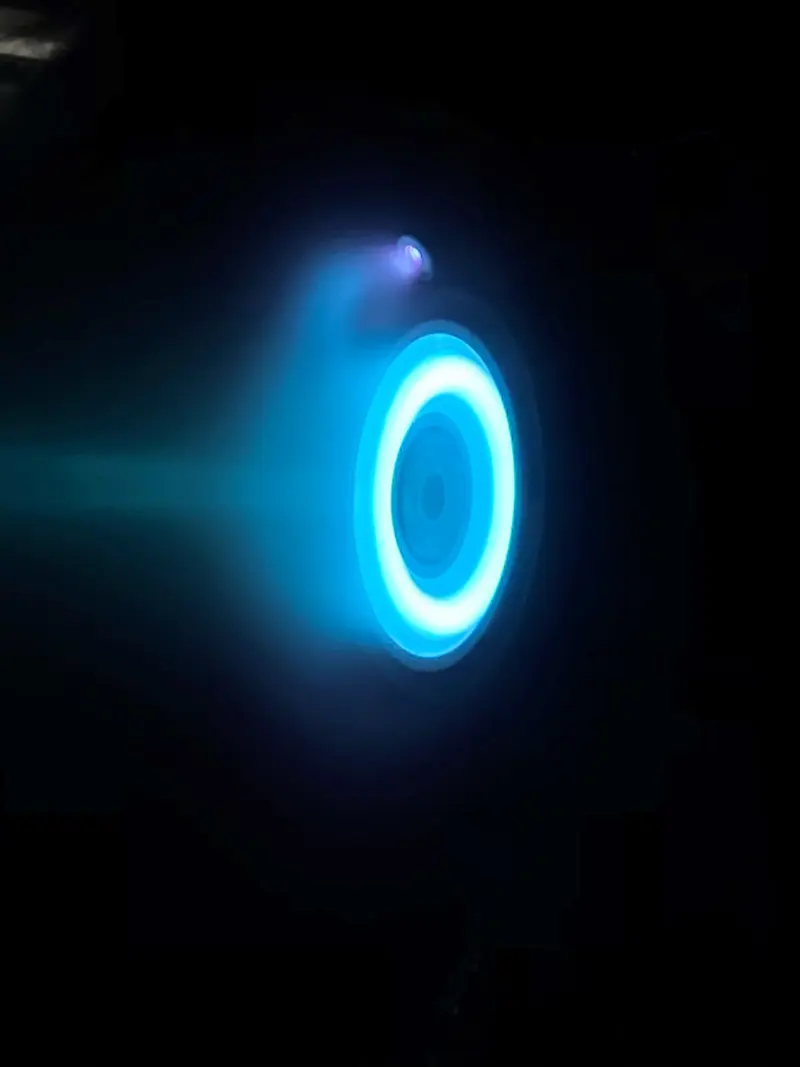
From LEO to GEO, coplanar: 7.784 − 3.075 = 4.71 km/s, 20% more than Hohmann. It looks worse, but with an Isp of about 1,500-2,000 s (Hall-effect thruster) versus 320 s, the propellant mass drops to a fraction. The price is time: all-electric geostationary satellites, such as the first Boeing 702SPs launched in 2015, took of the order of six months to reach their slots, crossing the radiation belts on the way (see space environment). The Dawn probe accumulated of the order of 11 km/s with its ion engines to orbit Vesta and Ceres, something impossible with chemical propulsion for a spacecraft of its size.
Phasing: when to leave
A Hohmann transfer to a specific target (a station, a planet) is useless if the target is not there on arrival. While the spacecraft travels 180°, the target advances n₂ · t_H. The lead angle it must have at departure is:
θ_departure = π − n₂ · t_H
and the configuration repeats with the synodic period:
T_syn = 1 / |1/T₁ − 1/T₂|
| Destination (from Earth) | t_H | Phase angle | Synodic period | v∞ departure / arrival |
|---|---|---|---|---|
| Venus | 146 days | −54° (Venus behind) | 584 days | 2.50 / 2.71 km/s |
| Mars | 259 days | +44° | 780 days | 2.94 / 2.65 km/s |
| Jupiter | 2.7 years | +97° | 399 days | 8.79 / 5.64 km/s |
| Saturn | 6.1 years | +106° | 378 days | 10.30 / 5.44 km/s |
(Circular, coplanar orbits; the real ones are slightly eccentric and inclined, which is why the cost varies from one window to the next.)
Full example: to Mars with patched conics
The patched-conic method splits the mission into three two-body problems: a departure hyperbola around the Earth, a Hohmann ellipse around the Sun and an arrival hyperbola around Mars, joined at the boundaries of the spheres of influence through the hyperbolic excess velocities v∞.
Faster than Hohmann: Lambert and porkchop plots
Real missions almost never fly an exact Hohmann transfer. The general problem is Lambert's problem: given two points r₁ and r₂ and the time of flight Δt, find the conic connecting them. It has a unique solution for each number of revolutions and direction of motion (Gauss, Battin, Izzo and others gave robust algorithms). Sweeping departure and arrival dates produces porkchop plots (named for their shape): contour lines of departure C3 and arrival v∞. The designer picks a point that balances what the launch vehicle can deliver, what atmospheric entry can tolerate and the length of the journey.
| Trajectory type | Transfer angle | Characteristics |
|---|---|---|
| Type I | < 180° | Shorter; somewhat higher C3 |
| Hohmann | = 180° | Ideal minimum Δv; sensitive to the relative inclination of the orbits |
| Type II | 180°-360° | Longer; sometimes cheaper with real orbits |
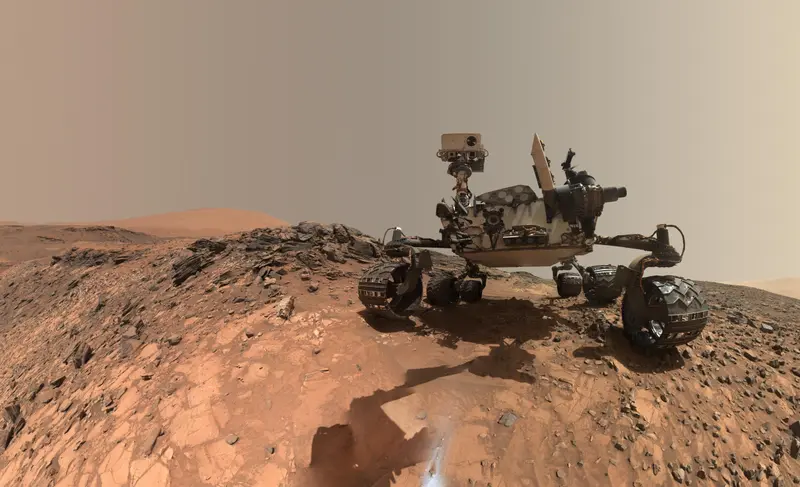
Perseverance launched on 30 July 2020 and landed on 18 February 2021: about 203 days, faster than the 259 of the ideal Hohmann, because a Type I trajectory with a somewhat higher C3 was within reach of its Atlas V.
Design trade-offs
| Choosing… | Gains | Loses |
|---|---|---|
| Hohmann | Minimum Δv with two impulses | Fixed time; waiting for a window |
| Bi-elliptic | Δv when r₂/r₁ > 12-16 | Time, risk, more maneuvers |
| Fast Type I | Time, radiation dose for a crew | C3, arrival Δv |
| Electric spiral | Propellant mass | Months, radiation, operations |
| Elliptical capture + aerobraking | Capture Δv | Months of operations, thermal risk |
Key points
- Hohmann: two tangential impulses, at the periapsis and apoapsis of the ellipse; t = half the period of the ellipse.
- 200 km → GEO: 2.455 + 1.477 = 3.93 km/s in 5 h 16 min; in LEO, 1 m/s raises the orbit by about 1.8 km.
- With r₂/r₁ > 11.94 the bi-elliptic can win; above 15.58 it always wins, but takes much longer.
- Patched conics to Mars: v∞ ≈ 2.9 km/s, 3.6 km/s departure from LEO, 259 days, windows every 780 days.
- The electric spiral costs v₁ − v₂ (4.7 km/s to GEO): more Δv but far less mass.
Further reading
- H. D. Curtis, Orbital Mechanics for Engineering Students, Butterworth-Heinemann (4th ed., 2020), chapters 6 and 8.
- D. A. Vallado, Fundamentals of Astrodynamics and Applications, Microcosm Press (4th ed., 2013), chapters 6 and 7.
- W. Hohmann, Die Erreichbarkeit der Himmelskörper, Oldenbourg (1925); NASA translation, The Attainability of Heavenly Bodies, NASA TT F-44 (1960).
- T. N. Edelbaum, "Propulsion Requirements for Controllable Satellites", ARS Journal 31(8), 1079-1089 (1961).
- D. Izzo, "Revisiting Lambert's problem", Celestial Mechanics and Dynamical Astronomy 121, 1-15 (2015).
Test yourself
Where are the two impulses of a Hohmann transfer between two circular orbits applied?
Above what radius ratio r₂/r₁ can a bi-elliptic transfer be cheaper than a Hohmann transfer?
If a Hohmann transfer to Mars takes about 259 days, how long must one wait, on average, between two windows?
To raise the ISS by 5 km with two small impulses, roughly what total Δv is needed? (v ≈ 7.66 km/s, a ≈ 6,795 km)
According to Edelbaum's approximation, a coplanar low-thrust spiral from LEO (200 km) to GEO costs…