A rocket cannot lift off from just anywhere or at just any time. The latitude of the launch site sets the orbits that can be reached without paying for plane changes; the surrounding geography sets the directions in which it can fly without overflying cities; and the target orbit sets the instant, sometimes to the second, at which the launch site passes through the right plane. This lesson quantifies each of those constraints: the cost of reaching geostationary orbit from different launch sites, the calculation of the launch time to the ISS, sun-synchronous orbits, lunar and interplanetary windows, and the weather and safety rules that decide "go" or "no go" on launch day. The rotation gain and the launch azimuth were derived in ascent trajectory.
Latitude and inclination
A vehicle lifting off from latitude φ with inertial azimuth β enters an orbit of inclination
cos i = cos φ · sin β
Since sin β ≤ 1, it follows that i ≥ φ: no launch site can directly reach an inclination lower than its latitude. Launching due east (β = 90°) gives exactly i = φ, with the maximum help from Earth's rotation. Any lower inclination requires a plane change, extremely expensive near Earth because it costs
Δv_plane = 2 · v · sin(Δi / 2)
proportional to the velocity at which it is done. In low Earth orbit (v ≈ 7.79 km/s), removing 10° costs 2 · 7.79 · sin 5° = 1.36 km/s, more than half of what it costs to go from LEO to GTO. That is why plane changes are made where velocity is lowest, at the apogee of a transfer orbit (see orbital plane change).
The case that decides everything: geostationary orbit
Geostationary orbit has zero inclination. A launcher leaves the satellite in a geostationary transfer orbit (GTO) with a low perigee, an apogee at 35,786 km altitude and an inclination equal (at least) to the launch site latitude. At apogee, at r = 42,164 km, the GTO velocity is 1.597 km/s and the circular GEO velocity is 3.075 km/s. The apogee burn combines circularization and plane change in a single manoeuvre:
Δv_GEO = √(v_a² + v_c² − 2 · v_a · v_c · cos Δi)
That is why launcher user's guides express GTO as "Δv remaining to GEO": a GTO-1500 (Ariane's standard from Kourou) or a GTO-1800 (typical from Cape Canaveral). Launchers from high-latitude sites compensate with supersynchronous orbits (apogee at 50,000-90,000 km, where velocity is even lower and the plane change cheaper) or with an upper stage that restarts at apogee and does part of the correction, at the cost of hours of flight and battery life on the stage.
Launch sites of the world
| Launch site | Latitude | Strengths | Limitations |
|---|---|---|---|
| Guiana Space Centre, Kourou (France) | 5.2° N | Nearly equatorial; ocean to the east and north | Far from Europe: logistics by ship |
| Cape Canaveral / Kennedy Space Center (US) | 28.5° N | Ocean to the east; infrastructure and cadence | Direct inclinations between ~28.5° and ~57°; polar orbits only through a southern corridor reopened in 2020 |
| Vandenberg (US) | 34.7° N | Pacific to the south: polar and sun-synchronous orbits | Unsuitable for low-inclination orbits |
| Starbase, Boca Chica (US) | 26.0° N | Gulf of Mexico to the east | Narrow corridor between the Caribbean and Florida |
| Baikonur (Kazakhstan, leased by Russia) | 45.6° N | Historic; crewed Soyuz | Over land; stage drop zones; practical minimum ~51.6° |
| Plesetsk / Vostochny (Russia) | 62.9° N / 51.9° N | Polar and high-inclination orbits; Vostochny on Russian soil | GEO very expensive |
| Wenchang (China) | 19.6° N | Coastal, the most equatorial in China | — |
| Jiuquan / Xichang / Taiyuan (China) | 41.0° / 28.2° / 38.8° N | Inland | Stages falling on inhabited land |
| Satish Dhawan, Sriharikota (India) | 13.7° N | Low latitude, Bay of Bengal to the east | Polar orbits need a dogleg to avoid Sri Lanka |
| Tanegashima (Japan) | 30.4° N | Coastal | Fishing seasons used to restrict launches |
| Mahia (New Zealand) | 39.3° S | Open ocean in almost every direction | Small launchers only |
| Andøya (Norway) / Esrange (Sweden) | 69.3° N / 67.9° N | Polar orbits; mainland Europe | Small launchers |
| El Arenosillo, Huelva (Spain) | 37.1° N | Atlantic to the southwest; suborbital flight of PLD Space's Miura 1 (2023) | No orbital capability for now |
The general rule: a coastline with ocean in the flight direction (stages, fairings and, in case of failure, debris fall into the sea) and low latitude for GEO or a clear north-south corridor for polar orbits. Baikonur is the great historical exception: it was chosen in the 1950s for military reasons and tracking range, and its first stages fall in designated impact zones on the steppe.
Flight safety
Before a trajectory is approved, the instantaneous impact point (IIP) is computed for every instant: where the vehicle would fall if the engine shut down at that moment. Its ground track must avoid populated areas, and the risk is quantified with the expected number of casualties E_c, summing, for each failure mode and each instant, failure probability × fragments × lethal area × population density. US regulations (FAA, 14 CFR Part 450) limit the collective risk to the public to 1·10⁻⁴ expected casualties per launch and the individual risk to 1·10⁻⁶.
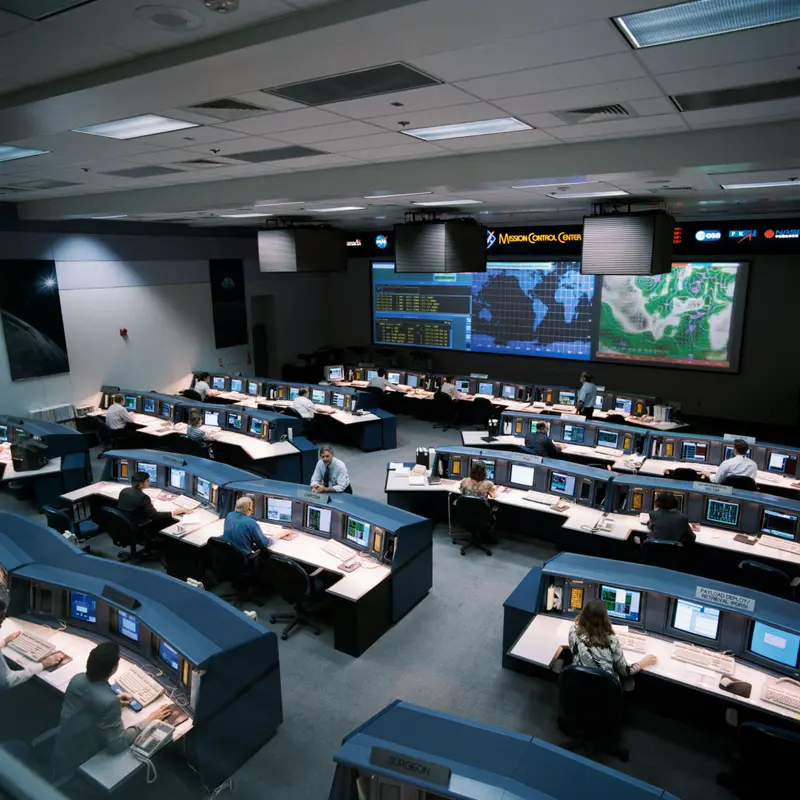
If the vehicle leaves its corridor, the flight termination system destroys it. Traditionally the command was given by a range safety officer on the ground; since 2017 Falcon 9 has flown with an autonomous flight termination system, which decides on board using its own sensors and rules, and which is now standard on new launchers. Before each flight, notices to mariners and to airmen (NOTMAR and NOTAM) are issued, closing the airspace and sea areas under the trajectory and in the drop zones.
Windows to an orbital plane: the ISS
To meet a spacecraft that is already in orbit you have to launch into its plane, and the launch site crosses it only twice a day, when rotation carries it underneath. With the orbit defined by its inclination i and its right ascension of the ascending node Ω (see orbital elements), the launch site, at latitude φ, is in the plane when its local sidereal time θ satisfies:
sin Δλ = tan φ / tan i
θ = Ω + Δλ            (ascending pass: launch to the northeast)
θ = Ω + 180° − Δλ     (descending pass: launch to the southeast)
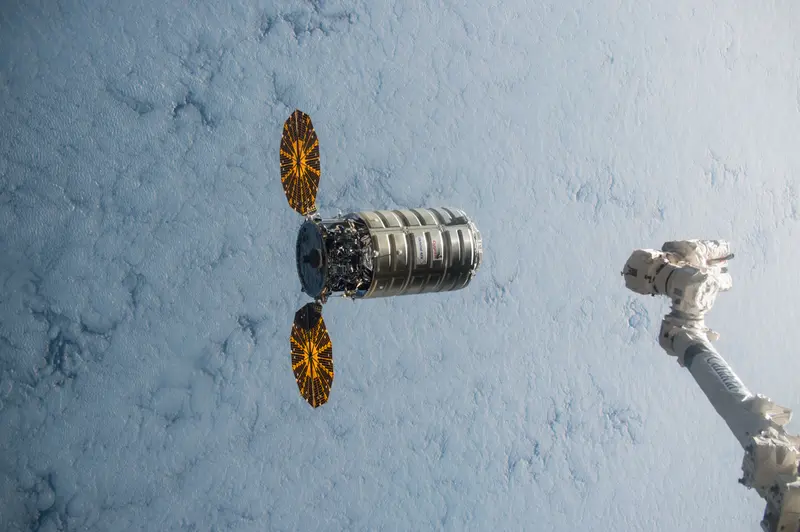
The window to the ISS is almost instantaneous: launching a few minutes late leaves the spacecraft in a rotated plane, and correcting it in flight (with upper-stage yaw steering) costs delta-v that comes out of the payload margin. Besides the plane, the spacecraft must arrive in the right phase: it has to enter orbit behind the station at the right distance to catch up with it. Since 2020, Soyuz and Progress have used a two-orbit scheme, about 3 hours to docking; Dragon usually takes around a day. Rendezvous is covered in rendezvous and docking.
Sun-synchronous orbits: a fixed local time
A sun-synchronous orbit (SSO) keeps the angle between its plane and the Sun constant: the satellite passes over each point at the same local solar time, with the same lighting, which makes it ideal for Earth observation. It is achieved by making the J₂ nodal regression exactly equal to the motion of the apparent Sun, +0.9856° per day, which requires an inclination slightly greater than 90°:
cos i = − (dΩ/dt)_SSO / [ (3/2) · J₂ · (R_E/a)² · n ]
| Altitude (circular) | Sun-synchronous inclination |
|---|---|
| 500 km | 97.4° |
| 700 km | 98.2° |
| 800 km | 98.6° |
The window is daily and is defined by the local time of the node (for example, a 10:30 descending node, common for optical satellites, with moderate shadows and before afternoon convective clouds build up). The mission fixes Ω relative to the Sun, and the launch site must be under the plane: again, a few minutes a day. Since the inclination is retrograde, the launch heads south-southwest or north-northwest, Earth's rotation subtracts instead of adding, and launch sites such as Vandenberg, Kourou (to the north), Plesetsk, Taiyuan or Sriharikota (to the south) are the usual ones.
Lunar and interplanetary windows
To the Moon. Translunar injection must aim at where the Moon will be three to five days later, and the parking orbit must contain that direction. That gives, each month, periods of several days with a daily window of one to two hours. For Orion on Artemis I, lighting constraints were added: maximum eclipse duration (because of the power from its solar arrays), thermal conditions and a daylight arrival at the splashdown zone. The result is windows of a few days per month with one or two hours each day (see lunar trajectories).
To the planets. A cheap transfer requires a relative position of the two planets that repeats with the synodic period:
1/S = |1/T_Earth − 1/T_planet|
| Destination | Orbital period | Synodic period |
|---|---|---|
| Venus | 224.7 days | ~584 days (19 months) |
| Mars | 687.0 days | ~780 days (26 months) |
| Jupiter | 11.86 years | ~399 days |
Each window lasts a few weeks: the exact day is chosen from diagrams of launch energy C3 against departure and arrival dates (porkchop plots). Perseverance lifted off on 30 July 2020, at the start of its window; missing it would have meant waiting 26 months. The Hohmann-type transfers that set these dates are in Hohmann transfer.
The weather on the day: launch rules
With the launch site and the window fixed, the last filter is the weather. Each vehicle's launch commit criteria include:
- Surface wind: limits the loads on the pad and the risk of striking the tower at liftoff.
- Upper-level winds and shear: the q·α loads at max Q are checked using weather balloons (see max Q and structural loads).
- Lightning: a rocket with its ionized exhaust plume is a lightning rod hundreds of meters long. Apollo 12 was struck twice during ascent in 1969, and in 1987 triggered lightning destroyed an Atlas-Centaur. The rules forbid launching near cumulus clouds, anvils and clouds with high electric fields, measured with networks of field mills.
- Temperature: Challenger was launched in 1986 at temperatures far below any its solid rocket booster joints had experienced; the stiffening of the O-rings was the cause of the accident.
- Recovery and emergency: sea state in the stage landing zones and, with a crew, in the emergency splashdown zones along the whole trajectory.
If any criterion is red within the window, the launch is postponed; and the next day's window, as we have seen, may be at a different time.
Launching from sea or from the air
Two ways of taking the launch site to the ideal spot:
- Sea platform: Sea Launch flew Zenit rockets from a platform on the equator at 154° W, with Kourou's advantage without its logistics; today China launches small rockets from ships in the Yellow Sea. In exchange, operations are complex and lack the infrastructure of a launch site.
- Air launch: Pegasus, dropped from the L-1011 Stargazer, starts at ~12 km altitude and can head for any latitude or azimuth, removing launch site and window constraints in exchange for a very small payload. LauncherOne attempted the same with a 747 until Virgin Orbit shut down in 2023.
Key points
cos i = cos φ · sin β: no launch site reaches inclinations lower than its latitude without a plane change, which costs2v sin(Δi/2).- Reaching GEO costs 1.49 km/s from Kourou and 1.84 km/s from Cape Canaveral: 12% more mass in orbit for the satellite launched near the equator.
- Launching into a given plane (ISS, sun-synchronous) is only possible in windows of minutes, at most twice a day; for the ISS, the time moves about 23 minutes earlier each day.
- Mars windows repeat every ~26 months and last weeks; lunar windows, a few days per month.
- The launch site is chosen by latitude, ocean in the flight direction and risk to the population (
E_c ≤ 10⁻⁴); the final "go" comes from weather and flight safety.
Further reading
- D. A. Vallado, Fundamentals of Astrodynamics and Applications, Microcosm Press (4th ed., 2013): launch windows, sidereal time and J₂ perturbations.
- H. D. Curtis, Orbital Mechanics for Engineering Students, Butterworth-Heinemann (4th ed., 2020): plane changes, sun-synchronous orbits and interplanetary transfers.
- V. A. Chobotov (ed.), Orbital Mechanics, AIAA Education Series (3rd ed., 2002).
- W. J. Larson, J. R. Wertz (eds.), Space Mission Analysis and Design, Microcosm (3rd ed., 1999).
- Federal Aviation Administration, 14 CFR Part 450, Launch and Reentry License Requirements (2020).
- Arianespace, Ariane 6 User's Manual (arianespace.com).
Test yourself
A 6,000 kg satellite in GTO has to circularize and remove its inclination with a 320 s Isp engine. How much more mass reaches GEO if it was launched from Kourou instead of Cape Canaveral?
From a launch site at latitude φ, what is the minimum inclination reachable without a plane-change manoeuvre?
Why does the launch time to the ISS move about 23 minutes earlier each day?
How often does a launch window to Mars open?
What approximate inclination does a circular sun-synchronous orbit at 700 km require?