For sixty years, launch vehicles were dumped in the sea after every flight. Since 2015, when a Falcon 9 first stage touched down again at Cape Canaveral, recovering stages has become the norm for the new generation. But reuse is not free: every kilogram of propellant kept for the return is payload that does not go up. This lesson quantifies that penalty with the rocket equation, studies the physics of the landing burn and the guidance that solves it on board, reviews the architectures flying today and sets out the cost model that decides whether it is worth it. The starting overview is in getting to orbit.
The first-stage recovery profile
The first stage of a two-stage vehicle separates, depending on the mission, at 2-3 km/s and 60-80 km altitude (see ascent trajectory). From there, the Falcon 9 profile:
- Flip. Using cold-gas (nitrogen) thrusters, the stage turns around and points its engines forward.
- Boost-back burn, only if it returns to land near the launch site: it reverses the horizontal component of velocity. This is the expensive part.
- Ballistic flight outside the atmosphere and deployment of the grid fins.
- Entry burn, with three engines, at around 60-70 km: it reduces velocity to limit heating and dynamic pressure on entry, and the forward-facing plume acts as a shield against the flow.
- Aerodynamic descent: the stage falls engines-first and corrects its impact point with titanium grid fins.
- Landing burn, with one or three engines, and leg deployment in the last few seconds.
If it lands on a barge out at sea (drone ship), the boost-back burn is saved: the stage follows its ballistic arc and only brakes. If the mission is very demanding, the stage is expended.
How much propellant must be kept
The reserve is calculated with the rocket equation applied to the empty stage. If Δv_rec is the sum of the recovery burns and m_dry the empty stage (with legs and fins):
m_res = m_dry · (e^(Δv_rec / c) − 1)
That propellant is not burned during ascent, so the stage separates more slowly and with more mass, and the upper stage has to make up for it.
The model gives the order of magnitude but falls short: it does not include the dispersion margins of the recovery, the added gravity losses of a second stage that starts off slower, or the extra mass of strengthening the structure for several flights. Published figures confirm it: for GTO, SpaceX quoted 8.3 t with an expendable Falcon 9 and 5.5 t with recovery, 34% less. On a GTO mission the stage separates faster and farther downrange, and braking it costs more delta-v; since the reserve grows exponentially with it, the penalty shoots up. That is why the heaviest missions still expend the stage, and why Falcon Heavy sometimes recovers the side boosters and lets the centre core fall.
The final burn: a landing with no second chance
During the descent, the empty stage reaches its terminal velocity, at which drag equals weight:
v_t = √(2 · m · g / (ρ · C_D · S))
In reality the mass drops during the burn, the density changes and the wind pushes, but the example shows the core of the problem: the nearly empty stage weighs so little compared with the thrust of a single engine that its thrust-to-weight exceeds one even at the Merlin's minimum throttle. It cannot hover. The burn (informally called a "hoverslam" or "suicide burn") must be computed so that velocity and altitude reach zero at the same time. This is also why engines designed for reuse aim for deep throttling: Raptor and BE-4 were designed with much wider throttle ranges than classic expendable engines.
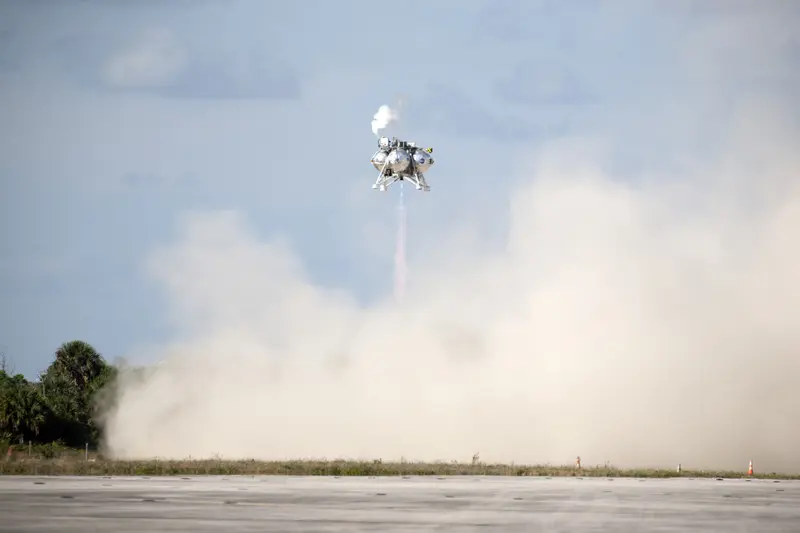
Game
Land the lunar module
Descent guidance: real-time convex optimization
The guidance problem is to find the thrust history that takes the stage from its current state to the landing pad at zero velocity, with minimum propellant and within the engine's limits. Stated directly:
min  ∫ ‖T(t)‖ dt
s.t. r̈ = T/m + g,   ṁ = −‖T‖ / c
     ρ₁ ≤ ‖T‖ ≤ ρ₂                 (minimum and maximum engine thrust)
     trajectory angle above the ground ≥ θ_min (glide-slope cone)
     r(t_f) = r_pad,  ṙ(t_f) = 0
The constraint ρ₁ ≤ ‖T‖ makes the problem non-convex: the set of admissible thrusts is an annulus, not a disc, and optimizers cannot guarantee finding the solution in bounded time. Açıkmeşe and Ploen (2007) showed that, by introducing a slack variable Γ with ‖T‖ ≤ Γ and ρ₁ ≤ Γ ≤ ρ₂, and changing variables (u = T/m, σ = Γ/m, z = ln m), the problem becomes a second-order cone program, which is convex and whose optimal solution also satisfies the original constraint: this is lossless convexification. A convex problem is solved with interior-point methods in a bounded number of iterations, in milliseconds, on a flight computer. Lars Blackmore, who worked on this line of research at JPL for Mars landings, later took it to SpaceX, and the company has publicly described the use of convex optimization in Falcon 9 landings.
Navigation (GNSS, inertial measurement units, radar or laser altimeter in the final phase) and control (engine gimbal, fins, cold gas) close the loop; see navigation and orbit determination and attitude control laws.
Re-entering without burning up
The first stage enters the atmosphere at 1-2 km/s, far from the 7.8 km/s of an orbital spacecraft: its specific energy is 15 to 60 times lower, and the heating (which scales with v³, see aerodynamic heating) can be handled with the entry burn and local protection at the engine section and the fins. This supersonic retropropulsion was for years the territory of wind tunnels and simulations; SpaceX shared Falcon 9 stage flight data with NASA, which is studying it for landing large payloads on Mars, where the atmosphere is too thin to brake with parachutes alone.
For an upper stage the problem is different: it returns at orbital velocity, with about 30 MJ/kg, and needs a full heat shield (see reusable thermal protection and re-entry dynamics), control surfaces and landing propellant. All of that sits on the stage with a 1:1 trade factor: every kilogram of shield is one kilogram less payload. That is why full reuse is much harder than first-stage reuse.
Reusable architectures
| Vehicle | What is recovered | How | Status |
|---|---|---|---|
| Space Shuttle | Orbiter and solid booster casings | Glide and runway landing; parachutes into the sea | Retired (1981-2011) |
| Falcon 9 / Falcon Heavy | First stage (and side boosters) and fairing halves | Propulsive landing on land or drone ship; fairings under parafoils from the sea | Operational; a single booster has reached some thirty flights |
| Electron (Rocket Lab) | First stage | Parachutes and splashdown; helicopter capture was tested | Recovery trials |
| New Glenn (Blue Origin) | First stage | Propulsive landing on a ship | First recovery in 2025 |
| Starship (SpaceX) | Both stages | Super Heavy caught by the tower arms (since October 2024); the ship, with a tile heat shield and flaps | In development and test flights |
| Themis / Callisto (Europe) | First stage (demonstrators) | Propulsive landing | Demonstrators in development |
The Space Shuttle is the counter-example every launch vehicle engineer studies: it was "reusable", but each orbiter needed months of inspection and refurbishment (tiles one by one, main engines removed), and with the programme's total cost spread over its 135 flights, each one came to on the order of 1.5 billion dollars (Pielke and Byerly, 2011). Reuse only makes things cheaper if refurbishment is a small fraction of the manufacturing cost.
Designing to fly many times
A reusable vehicle changes the requirements of every subsystem:
- Engines: reliable in-flight restart (several times per mission), deep throttling, a life of dozens of thermal and mechanical cycles, inspection without disassembly. Methane has an advantage over kerosene here: it leaves no soot (coking) deposits in the cooling channels and turbines (see propellants and liquid-propellant rocket engines).
- Structure: sizing shifts from "survive one flight" to withstanding fatigue and cryogenic cycles; new loads appear (landing, return transport, leg impact).
- Avionics and sensors: monitoring vehicle health in flight to decide whether it can fly again without disassembly.
- Operations: ships, cranes, inspection hangars, transport logistics. Turnaround time is as much a design parameter as mass.
Does it pay off? A cost-per-kilogram model
Let us normalize the cost of an expendable flight to 1: first stage 0.6, upper stage 0.2, launch operations 0.2. In the reusable version, the first stage is amortized over N flights, each flight pays a refurbishment of 10% of the stage cost (0.06) and a recovery cost of 0.05, and the payload falls by 24%:
C_flight(N) = 0.6/N + 0.06 + 0.05 + 0.2 + 0.2
Relative cost per kilogram = C_flight(N) / 0.76
The economic reality is even more favourable than the model says if refurbishment is very cheap and cadence high, and considerably worse if not: the Space Shuttle was, in practice, in the N = 1 row. Jones's analysis (NASA, 2018) put the list cost per kilogram to LEO of Falcon 9 at about 2,700 dollars, against ~54,500 for the Space Shuttle.
Design trade-offs
| Decision | For | Against |
|---|---|---|
| Landing on a drone ship | Smaller reserve (−10% payload in the model) | Ships, return transport, the sea |
| Return to launch site | Simpler, faster operations | Much larger payload penalty |
| Small first stage (slow separation) | Cheap recovery | Larger, expendable upper stage |
| Parachutes and splashdown | No propellant reserve | Salt water, damage, expensive inspection |
| Tower catch | No legs; immediate reuse | Extreme precision; risk to the launch pad |
| Full reuse | Minimum marginal cost | Heat shield and landing at a 1:1 trade factor |
Key points
- Recovery reserve:
m_res = m_dry · (e^(Δv_rec/c) − 1); the penalty grows exponentially with separation velocity. - Drone ship recovery costs on the order of 10-25% of the payload; returning to the launch site or flying to GTO, considerably more.
- The empty stage has thrust-to-weight > 1 on one engine: it cannot hover, and the burn must reach zero exactly at the ground, with closed-loop guidance.
- Descent is guided by solving a convex problem on board (Açıkmeşe's lossless convexification).
- Reuse only makes launch cheaper if refurbishment is cheap and the stage flies several times; after that, the cost of the upper stage dominates.
Further reading
- B. Açıkmeşe, S. R. Ploen, "Convex Programming Approach to Powered Descent Guidance for Mars Landing", Journal of Guidance, Control, and Dynamics 30(5), 1353-1366 (2007).
- L. Blackmore, "Autonomous Precision Landing of Space Rockets", The Bridge 46(4), National Academy of Engineering (2016).
- R. Pielke Jr., R. Byerly, "Shuttle programme lifetime cost", Nature 472, 38 (2011).
- H. W. Jones, "The Recent Large Reduction in Space Launch Cost", 48th International Conference on Environmental Systems, ICES-2018-81 (2018).
- G. P. Sutton, O. Biblarz, Rocket Propulsion Elements, Wiley (9th ed., 2016).
Test yourself
A stage with a dry mass of 25.6 t and c = 2.9 km/s needs 1.2 km/s to return and land. How much propellant must it hold in reserve?
Why can't the Falcon 9 first stage hover before touching down?
Why is the reuse penalty larger for GTO missions than for LEO?
In the convex formulation of powered descent, which non-convex constraint is "relaxed" without losing the optimal solution?
In the lesson's cost model, from how many flights per stage does reuse start to pay off?