The vacuum, cold and heat of space are dealt with by thermal control. What this lesson covers is the rest of the environment, the part that does damage: charged particles that degrade transistors and flip bits, electrons that charge up the spacecraft until a spark jumps, atomic oxygen that eats polymers, a residual atmosphere that slows things down and swells with every solar storm, and fragments that hit at 10 km/s. In what space is you saw the radiation populations and the basic figures; here we will see how they translate into design requirements, with the models and calculations an engineer uses to size shielding, select components and plan the end of life.
A map of effects by orbit
| Effect | Low LEO (300-600 km) | High and polar LEO (600-1,400 km) | MEO (GNSS, 20,000 km) | GEO |
|---|---|---|---|---|
| Atmospheric drag | dominant | moderate | none | none |
| Atomic oxygen | strong | moderate | none | none |
| Trapped protons | South Atlantic Anomaly | strong | moderate | low |
| Trapped electrons | low | moderate | very strong (outer belt) | strong |
| Solar protons and cosmic rays | partly shielded by the magnetic field, except at high latitudes | partly shielded | exposed | exposed |
| Surface and internal charging | low (dense plasma) | charging in auroral zones | strong | strong, during substorms |
| Space debris | high | maximum (700-1,000 km) | low | GEO ring, low relative velocity |
Radiation: three ways of damaging electronics
Total ionising dose (TID)
The energy that particles deposit by ionisation accumulates in the oxides of MOS transistors as trapped charge, which shifts the threshold voltage and increases leakage currents. It is measured in rad(Si) or gray (1 Gy = 100 rad), always referred to silicon. A typical commercial component withstands of the order of 5-50 krad(Si); a hardened one, from 100 krad to more than 1 Mrad.
The dose depends on shielding, which is measured as mass per unit area: 1 mm of aluminium is 0.27 g/cm². Dose-depth curves (calculated with models such as AE9/AP9 for the belts and codes such as SHIELDOSE) have a characteristic shape: the first few millimetres of aluminium stop most of the electrons and the dose falls very quickly; beyond about 5-10 mm the curve flattens out, because what remains are the energetic protons and the bremsstrahlung from the electrons, which aluminium does not stop. Adding shielding beyond that knee costs a lot of mass and gives little: the efficient approach is to shield sensitive components locally ("spot shielding") and to make use of the structure itself and neighbouring units.
Displacement damage (DDD)
High-energy protons, neutrons and electrons displace atoms from the crystal lattice and create defects that trap carriers. It hardly affects CMOS logic, but it degrades components that depend on minority-carrier lifetime: solar cells (it is the main cause of the array degradation you saw in power), CCD detectors (loss of charge transfer efficiency, a well-known problem on Hubble and Gaia), optocouplers and bipolar transistors. For solar cells the 1 MeV equivalent electron fluence method is used: all the radiation of the mission is converted into a fluence of 1 MeV electrons that would produce the same damage, and it is compared with test curves.
Single-event effects (SEE)
A single heavy cosmic-ray ion, or a proton that triggers a nuclear reaction in the silicon, leaves a column of charge along its track. The quantity that describes it is the linear energy transfer (LET), in MeV·cm²/mg. If the charge collected by a node exceeds its critical charge:
- SEU (single event upset): flips a bit in memory or in a register. It is recoverable.
- SET: a transient pulse in an analogue or logic circuit.
- SEFI: the component enters an erroneous state (it hangs) and must be reset.
- SEL (latch-up): a parasitic thyristor is triggered, the current rises and the component is destroyed unless the power is cut within milliseconds.
- SEB / SEGR: destructive breakdown in power transistors.
Sensitivity is characterised in accelerators by a cross section σ(LET) (cm² per bit or per device), which rises from a threshold to a saturation value; the in-flight rate is obtained by combining it with the LET spectrum of the environment (models such as CREME96). A component with a latch-up threshold above about 60-75 MeV·cm²/mg is considered immune in practice.
Hardened or commercial components
| Hardened (rad-hard) | Selected commercial (COTS) | |
|---|---|---|
| Typical TID | 100 krad - >1 Mrad | ~5-50 krad, highly variable between lots |
| Latch-up | immune by design or process | must be tested and protected against |
| Performance | one or more generations behind | state of the art |
| Cost and lead time | very high | low, but with lot testing |
| Use | GEO, deep space, long missions | short LEO, CubeSats, constellations with system-level redundancy |
The large low-orbit constellations have popularised the second route: commercial components, selective testing and fault tolerance through the number of satellites rather than the quality of each one.
Spacecraft charging
In GEO, during magnetic substorms (especially in the midnight-to-dawn sector), a cloud of electrons with energies from keV to tens of keV envelops the satellite. In eclipse, without the photoemission that offsets it in sunlight, the surface can charge to potentials of the order of negative kilovolts. What is dangerous is not the absolute potential, but the differences between neighbouring insulating surfaces: when they exceed a certain value an electrostatic discharge (ESD) occurs that induces pulses in the harness and can corrupt memories, switch relays or damage solar cells and their interconnects. Some of the anomalies of geostationary satellites are attributed to these discharges.
There are two variants:
- Surface charging, by low-energy electrons. It is combated by making all external surfaces conductive and grounding them (ITO coatings on OSRs, conductive black Kapton on MLI blankets).
- Internal charging, by electrons above ~1 MeV that pass through the shielding and are deposited in internal dielectrics (circuit boards, cable insulation) during days of enhanced outer belt. It is combated with shielding, materials with some conductivity and no floating conductors.
The reference design guidelines are NASA-HDBK-4002A and standard ECSS-E-ST-20-06C.
Atomic oxygen and contamination
In LEO, atomic oxygen strikes the surfaces facing the direction of motion (the ram face) at about 5 eV.
Atomic oxygen is not alone: ultraviolet yellows paints and adhesives, and molecular contamination from outgassing is deposited on the coldest surfaces, especially optics and radiators. It is controlled with materials that pass the ASTM E595 test (details in materials for space), with vacuum bake-outs before launch and with contamination budgets in ppm or ng/cm² for each critical surface.
The atmosphere that slows you down, and solar storms
Drag in low orbit makes the orbit decay. For a near-circular orbit, the loss of semi-major axis per revolution is:
Δa_rev ≈ −2π · ρ · a² / B with B = m / (C_D · A) ballistic coefficient, in kg/m²
Density at those altitudes varies by the order of a factor of 10 between the minimum and the maximum of the solar cycle, and rises sharply during geomagnetic storms, which heat the thermosphere. In February 2022 a moderate storm increased drag just after 49 Starlink satellites had been launched into an insertion orbit of about 210 km, and about 38 of them re-entered without being able to climb. In May 2024 the most intense storm in two decades forced thousands of satellites to manoeuvre at once and scrambled the position catalogues for days. Solar cycle 25 reached its maximum around 2024-2025; for very low orbits, space weather is now an everyday operational input.
Game
Climb through the atmosphere

Space debris and micrometeoroids
How much there is
According to ESA, there are of the order of 40,000 objects tracked by surveillance networks, and an estimated 54,000 larger than 10 cm, of the order of 1.2 million between 1 and 10 cm and of the order of 140 million between 1 mm and 1 cm, with a total mass in orbit of more than 10,000 tonnes. Three events account for a large share of the fragments in LEO: the Chinese anti-satellite test against Fengyun-1C (2007, at about 865 km, more than 3,000 catalogued fragments), the collision between Iridium 33 and Kosmos 2251 (2009, at about 790 km) and the Russian anti-satellite test against Kosmos 1408 (2021, more than 1,500 catalogued fragments).
How much risk it poses
Flux models (ESA's MASTER, NASA's ORDEM) give the flux F of particles larger than a given size for an orbit and an orientation. The expected number of impacts on an area A over a time t is N = F · A · t, and, since impacts are Poisson events, the probability of at least one is:
P(≥1) = 1 − e^(−F · A · t)
For tracked objects (larger than about 10 cm in LEO) a mean flux is not used, but a conjunction analysis: from the orbits and their covariances the collision probability of each close approach is calculated, and a manoeuvre is made if it exceeds a threshold, typically of the order of 10⁻⁴. The Station has made more than thirty avoidance manoeuvres since 1999, and the large constellations make tens of thousands every six months autonomously; see rendezvous and docking for the relative dynamics they are based on.
How a spacecraft is protected
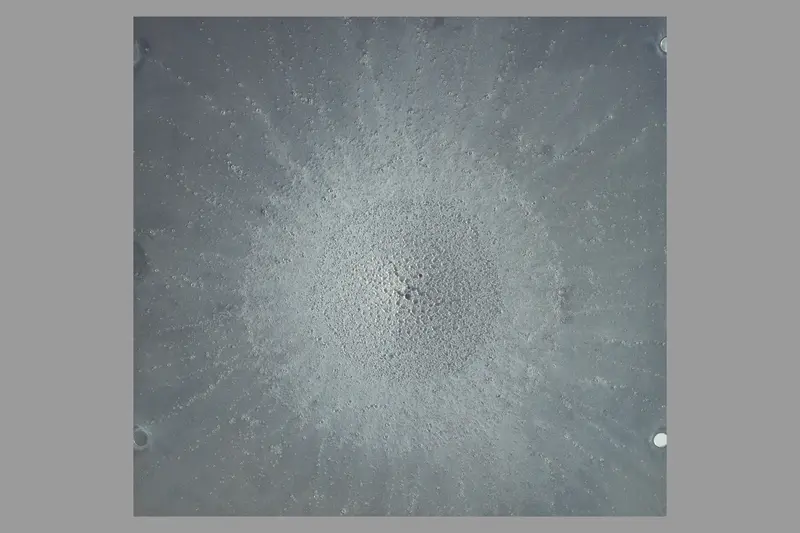
Between ~1 mm and ~1 cm, particles are too small to track and too large to ignore: they are shielded against. The Whipple shield places a thin sheet (the bumper) at a standoff from the main wall: the projectile, at more than about 6-7 km/s, fragments and partially vaporises as it passes through, and the resulting debris cloud spreads over a large area of the rear wall. Its capability is described by ballistic limit equations (those of Christiansen and Cour-Palais are the classic ones), which give the critical projectile diameter as a function of velocity, angle, thicknesses and spacing, and are fitted with light-gas gun tests. The Station's stuffed Whipple shields interleave Nextel ceramic fabric and Kevlar, and protect the modules against particles up to the order of 1 cm.
End of life and regulations
The defence against the Kessler syndrome is not to leave new debris behind:
- Passivation: at the end of the mission, empty tanks, discharge batteries and disable everything that could explode. Explosions of abandoned stages and satellites have produced more fragments than collisions.
- LEO: re-enter within a limited time. The IADC guideline set 25 years; since 2022 the FCC has required 5 years of the new satellites it licenses in low orbit, and ESA has tightened its requirements with a "zero debris" goal for 2030. Below about 550 km drag does it unaided within a few years; higher up, propulsion or drag-augmentation devices are needed.
- GEO: at end of life, raise the satellite to a graveyard orbit at least about 235 km above geostationary (plus a term that depends on area and mass, according to the IADC formula), which costs of the order of 10 m/s of delta-v (Δv ≈ ½ · v_GEO · Δa / a), the propellant for about three months of station-keeping.
- Controlled re-entry of large objects, whose remains could reach the ground: the casualty risk must be below 1 in 10,000 per re-entry.
All these requirements weigh on the propellant budget and on the reliability demanded of the spacecraft at the end of its life, as you will see in systems engineering.
Design trade-offs
- Global or spot shielding. A thicker wall reduces the dose everywhere, but flattens out quickly; spot shielding of sensitive components is far more mass-efficient.
- Component quality or system tolerance. Rad-hard for a few expensive, long-lived satellites; COTS with redundancy for constellations.
- Altitude. Lower: less persistent debris, less radiation and rapid natural re-entry, but more drag, more atomic oxygen and more propellant to stay up. Higher: the opposite.
- External surfaces. Conductive for charging, resistant to atomic oxygen and ultraviolet, and with the optical properties that thermal control demands: a single coating has to satisfy them all.
Key points
- Radiation does damage in three ways: total dose (TID, cumulative), displacement (solar cells, CCDs) and single-event effects (a single ion, from the first day).
- Shielding is measured in g/cm²; dose curves flatten out beyond about 5-10 mm of aluminium, so shielding is applied locally.
- Single-event effects are managed: EDAC, scrubbing, TMR, watchdogs and latch-up current limiters.
- In LEO, atomic oxygen (~95 µm/year of Kapton in the example) and drag, which varies by a factor of ~10 with the solar cycle; in GEO, spacecraft charging and discharges.
- Debris: ~40,000 tracked objects and ~1.2 million larger than 1 cm; Whipple shields against the small, manoeuvres with a ~10⁻⁴ threshold against the large, and disposal within 5 years in LEO or a graveyard orbit in GEO.
Further reading
- A. C. Tribble, The Space Environment: Implications for Spacecraft Design, 2nd ed., Princeton University Press (2003).
- A. Holmes-Siedle, L. Adams, Handbook of Radiation Effects, 2nd ed., Oxford University Press (2002).
- NASA, Mitigating In-Space Charging Effects — A Guideline, NASA-HDBK-4002A (2011).
- ECSS-E-ST-10-04C, Space engineering: Space environment, ESA-ESTEC.
- ESA Space Debris Office, ESA's Annual Space Environment Report (annual edition).
- IADC, IADC Space Debris Mitigation Guidelines, Inter-Agency Space Debris Coordination Committee (current revision).
Test yourself
What is the difference between total ionising dose (TID) and a single-event effect (SEE)?
Approximately what thickness does atomic oxygen erode in one year from a Kapton sheet exposed to a flux of 10¹⁴ atoms/(cm²·s), with an erosion yield of 3·10⁻²⁴ cm³ per atom?
Why did the geomagnetic storm of February 2022 cause the loss of some 38 newly launched Starlink satellites?
What does a space computer's memory do with "scrubbing"?
Since 2022, what maximum post-mission re-entry time does the FCC require of the new low Earth orbit satellites it licenses?