Space is not "nothing" but an environment with very specific properties that drive the design of every vehicle: a pressure that drops by about eleven orders of magnitude in the first 400 km, purely radiative heat transfer, charged particles trapped by the magnetic field, atomic oxygen, orbital debris and distances that force you to think in terms of energy rather than kilometers. This page collects those numbers, with the order of magnitude anyone designing a mission should carry in their head.
Where space begins: the Kármán line
There is no physical surface where the atmosphere ends; density decays almost exponentially with altitude. The conventional criterion, used by the Fédération Aéronautique Internationale (FAI), is the Kármán line at 100 km. In the United States the Air Force and NASA award "astronaut wings" from 50 miles (about 80 km), and there are arguments (McDowell, 2018) for placing the physical boundary closer to 80 km, because below that altitude no satellite survives more than one or two orbits.
Kármán's reasoning is aerodynamic. Lift is L = ½ ρ v² S C_L. For a vehicle of mass m to stay up on wings it needs L = m g; as ρ falls, the required speed grows as v ∝ ρ^(−1/2). Near 100 km that speed approaches orbital velocity (about 7.8 km/s), so from there on what keeps the vehicle up is not the air but orbital mechanics: the vehicle "falls around" the Earth (see gravity and orbits).
The atmosphere as a boundary: density and pressure profiles
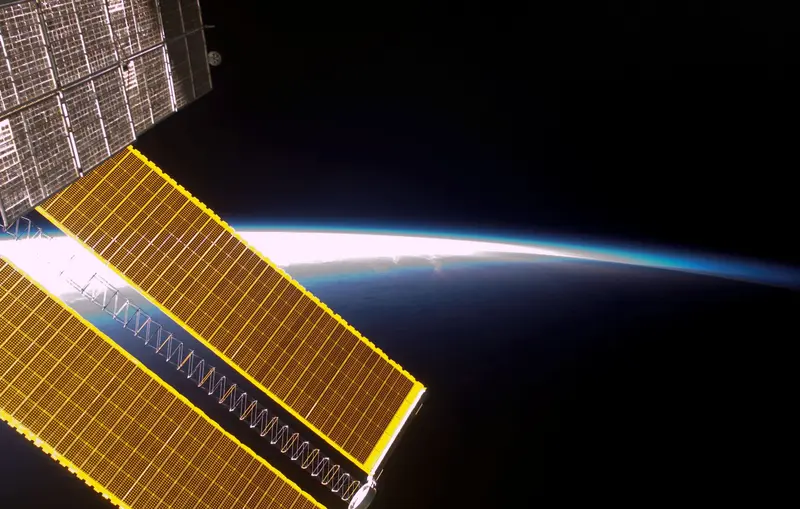
In an isothermal atmosphere in hydrostatic equilibrium, pressure follows p(h) = p₀ · exp(−h / H), with the scale height H = R·T / (M·g). For the troposphere (T ≈ 250-290 K, M = 0.029 kg/mol) this gives H ≈ 7-8.5 km. That is why 50 % of the mass of the air lies below about 5.5 km, 90 % below about 16 km and 99 % below about 30 km.
Approximate values from the U.S. Standard Atmosphere, 1976 (above 150 km they depend strongly on solar activity, by up to a factor of 10):
| Altitude | Pressure | Density | Mean free path | Comment |
|---|---|---|---|---|
| 0 km | 101.3 kPa | 1.225 kg/m³ | ~70 nm | sea level |
| 11 km | 22.6 kPa | 0.36 kg/m³ | ~0.2 µm | airliner cruise, tropopause |
| 30 km | 1.2 kPa | 0.018 kg/m³ | ~4 µm | stratospheric balloons |
| 50 km | 80 Pa | 1·10⁻³ kg/m³ | ~80 µm | stratopause |
| 100 km | ~0.03 Pa | ~5·10⁻⁷ kg/m³ | ~0.1 m | Kármán line |
| 200 km | ~10⁻⁴ Pa | ~2.5·10⁻¹⁰ kg/m³ | ~200 m | very low orbits |
| 400 km | ~10⁻⁶-10⁻⁵ Pa | ~10⁻¹²-10⁻¹¹ kg/m³ | tens of km | Space Station |
Two design consequences:
- The flow regime changes. The Knudsen number
Kn = λ / L(mean free path versus vehicle size) goes from ~10⁻⁸ at the ground to ≫ 1 in orbit. Above about 120-150 km the aerodynamics is free molecular flow: drag is computed molecule by molecule, with drag coefficients C_D of order 2-2.5, not with the Navier-Stokes equations. - Residual drag is not negligible. At 400 km, with ρ ~ 3·10⁻¹² kg/m³, the Space Station loses altitude continuously and needs periodic reboosts. A satellite at 300 km reenters within weeks or months; at 500 km, within years; at 800 km, within decades or centuries. This "self-cleaning" is the main defense against debris in low orbit.
Game
Climb through the atmosphere
Air temperature versus object temperature
The thermosphere (above ~90 km) absorbs solar extreme ultraviolet and its kinetic temperature rises to 700-2,000 K depending on the solar cycle. But at densities of 10⁻¹¹ kg/m³ the heat flux that gas can deliver to a surface is minute: an object in the thermosphere is not heated by the air, but by radiation. Confusing the two is a common mistake.
Epic moment · 2017
Earth at Night from the Space Station
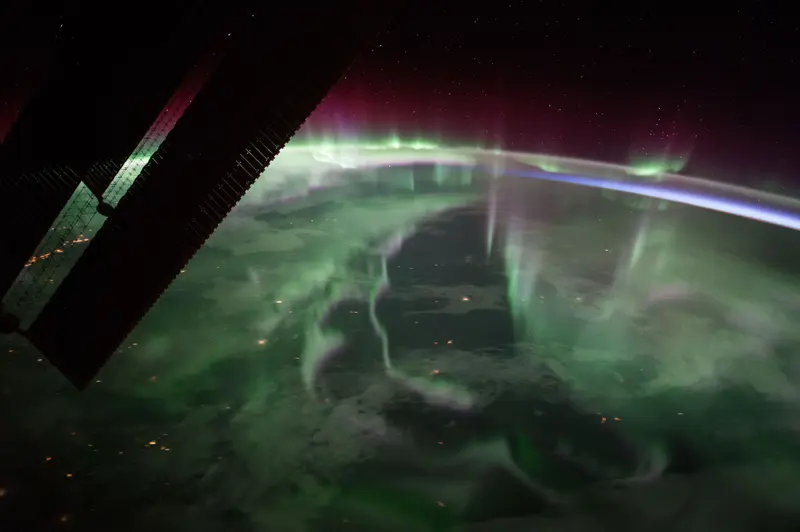
A green and violet aurora borealis ripples over Canada while, below, the lights of cities across the United States switch on all the way down to Florida. They are hundreds of photos that the Expedition 53 astronauts took one after another from the Space Station, about 400 kilometers up. The Station moves so fast, about 28,000 km/h (17,500 mph), that it circles the world every hour and a half and its crew sees 16 sunrises a day.
Watch the full momentNASA (Crew Earth Observations, Johnson Space Center) · Public domainVacuum and its effects
In low orbit the pressure is on the order of 10⁻⁶-10⁻⁵ Pa; in the interplanetary medium, with the solar wind at about 5 particles/cm³ at 1 AU, the thermal pressure is on the order of 10⁻¹¹ Pa and the dynamic pressure of the solar wind 1-2 nPa. That beats any industrial vacuum except ultra-high vacuum. Practical effects:
- Outgassing. Polymers, adhesives and paints release water and volatile compounds that condense on cold optics and solar panels. That is why materials are screened with the ASTM E595 test (total mass loss < 1 % and collected volatile condensable materials < 0.1 %); see materials for space.
- Cold welding and galling. Without a renewed oxide layer, two clean metal surfaces in contact can adhere. Mechanisms and bearings use dry lubricants (MoS₂) or oils with very low vapor pressure.
- Arcing and corona discharge in high-voltage electronics at intermediate pressures (during ascent), according to Paschen's law.
- Boiling of liquids. Below 6.3 kPa (the Armstrong limit) water boils at 37 °C: a human body exposed without a suit loses consciousness in about 10-15 s. Covered in surviving in space.
Temperature: radiative balance
Without convection, a body's temperature is set by the balance between absorbed and radiated power:
α · S · A_proj + Q_internal = ε · σ · A_rad · T⁴

S = 1361 W/m² · (1 AU / r)²     solar constant (TSI) and its fall-off with distance
σ = 5.670·10⁻⁸ W/(m²·K⁴)         Stefan-Boltzmann constant
α  solar absorptance; ε  infrared emittance
(A_proj is the projected area; Q_internal the internal heat dissipation.) For a black sphere (α = ε, A_rad = 4·A_proj) at 1 AU this gives T ≈ 279 K. A black plate facing the Sun and radiating from one side only reaches about 394 K. What the engineer controls is the α/ε ratio: a white paint (α ≈ 0.2, ε ≈ 0.9) stays cold in sunlight; a gold coating (α ≈ 0.3, ε ≈ 0.03) gets very hot. In low orbit there is also Earth's albedo (30 % of sunlight reflected) and Earth's infrared emission (240 W/m² on average), and the spacecraft passes into shadow about 16 times a day, with thermal cycles of tens to more than a hundred kelvin on exposed surfaces.
| Location | Characteristic temperature |
|---|---|
| Cosmic microwave background | 2.725 K |
| Permanently shadowed craters at the lunar south pole (LRO/Diviner) | ~25-40 K |
| Lunar surface at night / by day | ~100 K / ~390 K |
| Black sphere at 1 AU | ~279 K |
| External surfaces of the Station | from about −150 °C to +120 °C |
Ionizing radiation
There are three populations that matter:
- Galactic cosmic rays (GCR). Nuclei (≈ 87 % protons, ≈ 12 % helium, ≈ 1 % heavier) with energies from hundreds of MeV to GeV per nucleon. Low flux but almost impossible to shield: the heavy nuclei (Fe ions, "HZE") dominate the biological dose and fragment in the shielding, producing secondaries. Their flux varies in antiphase with the solar cycle (GCR maximum at solar minimum).
- Solar particle events (SPE). Protons accelerated in coronal mass ejections; lasting hours to days; they can deliver dangerous acute doses outside the magnetosphere, but are reasonably shielded with ~10-20 g/cm² of hydrogen-rich material.
- Van Allen belts. Protons trapped in the inner belt (peaking at around
1,000-6,000 km) and electrons in the outer belt (13,000-60,000 km). The South Atlantic Anomaly, where the inner belt dips to a few hundred kilometers because of the tilt and offset of Earth's dipole, accounts for much of the dose in low orbit and of the electronics upsets.
| Environment | Typical dose equivalent |
|---|---|
| Natural background on Earth (world average, UNSCEAR) | ~2.4 mSv/year |
| Space Station, orbit at ~400 km and 51.6° | on the order of 0.3-0.8 mSv/day |
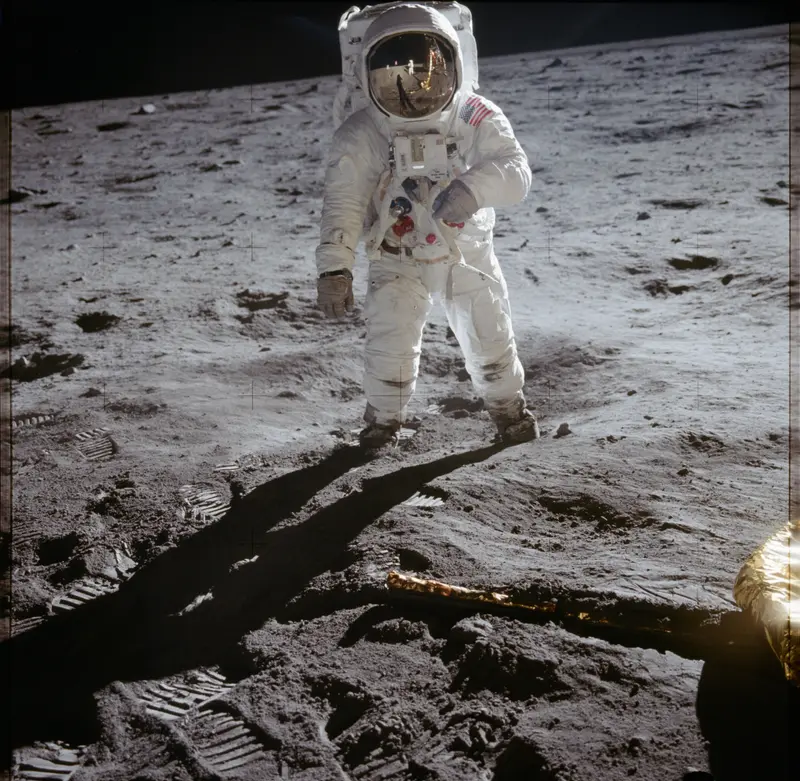
| Lunar surface (Chang'e 4, LND) | ~1.4 mSv/day |
| Interplanetary cruise (MSL/RAD, 2011-2012) | ~1.8 mSv/day |
| Surface of Mars (Curiosity/RAD) | ~0.65 mSv/day |
For electronics, the metrics are total ionizing dose (TID, in krad(Si)), displacement damage and single-event effects (SEU, latch-up), caused by a single ion. A 15-year geostationary mission can accumulate tens to hundreds of krad behind light shielding; there, radiation-hardened parts or redundancy and error correction are used.
Atomic oxygen, debris and micrometeoroids
Between ~200 and ~700 km, atomic oxygen dominates, produced by photodissociation of O₂. At orbital velocity each atom strikes with about 5 eV of kinetic energy (E = ½ m v² with m = 16 u and v = 7.7 km/s), enough to break organic bonds. The erosion yield of Kapton is about 3·10⁻²⁴ cm³ per incident atom; with fluxes of 10¹³-10¹⁵ atoms/(cm²·s), an unprotected polymer loses microns per month.
Particles are the other mechanical hazard. Micrometeoroids arrive at 10-70 km/s (averaging on the order of 20 km/s); orbital debris collides in low orbit at an average of about 10 km/s. According to ESA there are about 40,000 tracked objects and on the order of a million fragments larger than 1 cm. A 1 cm aluminum sphere (1.4 g) at 10 km/s carries about 70 kJ, the kinetic energy of a one-tonne car at 43 km/h concentrated on a single point; protection comes from Whipple shields (a sacrificial bumper that vaporizes the projectile and a separate rear wall). The collision cascade envisaged by Kessler (1978) is today the main argument for removing satellites at the end of their lives.
Scales and distances
Intuition fails with space distances; it helps to keep a few figures in mind:
| Reference | Distance | Light time |
|---|---|---|
| Space Station | ~400 km altitude | 1.3 ms |
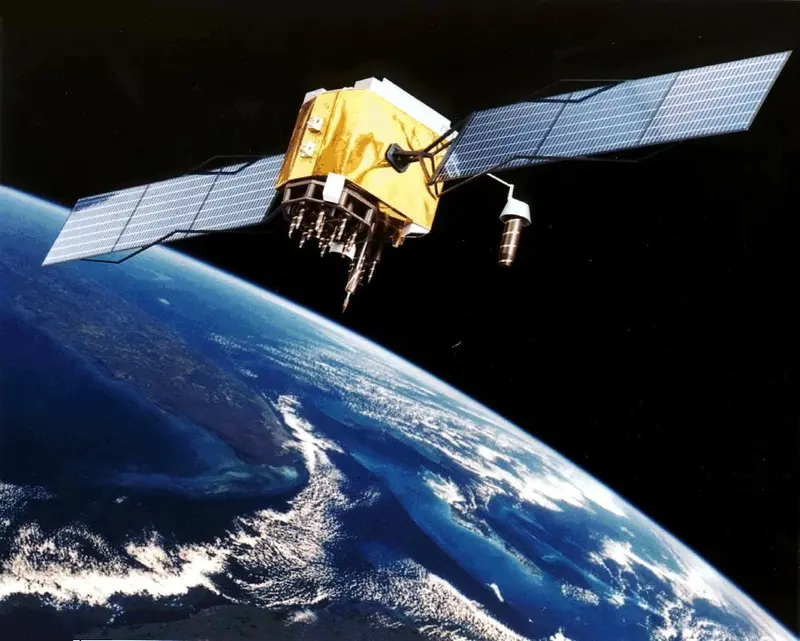
| GNSS constellations (GPS) | ~20,200 km | 67 ms |
| Geostationary orbit | 35,786 km altitude | 0.12 s |
| Moon (mean) | 384,400 km | 1.28 s |
| Sun-Earth Lagrange points L1/L2 | ~1.5 million km | 5 s |
| Sun (1 AU) | 149,597,871 km | 8 min 19 s |
| Mars (favorable opposition / conjunction) | ~55 / ~400 million km | 3 / 22 min |
| Voyager 1 (2026) | more than 165 AU | more than 22 h |
| Proxima Centauri | 4.24 light-years (~268,000 AU) | 4.24 years |
But in astronautics distance matters less than energy. Getting to geostationary orbit (36,000 km) costs more delta-v than reaching lunar orbit; and reaching low orbit, just 400 km up, is the most expensive part of all. That is the idea developed in getting to orbit and traveling to the Moon.
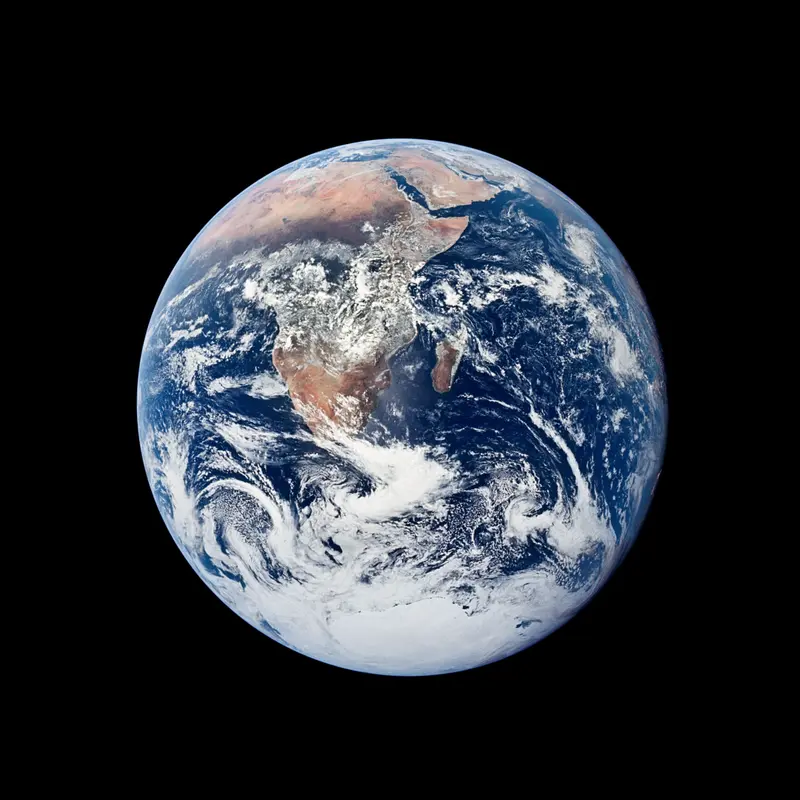
Spheres of influence
For trajectories, Laplace's sphere of influence is used, r_SOI = a · (m / M)^(2/5): inside it, the dominant gravity is that of the smaller body. For the Earth relative to the Sun it comes out at ~925,000 km; for the Moon relative to the Earth, ~66,000 km. It is the basis of the patched conics method used in preliminary mission design.
Key points
- The 100 km boundary is an aerodynamic convention; the atmosphere keeps slowing satellites down up to about 1,000 km.
- The temperature of an object in space is a radiative balance: it depends on α/ε, geometry and distance from the Sun, not on the "air".
- Radiation has three sources (GCR, SPE, belts) that are shielded in very different ways; the dose outside the magnetosphere is hundreds of times the terrestrial one.
- Atomic oxygen, vacuum, thermal cycling and debris drive the choice of materials.
- Distance is not cost: cost is measured in delta-v.
Further reading
- U.S. Standard Atmosphere, 1976. NOAA, NASA and USAF, Washington, D.C., 1976.
- J. C. McDowell, "The edge of space: Revisiting the Karman Line", Acta Astronautica 151, 668-677 (2018).
- D. M. Hassler et al., "Mars' Surface Radiation Environment Measured with the Mars Science Laboratory's Curiosity Rover", Science 343, 1244797 (2014).
- A. C. Tribble, The Space Environment: Implications for Spacecraft Design, Princeton University Press (2nd ed., 2003).
- ESA Space Debris Office, ESA's Annual Space Environment Report (annual edition).
Test yourself
Why is the edge of space set at around 100 km?
What is the equilibrium temperature of a black sphere at 1 AU from the Sun, with no other heat sources?
Which chemical species dominates the residual atmosphere at 400 km and erodes polymers such as Kapton?
Roughly what radiation dose did the RAD instrument measure during the cruise to Mars?
How is heat lost in vacuum, without convection?
Go deeper: engineering subjects
If you want to go beyond this lesson, these subjects develop it at university level.