Almost every design decision in space ends up being a materials decision. Every kilogram of structure on the upper stage is one kilogram less of payload; tanks operate at 20 K and heat shields at 3,000 °C; in vacuum plastics lose mass and clean metals cold-weld; atomic oxygen eats polymers and radiation degrades semiconductors, glasses and insulators. This page reviews the materials used today and their trade-offs, and devotes a long section to a family that the first version of this website studied: metastable materials, amorphous solids that store energy in their atomic disorder and release it when they crystallize.
Selection criteria: material indices
The choice is not made on strength or stiffness alone, but on material indices (merit indices) that depend on the loading mode (Ashby). To minimize mass:
| Component | Index to maximize |
|---|---|
| Tie in tension, pressure vessel (strength-limited) | σ_y / ρ |
| Tie (stiffness-limited) | E / ρ |
| Beam or column in buckling | E^(1/2) / ρ |
| Panel in buckling, launcher shell | E^(1/3) / ρ |
| Thermally stable part (mirrors, optical benches) | λ / α_th (conductivity / expansion) |
| Material | ρ (g/cm³) | E (GPa) | Typical σ_y (MPa) | E/ρ (MJ/kg) | Typical use |
|---|---|---|---|---|---|
| Al 2219-T87 | 2.84 | 73 | ~390 | 26 | Cryogenic tanks (SLS) |
| Al-Li 2195 | 2.71 | ~76 | on the order of 500-550 | 28 | Tanks (Falcon 9, Orion) |
| Ti-6Al-4V | 4.43 | 114 | ~880 | 26 | Joints, pressure vessels, hot parts |
| Austenitic stainless steel 304L | 7.9 | 193 | ~200 (annealed; higher cold-worked) | 24 | Starship, cryogenic parts |
| Inconel 718 | 8.19 | ~200 | ~1,000-1,100 | 24 | Turbopumps, nozzles, hot fasteners |
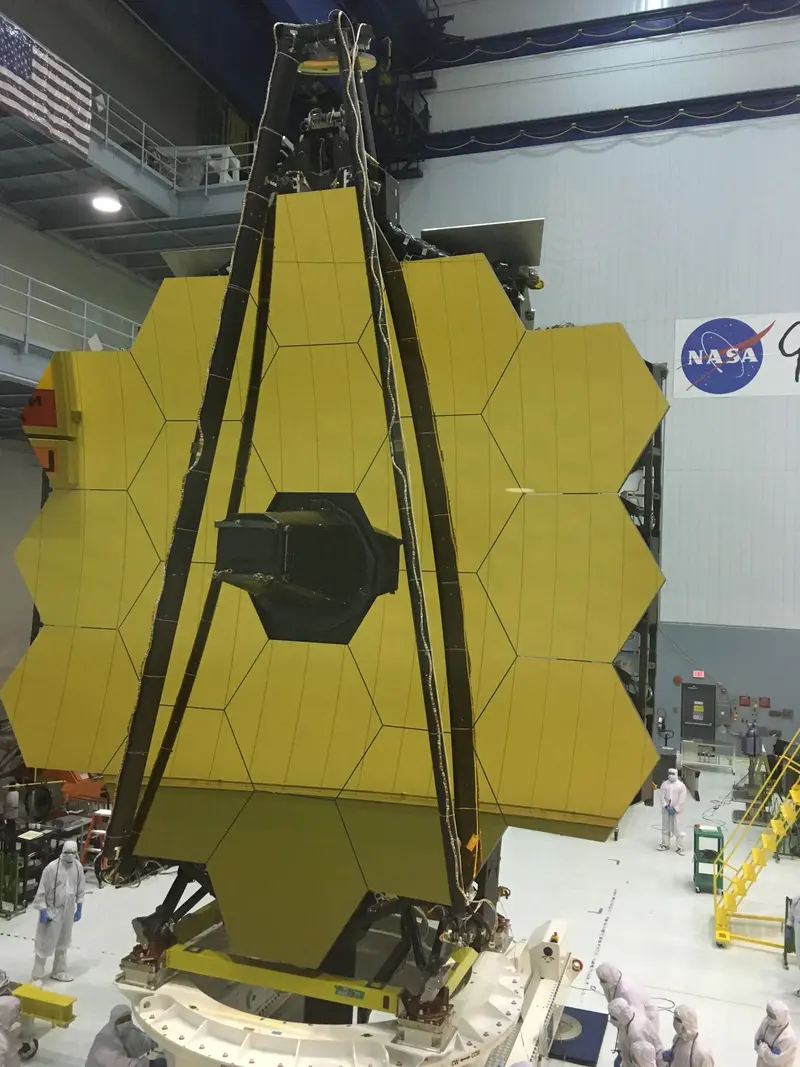
| Beryllium | 1.85 | ~290-300 | ~250-350 | ~160 | Mirrors (James Webb), stiff structures |
| Unidirectional CFRP (on axis) | ~1.58 | ~150-165 | ~2,500 (ultimate) | ~100 | Filament-wound vessels, interstages |
| Quasi-isotropic CFRP | ~1.58 | ~50-60 | ~600-800 (ultimate) | ~35 | Panels, fairings, adapters |
The lesson of the table: aluminum, titanium and steel have almost the same specific stiffness (~25 MJ/kg). What sets them apart is specific strength, service temperature, behavior in the cold, weldability and cost. For stiffness, only beryllium (expensive and toxic to machine) and fiber composites break away from the line.
Metals and cryogenics
Aluminum-lithium. Each 1 % by mass of lithium lowers density by ~3 % and raises modulus by ~6 %. The Shuttle's "super lightweight" external tank (1998), in Al-Li 2195, weighed about 3,400 kg less than its 2219 predecessor, which was key to carrying payload to the Station's 51.6° orbit. Drawbacks: anisotropy and delicate welding, largely solved today with friction stir welding, which does not melt the metal.
Titanium. Ti-6Al-4V gives good specific strength up to about 350-400 °C and resists corrosion: it is the usual material for satellite propellant tanks (often overwrapped with composite, COPV). It is not used in contact with liquid oxygen, because it can ignite on impact.
Austenitic stainless steels and superalloys. Face-centered cubic (fcc) structures, such as aluminum and austenitic steel, have no ductile-to-brittle transition: they are tough at 20 K and even gain strength. Starship bets on a stainless steel: heavier than aluminum, but cheap, weldable and able to withstand much higher temperatures, which lightens the heat shield on the hot side. Nickel superalloys (Inconel 718) retain strength up to 650-700 °C; in oxygen-rich staged-combustion engines, the hot oxidizing gas burns almost any metal and demands special alloys.
Copper. Regeneratively cooled chambers use high-conductivity copper alloys (NARloy-Z, GRCop-42, the latter producible by powder bed fusion) to remove tens of MW/m² at the throat (see how a rocket works).
Cryogenics. Liquid hydrogen is at 20 K and oxygen at 90 K: one has to manage contraction (aluminum shrinks ~0.4 % from 293 K to 20 K), hydrogen embrittlement of high-strength steels and titanium, and insulation with spray-on foams, whose shedding caused the Columbia accident (2003). Storing cryogens for weeks in orbit to refuel lunar landers requires multilayer insulation, cooled shields and cryocoolers.
Epic moment · April 10, 2026
Coming Home from the Moon: Artemis II Reentry
A camera attached to the pilot's window of the Orion capsule records the return of the four Artemis II astronauts after looping around the Moon. The spacecraft enters the atmosphere at almost 40,000 km/h (25,000 mph) and the air, compressed in front of the heat shield, becomes a glowing plasma at about 2,700 °C: that is why the window turns pink and orange and sparks of burning material fly off. Minutes later the red and white parachutes open, slowing the capsule until it settles gently in the Pacific Ocean.
Watch the full moment, with soundNASA · Public domainHeat shields
Two strategies: absorb the heat by consuming material (ablation) or reject it by re-radiating from a very hot surface over an insulator (reusable).
| Material | Density | Principle | Missions |
|---|---|---|---|
| Avcoat (epoxy novolac resin in a fiberglass honeycomb) | ~0.51 g/cm³ | Charring ablator | Apollo, Orion |
| PICA (phenolic-impregnated carbon ablator) | ~0.25-0.27 g/cm³ | Low-density ablator | Stardust (12.9 km/s), Curiosity, Perseverance; PICA-X on Dragon |
| SLA-561V (cork and silica in silicone) | ~0.26 g/cm³ | Lightweight ablator | Viking, Mars Pathfinder, MER |
| Carbon phenolic | ~1.45 g/cm³ | Dense ablator | Galileo probe to Jupiter (entry at ~47 km/s) |
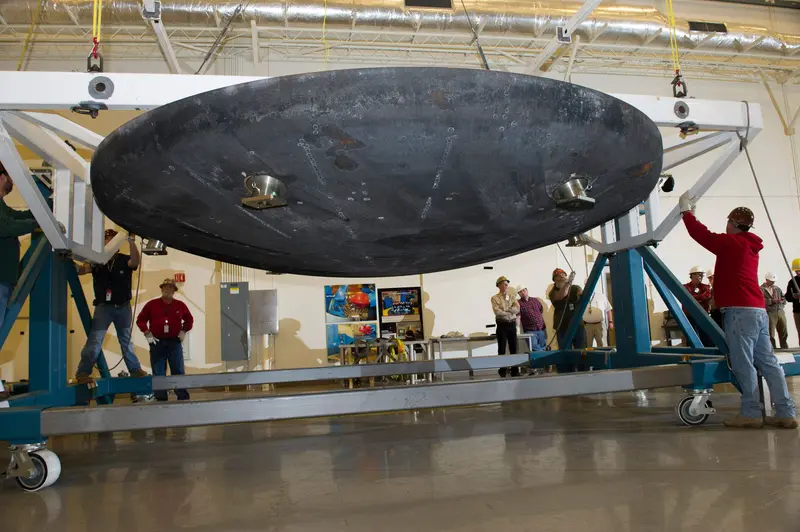
| LI-900 silica tiles | 0.144 g/cm³ | Re-radiating insulator, up to ~1,260 °C | Space Shuttle; Starship's hexagonal tiles |
| Reinforced carbon-carbon (RCC) | ~1.6 g/cm³ | Hot structure, up to ~1,650 °C | Shuttle wing leading edges and nose cap |
| Ultra-high-temperature ceramics (ZrB₂, HfB₂) | ~6-11 g/cm³ | Melting point > 3,000 °C | Sharp hypersonic leading edges (research) |
In a charring ablator the resin pyrolyzes in depth; the pyrolysis gas escapes through the pores, carries heat away and thickens the boundary layer; the char layer re-radiates at very high temperature and is gradually consumed. On Artemis I, Orion's Avcoat lost chunks of char because gases were trapped in a material of low permeability: permeability is a design property. LI-900 tiles are 94 % air; their weak points are brittleness against impacts and attachment to the structure. The physics of reentry is in getting to orbit.
Game
The heat shield
Thermal control: coatings and multilayer insulation
The temperature of a sunlit surface is set by its α/ε ratio (see what is space): a second-surface mirror (α ≈ 0.07-0.1, ε ≈ 0.8) serves as a radiator; a white paint (α ≈ 0.15-0.25, ε ≈ 0.9) stays cold but yellows under UV; polished gold (α ≈ 0.25-0.3, ε ≈ 0.02-0.04) gets very hot. Multilayer insulation (MLI) stacks 10 to 30 aluminized polyimide or polyester films separated by netting; in vacuum its effective emittance drops to 0.005-0.03, but it gets much worse with seams and compression, and it is useless in an atmosphere (aerogel is used on Mars).
Vacuum, atomic oxygen, radiation and impacts
- Outgassing. Resins, adhesives and silicones release water and volatiles that fog optics. The ASTM E595 criterion (24 h at 125 °C in vacuum) requires total mass loss < 1.0 % and collected volatile condensable materials < 0.10 %.
- Cold welding and lubrication. Without the oxide film, two clean metals in contact can adhere; ESA quantified this for impact and fretting in vacuum (Merstallinger et al., 2009). The failure of Galileo's high-gain antenna (1991) was attributed to loss of dry lubricant and galling. MoS₂, PTFE and very-low-vapor-pressure oils (perfluoropolyethers) are used.
- Atomic oxygen. It strikes at about 5 eV; Kapton H erodes by about 3.0·10⁻²⁴ cm³ per atom (the reference from the MISSE experiments), and silver oxidizes. Protection comes from SiO₂ or Al₂O₃ coatings tens of nanometers thick, or silicon-containing polyimides.
- UV and thermal cycling. About 16 eclipses a day, on the order of 90,000 cycles in 15 years: they fatigue solder joints and adhesives. On Hubble, the aluminized FEP Teflon blankets cracked.
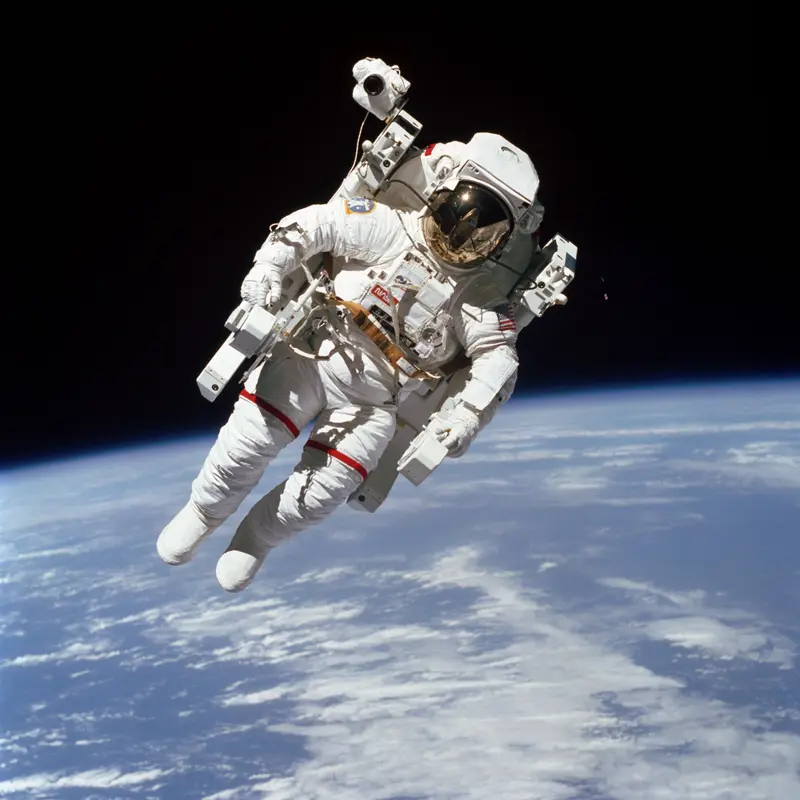
- Radiation. Commercial components often tolerate a few tens of krad(Si); radiation-hardened ones, from 100 krad to 1 Mrad. Glasses darken (solar cell cover glasses are cerium-doped); PTFE embrittles; solar cells lose power through displacement damage. Shielding for people is covered in surviving in space.
- Impacts. Against particles at 7-15 km/s the Whipple shield puts a thin bumper sheet in front that shatters the projectile; the Station adds layers of ceramic fabric (Nextel) and aramid (Kevlar) and protects against particles up to ~1 cm in critical areas.
Metastable materials: energy stored in disorder
A solid does not have to be in its minimum-energy state. A metastable state is a local minimum of free energy: stable against small perturbations, but not the global minimum. An amorphous solid has more enthalpy than the crystal of the same composition; it persists because rearranging into the crystal requires the atoms first to pass through higher-energy configurations. That energy "stored in disorder" is real and measurable: it is released as heat when the material crystallizes. The first version of gamoras.com was devoted to this idea, with a mission simulator in which energy comes from crystallizing six real materials.
Two independent numbers: barrier and enthalpy
ΔG = ΔH − T·ΔS < 0      (crystallization is favorable)
rate ∝ exp(−E_a / k_B·T)      (but the rate is set by the barrier)
A material is described by two independent quantities: the activation barrier E_a (the height of the hill) and the transformation enthalpy ΔH (the depth of the other valley). A high barrier does not imply a large release. And heating does not lower the hill: in Arrhenius kinetics E_a is a property of the material; what changes with temperature is the energy scale the atoms can explore in a given time τ, k_B·T·ln(ν₀·τ).
Arrhenius: exponential sensitivity
K(T) = ν₀ · exp(−E_a / k_B·T),     ν₀ ≈ 10¹³ s⁻¹
d ln K / dT = E_a / (k_B·T²)   ⇒   K doubles every ≈ k_B·T²·ln 2 / E_a ≈ 10-15 K
ν₀: attempt frequency, on the order of an optical phonon frequency.k_B = 8.617·10⁻⁵ eV/K: Boltzmann constant.
A few tens of kelvin separate "inert for years" from "consumed in a second". And since the same law governs every temperature, a low-barrier material is necessarily more vulnerable when heated: activation and persistence are linked.
Structures: covalent networks and metallic glasses
Covalent continuous random networks (CRN): amorphous silicon, germanium and Si-Ge. Amorphous silicon (a-Si) keeps the local chemistry of the crystal —almost all atoms remain fourfold coordinated— but bond angles and lengths spread out and the tetrahedra no longer fill space periodically. The excess enthalpy relative to diamond-cubic Si lies in that strained network and in its coordination defects (dangling bonds). The heat of crystallization of pure a-Si, measured by calorimetry, is on the order of 11-14 kJ/mol depending on its state of relaxation (about 0.12-0.14 eV per atom, ~0.4-0.5 MJ/kg).
Germanium forms the same kind of network, but with weaker bonds and heavier atoms: under comparable conditions a-Ge crystallizes at clearly lower temperatures than a-Si, even though the two films look identical under the microscope. Si and Ge are fully miscible, so an amorphous Si₁₋ₓGeₓ alloy allows the chemistry of the network to be tuned continuously: as the Ge fraction rises, crystallization usually shifts to lower temperatures and speeds up. Composition is a knob on the barrier, while the stored enthalpy changes relatively little: the height of the hill and the depth of the valley are different things.
Metallic glasses. These are metallic alloys with a glassy atomic arrangement, without directional bonds, obtained by cooling the liquid fast enough that it does not crystallize:
- Zirconium-based: multicomponent alloys (Zr with Ti, Cu, Ni, Al, Be…) that can be cast glassy in centimeter-scale sections; Vitreloy 1 (Zr₄₁.₂Ti₁₃.₈Cu₁₂.₅Ni₁₀Be₂₂.₅; Peker and Johnson, 1993) needs cooling rates on the order of only 1 K/s. Mixing many elements with different atomic sizes and negative heats of mixing frustrates crystallization —the confusion principle— and raises the barrier to forming competing crystalline phases. Inoue's empirical rules sum it up: three or more elements, atomic size differences above ~12 % and negative heats of mixing.
- Iron-based: Fe with metalloids (B, Si, P, C), usually made by melt spinning a thin ribbon, with cooling rates on the order of a million kelvin per second. They are industrial soft magnetic materials: without grains there is no magnetocrystalline anisotropy to pin domain walls, and transformer cores made from them lose less energy. Their stored energy and stability depend strongly on processing history (quench rate, thickness, anneals), which changes the frozen-in free volume: two ribbons of the same nominal composition can behave differently.
- Aluminum-rich (Al with transition metals and rare earths): marginal glass formers, which need very fast quenching and often show no glass transition before crystallizing. Their first transformation is usually primary crystallization: fcc Al nanocrystals nucleate in the amorphous matrix while the remaining glass becomes enriched in solute. Stopping there gives nanocomposites of remarkable strength (He, Poon and Shiflet, 1988).
In space, metallic glasses already have real uses: the Genesis probe (2001-2004) carried metallic glass solar wind collectors, and JPL has developed metallic glass gears designed to work in extreme cold without liquid lubricant.
Structural relaxation
When an amorphous material is annealed, part of its excess enthalpy relaxes before any crystal appears: the network rearranges toward lower strain and defects annihilate (Roorda et al., 1991, measured this by calorimetry in ion-implanted a-Si). In metallic glasses, relaxation removes free volume. Practical consequence: the available energy depends on thermal history. An "aged" material stores less.
Crystallization: nucleation, epitaxy and explosive fronts
Crystallization of an amorphous solid proceeds in two ways:
- Random nucleation in the bulk, followed by grain growth until the grains impinge.
- Solid phase epitaxy (SPE): on a crystalline template, a planar amorphous/crystal interface sweeps through the film. In silicon this is a textbook process, with an activation energy of about 2.7 eV (Olson and Roth, 1988) and rates on the order of nanometers per second at around 550-600 °C.
Because the moving interface releases latent heat, a thick enough, poorly cooled film can sustain a self-propagating front: explosive crystallization. Amorphous germanium films are the reference system: a local trigger (a laser pulse, a scratch) launches a front that sweeps across the film on its own (Takamori, Messier and Roy, 1972). The phenomenon has been known since the 19th century: "explosive antimony", an electrodeposited amorphous form that crystallized violently when struck, was described in the 1850s. Lesson: a lower barrier is not "more energy"; it changes when and how easily the energy comes out, even when nobody asks it to.
JMAK kinetics (Johnson-Mehl-Avrami-Kolmogorov)
For random nucleation and growth, the transformed fraction follows:
X(t) = 1 − exp[−(K·t)ⁿ]
The Avrami exponent n encodes mechanism and dimensionality: n ≈ 1 for growth from pre-existing sites with little geometric constraint; larger n (up to ~4 in 3D with continuous nucleation) when nuclei keep forming during the transformation. A large n gives a sigmoid with an incubation period: the material barely changes under slow thermal exposure and then transforms all at once. With varying temperature, the isokinetic additivity rule applies:
θ(t) = ∫₀ᵗ ν₀ · exp(−E_a / k_B·T(t′)) dt′, X = 1 − exp(−θⁿ)
Tg, Tx and ΔTx: how they are measured
The reference technique is differential scanning calorimetry (DSC): the sample is heated at a constant rate β and the additional heat flow is measured. Each transformation shows up as an exothermic peak; its area is the enthalpy released and its position the peak temperature T_p. Varying β, Kissinger analysis gives an effective activation energy:
ln(β / T_p²) = −E_a / (k_B · T_p) + constant
Metallic glasses show a step in heat flow before the peak: the glass transition Tg. Between Tg and the crystallization temperature Tx the material is a supercooled liquid: its viscosity drops by orders of magnitude and it can be thermoplastically formed. The width ΔTx = Tx − Tg measures thermal stability: in the best bulk metallic glasses it reaches the order of 50-100 K or more (Inoue, 2000). a-Si and a-Ge, with rigid, directional covalent bonds, crystallize without a detectable Tg; marginal aluminum glasses often do not show one either. DSC isotherms fitted to JMAK give the Avrami exponent. All these values depend on composition, preparation route (sputtering, evaporation, melt spinning, ion implantation, casting) and thermal history: they must be quoted sample by sample.
The six materials in the simulator
| Material | Structure | Relative barrier | Incubation (n) | Key feature |
|---|---|---|---|---|
| a-Si | Covalent CRN | high | medium | Stable and reliable; SPE and explosive crystallization |
| a-Ge | Covalent CRN, weaker bonds | low | low | Activates easily; if heated, it crystallizes on its own |
| a-Si-Ge | Composition-tunable CRN | intermediate | short but real | Composition tunes the barrier |
| Zr glass | Multicomponent metallic glass | the highest | the largest | Wide supercooled liquid region |
| Fe glass | Metal-metalloid glass | high | medium | Large reserve; depends on processing |
| Al glass | Marginal metallic glass | the lowest | none (n ≈ 1) | Responds instantly; the first to be lost to heat |
The relative positions follow the literature qualitatively; the simulator's numerical parameters (E_a, n, Q) are illustrative, chosen to cover a range of behaviors, not measurements of any sample. The simulator defines each material by its onset temperature T_on, where K = 0.03 s⁻¹, and derives E_a = k_B·T_on·ln(ν₀/K_on).
Heat, thermal runaway and propulsion
An exothermic transformation heats the very material that is transforming. Heat generation grows exponentially with T; losses only polynomially. Semenov's thermal explosion theory compares the slopes of both curves at the operating point:
Se = (dG/dT) / (dL/dT) = [P_exo · E_a / (k_B·T²)] / [4εσA·T³ + ṁ·c_p + G]
with P_exo the exothermic power, 4εσAT³ the derivative of radiative losses, ṁ·c_p the heat carried away by the propellant and G the conductance to the rest of the spacecraft. If Se > 1, a small temperature rise generates more heat than can be removed and the temperature runs away. That is why the reserves are split into small isolated cartridges: segmenting bounds the adiabatic temperature rise ΔT_ad = q / C, just as energetic materials are stored in separate charges. And that is why a propellant flow is a stabilizer: it carries the heat away, which is precisely how that heat is turned into thrust.
Because that is the other law that is not negotiable: energy alone does not produce thrust; mass has to be expelled. The simulator's concept is a resistojet-type electrothermal thruster: water passes through a chamber heated by the material and by a battery, and exits through a nozzle:
vₑ = √(2η·c_p·(T − T_in) + v_cold²), F = ṁ·vₑ, I_sp = vₑ / g₀, F/P = 2η / vₑ
(v_cold is the cold-flow exhaust velocity.) A hotter chamber raises vₑ (each gram of propellant gives more delta-v), but lowers thrust per watt: hot and frugal, or cold and greedy, the dilemma of every electrothermal engine.
 ActivityMetastable propulsion simulatorThe first version of Gamoras: missions where the energy comes from crystallising metastable materials (amorphous silicon and germanium, Si-Ge, and zirconium, iron and aluminium metallic glasses).Open the simulator
The best material depends on the mission: on a perihelion pass, where the solar flux S(r) = 1361 W/m² · (1 AU/r)² can rise tenfold, a high-barrier, strong-incubation material holds up; a low-barrier one is lost. Making materials and propellant at the destination is the other side of the problem, and the Gamoras 3D Mission explores it, with a glass-ceramic nozzle and propellant extracted from an asteroid's water:
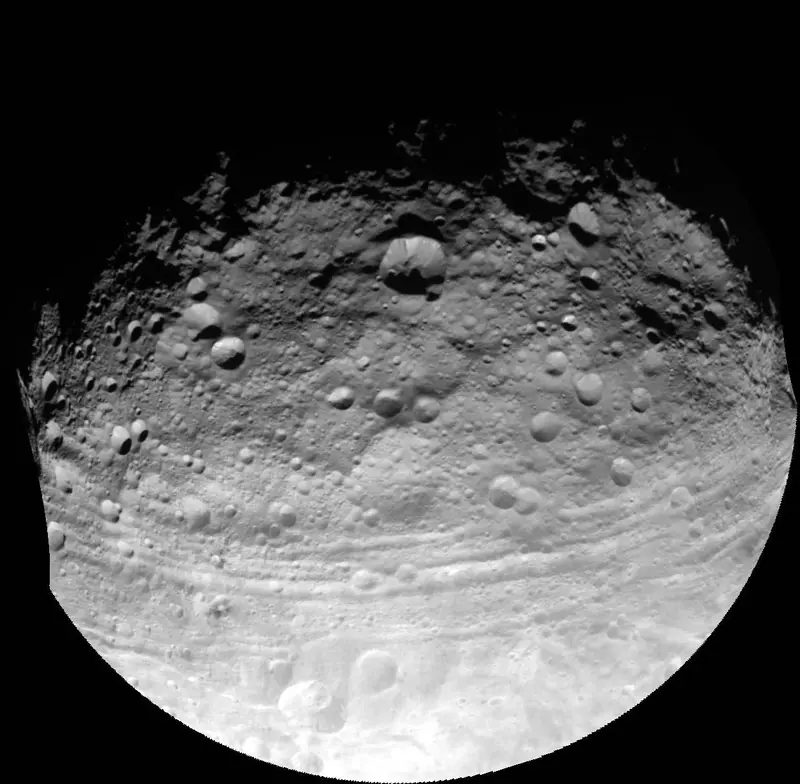 ActivityGamoras 3D MissionLand a damaged ship on a 220 km asteroid, search for water with a hopping robot, make propellant and a glass-ceramic nozzle, and fly back up to dock with your ship in orbit. With real physics.Play the mission
Key points
- Mass rules: material indices (σ/ρ, E/ρ, E^(1/3)/ρ) before absolute values; Al, Ti and steel have almost the same specific stiffness.
- Heat shields: ablators (Avcoat, PICA) for fast returns; tiles and RCC for reuse.
- Vacuum forces control of outgassing (ASTM E595), cold welding and lubrication; low orbit adds atomic oxygen, UV and 16 thermal cycles a day.
- In a metastable material, the barrier E_a decides when the energy comes out and ΔH how much: they are independent.
- Arrhenius doubles the rate every 10-15 K; JMAK with high n gives incubation; ΔTx = Tx − Tg measures the stability of a metallic glass.
Further reading
- M. F. Ashby, Materials Selection in Mechanical Design, Butterworth-Heinemann (5th ed., 2016).
- G. L. Olson, J. A. Roth, "Kinetics of solid phase crystallization in amorphous silicon", Materials Science Reports 3, 1 (1988); S. Roorda et al., "Structural relaxation and defect annihilation in pure amorphous silicon", Phys. Rev. B 44, 3702 (1991).
- T. Takamori, R. Messier, R. Roy, "New noncrystalline germanium which crystallizes "explosively" at room temperature", Appl. Phys. Lett. 20, 201 (1972).
- A. Peker, W. L. Johnson, "A highly processable metallic glass: Zr41.2Ti13.8Cu12.5Ni10.0Be22.5", Appl. Phys. Lett. 63, 2342 (1993); A. Inoue, "Stabilization of metallic supercooled liquid and bulk amorphous alloys", Acta Materialia 48, 279 (2000); Y. He, S. J. Poon, G. J. Shiflet, Science 241, 1640 (1988); F. E. Luborsky (ed.), Amorphous Metallic Alloys, Butterworths (1983).
- M. Avrami, J. Chem. Phys. 7, 1103 (1939); H. E. Kissinger, Anal. Chem. 29, 1702 (1957); A. Merstallinger et al., Assessment of Cold Welding between Separable Contact Surfaces due to Impact and Fretting under Vacuum, ESA STM-279 (2009).
Test yourself
Why do aluminum, titanium and steel have almost the same specific stiffness E/ρ?
What does the ASTM E595 outgassing test require for a material to be used in vacuum?
In a metastable material, what does the activation barrier Ea determine?
What does a wide supercooled liquid region ΔTx = Tx − Tg indicate in a metallic glass?
In the JMAK equation, X = 1 − exp[−(Kt)ⁿ], what does a large Avrami exponent n produce?
Go deeper: engineering subjects
If you want to go beyond this lesson, these subjects develop it at university level.
Subject · 5 lessonsAtmospheric entryHow spacecraft come home: entry trajectories, the heat they generate, the shields that survive it and the descent down to land or water.Dynamics · Heating · Ablators · Reusable · Landing Subject · 5 lessonsSpacecraft systemsWhat keeps a spacecraft alive: power, thermal control, communications, the environment that attacks it and the systems engineering that ties it all together.Power · Thermal · Link · Environment · Systems