A chemical rocket is limited by the energy stored in its propellant: not even the best combination exceeds about 4.5 km/s of exhaust velocity. Electric propulsion decouples energy from propellant: the energy comes from solar arrays or a reactor, and the propellant only supplies the mass. This yields exhaust velocities of 15 to 50 km/s and saves of the order of 90 % of the propellant, at the cost of tiny thrusts, from millinewtons to a little over one newton. This lesson shows why power rules, how gridded ion thrusters and Hall-effect thrusters work, how the optimum Isp is chosen, which propellants are used, and what Dawn, BepiColombo, Psyche and communications satellites have achieved. It expands on the propulsion part of the future in space.
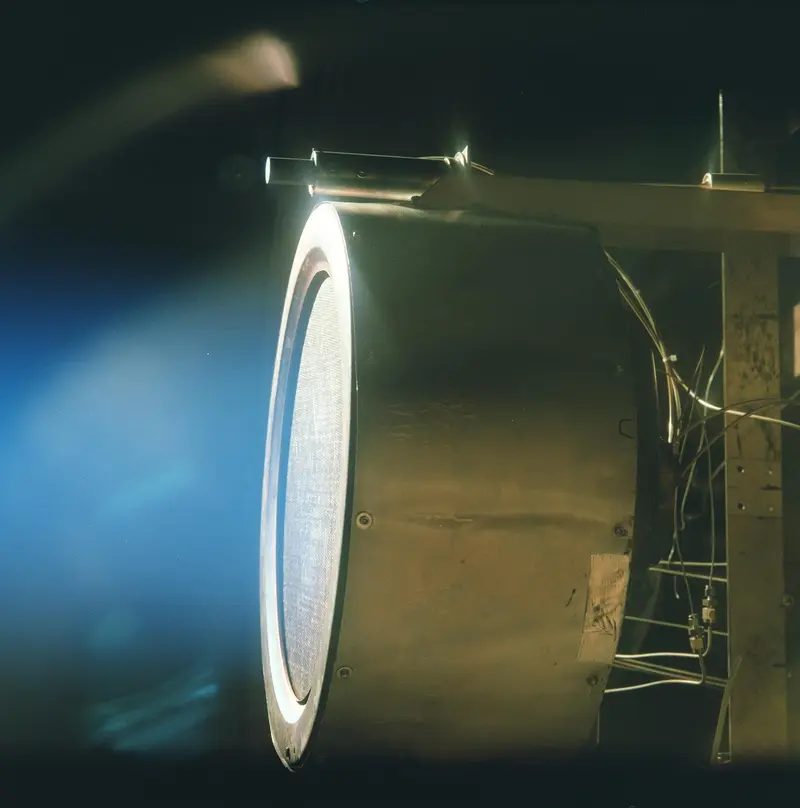
The fundamental constraint: power
The mechanical power of a thruster's jet is its kinetic energy per unit time:
P_jet = ½ · ṁ · vₑ² = ½ · F · vₑ
If the electrical source supplies P and the thruster converts it with an efficiency η = P_jet/P (0.5-0.7 for ion and Hall thrusters at good power levels):
F = 2 · η · P / vₑ
At fixed power, thrust and Isp move in opposite directions. That is why electric propulsion is classified not by its thrust but by its thrust per kilowatt: a Hall thruster at 1,800 s gives of the order of 55-60 mN/kW; an ion thruster at 3,100 s, of the order of 40 mN/kW. In chemical propulsion the problem does not exist because the propellant brings its own power: an RS-25 delivers of the order of 5 GW to its jet.
The resulting acceleration is minute: a 1,000 kg spacecraft with 0.1 N accelerates at 10⁻⁴ m/s², about 8.6 m/s per day. But it does so for months or years: one year of operation adds about 3.2 km/s. The delta-v from the Tsiolkovsky equation still holds (see how a rocket works), only the orbital mechanics of continuous thrust are different: the impulsive manoeuvres of a Hohmann transfer are replaced by spirals.
Families of electric propulsion
| Family | How it accelerates | Typical Isp | Examples |
|---|---|---|---|
| Electrothermal: resistojet | Heats the gas with a resistor and expands it through a nozzle | 150-350 s | Satellite orbit control, with hydrazine or water |
| Electrothermal: arcjet | Heats the gas with an electric arc | 500-600 s (hydrazine) | Station-keeping of geostationary satellites |
| Electrostatic: gridded | Ionizes the gas and accelerates the ions between high-voltage grids | 2,500-4,500 s | NSTAR (Deep Space 1, Dawn), T6 (BepiColombo), NEXT-C (DART) |
| Electrostatic: Hall | Accelerates ions in a quasi-neutral plasma with an axial electric field and a radial magnetic field | 1,200-2,800 s | SPT-100, SPT-140 (Psyche), PPS-1350 (SMART-1), Starlink's thrusters |
| Electrostatic: electrospray and FEEP | Extracts ions or charged droplets from a liquid | 1,000-8,000 s | µN-level fine control (LISA Pathfinder) |
| Electromagnetic | Lorentz force j × B on a plasma | 1,000-5,000 s | Pulsed plasma (PPT), magnetoplasmadynamic, on the test stand |
Gridded ion thrusters
They work in three steps:
- Ionization: in a discharge chamber, electrons emitted by a hollow cathode collide with xenon atoms and ionize them; magnets lengthen the electrons' paths to increase collisions. Other thrusters ionize with radio frequency (Airbus's RIT) or microwaves (Hayabusa's µ10).
- Acceleration: two or three molybdenum or carbon grids perforated with thousands of aligned holes. The first is at high positive voltage and the second negative; ions reaching the plasma edge fall through the potential difference
V. - Neutralization: a second cathode injects electrons into the beam so that the spacecraft does not charge negatively and the ions do not come back.
Exit velocity follows from energy conservation for an ion of charge q and mass m:
½ · m · v² = q · V → v = √(2·q·V / m)
The space-charge limit
Between the grids there are only positive ions, and their own charge slows those coming behind. The maximum current density across a planar gap of width d is given by the Child-Langmuir law:
j_max = (4·ε₀/9) · √(2q/m) · V^(3/2) / d²
and from it the maximum thrust density: F/A = (8/9)·ε₀·(V/d)². For 1,100 V and a 1 mm gap this gives about 9.5 N/m² in the gap; with the real transparency of the grids and the plasma density available, real thrusters reach only a fraction of that. That is why an ion thruster has low thrust per unit area and needs diameters of 30-40 cm to deliver a few tens of mN. Bringing the grids closer increases thrust, but is limited by thermal deformation and by arcing between them.
Hall-effect thrusters
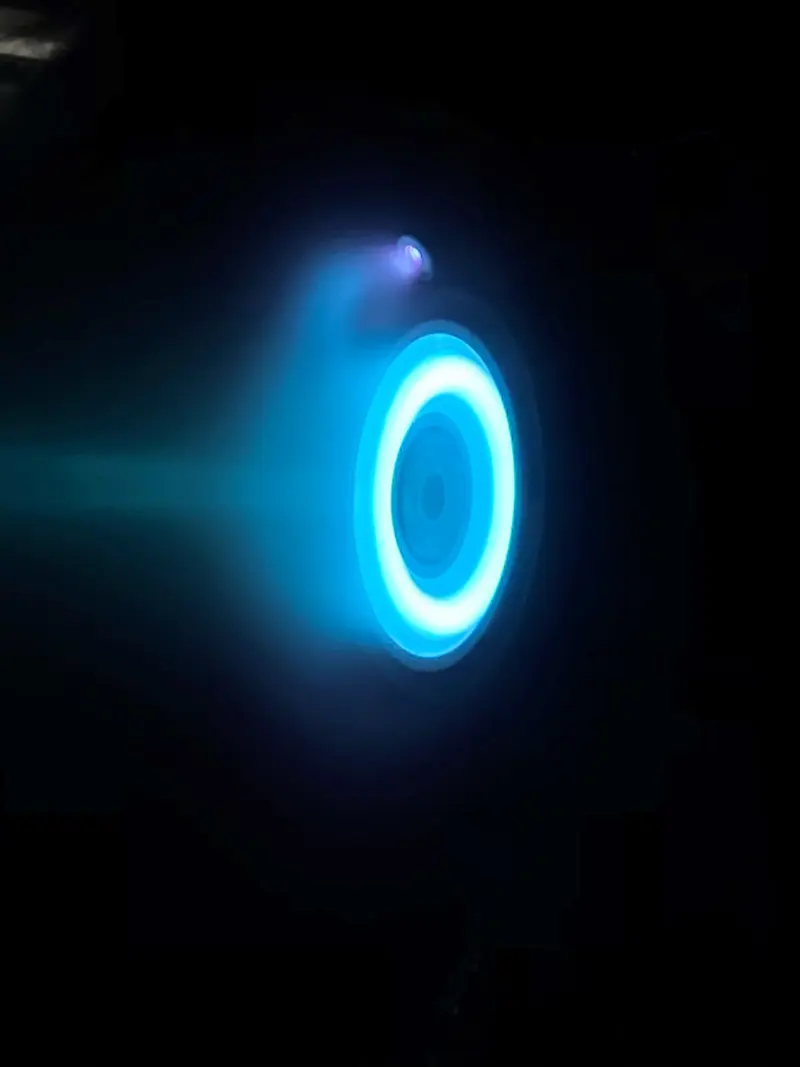
A Hall thruster is an annular ceramic channel (typically boron nitride) with an anode at the bottom and a cathode outside. Coils create a radial magnetic field at the channel exit of a few hundred gauss. That field is too weak to deflect the heavy ions, but it traps the electrons coming from the cathode: they gyrate in the field and drift azimuthally through the E × B effect, forming a Hall current that gives the thruster its name. The cloud of trapped electrons ionizes the xenon entering through the anode and creates a strong axial electric field that accelerates the ions outwards.
The key is that the acceleration zone contains both ions and electrons: the plasma is quasi-neutral and there is no space-charge limit. At equal power, a Hall thruster is more compact, simpler (it has no grids) and cheaper than an ion thruster. In return:
- Typical voltage is 300-600 V, and not all ions fall through the full potential: with xenon at 300 V the ideal Isp would be about 2,140 s, and the real one is of the order of 1,500-1,900 s.
- The plume is more divergent (half-angle of the order of 40-45°).
- Ions erode the channel walls, which used to limit life to a few thousand hours. Magnetic shielding, developed at JPL, curves the field lines to keep the plasma away from the walls and multiplies lifetime; it is used by NASA's 12 kW AEPS thruster, planned for the Power and Propulsion Element of the lunar Gateway station.
| Thruster | Type | Power | Thrust | Isp | Mission |
|---|---|---|---|---|---|
| NSTAR | Gridded | 2.3 kW | 92 mN | ~3,100 s | Deep Space 1, Dawn |
| T6 | Gridded (Kaufman) | ~4.5 kW | ~145 mN | ~4,000 s | BepiColombo (up to two at once) |
| NEXT-C | Gridded | ~6.9 kW | ~235 mN | ~4,190 s | DART |
| PPS-1350 | Hall | ~1.2 kW | ~70 mN | ~1,600 s | SMART-1 (ESA, to the Moon) |
| SPT-140 | Hall | ~4.5 kW | of the order of 0.25 N | ~1,800 s | Psyche |
| Starlink argon Hall thruster | Hall | ~4.2 kW | ~170 mN | ~2,500 s | Starlink V2 mini |
Dawn and Psyche: what it makes possible
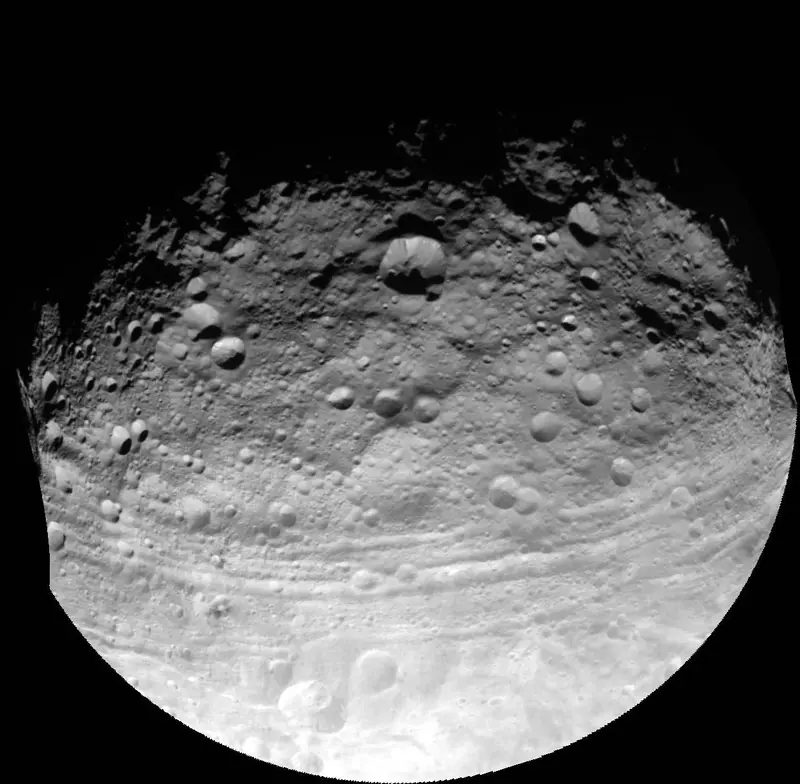
Dawn (NASA, 2007-2018) carried about 425 kg of xenon for a launch mass of about 1,218 kg. At 3,100 s, the rocket equation gives an upper bound of 30.4 × ln(1,218/793) ≈ 13 km/s; the probe accumulated of the order of 11.5 km/s with its ion thrusters, in almost six years of operation spread over eleven, because much of the time it ran at lower power and lower Isp as it moved away from the Sun. That allowed it to enter orbit around Vesta, leave it and enter orbit around Ceres: the first spacecraft to orbit two different bodies beyond the Earth and the Moon. With chemical propulsion and the same delta-v, the mass ratio would be e^(11.5/3.1) ≈ 41: impossible.
Psyche (NASA, launched in 2023) is the first mission to use Hall thrusters beyond lunar orbit: four SPT-140s (one firing at a time), powered by solar arrays that deliver about 20 kW near Earth, with a Mars flyby in 2026 to gain speed and arrival at the asteroid Psyche in 2029. Choosing a Hall thruster instead of an ion thruster was, above all, a decision about cost and thrust: it is a commercial communications-satellite thruster, and it gives more thrust per kilowatt.
Optimum specific impulse
More Isp is not always better. If the mass of the power system scales with power, m_power = α·P, with α the specific mass (kg/W), and the thruster runs for a time t:
m_power = α · F · vₑ / (2η) m_propellant = F · t / vₑ
The first grows with vₑ and the second decreases. Differentiating the sum and setting it to zero:
vₑ,opt = √(2 · η · t / α)
The same formula explains why high-power electric propulsion needs nuclear energy: with solar arrays, α does not fall much below 10-20 kg/kW; a reactor with its conversion system and radiators could drop to a few kg/kW, and then the optimum for crewed trips to Mars would be thousands of seconds with hundreds of kW or megawatts. The power-system mass accounting is in spacecraft power.
Continuous thrust: spirals and orbit raising to geostationary
With low tangential thrust, a spacecraft in circular orbit climbs in a spiral through nearly circular orbits. The delta-v of a spiral between coplanar circular orbits is simply the difference in orbital velocities, Δv = v₀ − v₁; if the plane must also change, the Edelbaum approximation gives:
Δv = √( v₀² + v₁² − 2·v₀·v₁·cos(π/2 · Δi) ) (Δi in radians)
The same applies to station-keeping in a low-orbit constellation: Starlink's Hall thrusters compensate for drag, change orbit and deorbit the satellite at end of life, a sustainability requirement covered in the space environment.
Propellants
| Propellant | Atomic mass | First ionization energy | Advantages | Drawbacks |
|---|---|---|---|---|
| Xenon | 131.3 u | 12.1 eV | Heavy (more thrust per kW), easy to ionize, inert, stored densely as a supercritical fluid | Expensive and scarce |
| Krypton | 83.8 u | 14.0 eV | Much cheaper | Somewhat lower performance; less dense storage |
| Argon | 39.9 u | 15.8 eV | Cheap and abundant | Harder to ionize; lower performance |
| Iodine | 126.9 u | 10.5 eV | Stored as a solid, with no high-pressure tanks | Corrosive; must be sublimated |
A heavy atom gives more thrust per kilowatt at the same voltage, because F/P ∝ √m, and one that is easy to ionize spends less energy before being accelerated. That is why xenon was the standard; krypton and argon are gaining ground in constellations, where cost rules; iodine flew for the first time in a ThrustMe ion thruster aboard a small satellite in 2020.
Design trade-offs
- Power or Isp: with limited power, every extra second of Isp costs thrust and trip time.
- Thruster life: tens of thousands of hours of operation. Erosion of the grids (ion) or the walls (Hall) is what is qualified through tests lasting thousands of hours in vacuum chambers.
- Power processing unit (PPU): converts bus voltage to hundreds or thousands of volts; it adds mass and dissipates heat, which must be rejected through thermal control.
- Spacecraft interactions: the plume can erode solar arrays or contaminate instruments, and the plasma interferes with communications; thruster pointing is managed carefully and the thruster is often mounted on a gimbal.
- Ground testing: vacuum chambers cannot reach the vacuum of space with the thruster running, and residual gas alters the measurements; it is a source of uncertainty in qualification.
Key points
F = 2ηP/vₑ: at fixed power, more Isp means less thrust. Electric propulsion is power-limited.- Ion thruster:
v = √(2qV/m), about 40 km/s for xenon at 1,100 V; thrust limited by Child-Langmuir space charge. - Hall thruster: quasi-neutral plasma, more thrust per area and per kilowatt, less Isp; magnetic shielding solved its lifetime problem.
- Optimum Isp
vₑ = √(2ηt/α): long missions and lightweight power call for more Isp. - Dawn accumulated of the order of 11.5 km/s with 425 kg of xenon; a LEO-GEO spiral with plane change costs about 5.9 km/s.
Further reading
- D. M. Goebel, I. Katz, Fundamentals of Electric Propulsion: Ion and Hall Thrusters, JPL Space Science and Technology Series, Wiley (2008); available as a free download from the JPL website.
- R. G. Jahn, Physics of Electric Propulsion, McGraw-Hill (1968; reissued by Dover, 2006).
- T. N. Edelbaum, "Propulsion Requirements for Controllable Satellites", ARS Journal 31 (8), 1079-1089 (1961).
- M. D. Rayman et al., "Dawn: A mission in development for exploration of main belt asteroids Vesta and Ceres", Acta Astronautica 58, 605-616 (2006).
- G. P. Sutton, O. Biblarz, Rocket Propulsion Elements, Wiley (9th ed., 2016), chapter 17 (electric propulsion).
Test yourself
With the same electric power and the same efficiency, what happens to thrust if exhaust velocity is doubled?
What velocity does a xenon ion reach when accelerated through a potential difference of 1,100 V?
Why does a Hall thruster achieve more thrust per unit area than a gridded ion thruster?
A thruster delivers 0.1 N at an Isp of 3,000 s. How much propellant does it use in a year of continuous operation?
Why do all-electric satellites not climb to geostationary orbit from low Earth orbit?