Choosing a rocket propellant seems easy: pick the one with the highest specific impulse. In practice it is one of the most consequential design decisions, because it drives tank size, engine cycle, insulation, launch-site infrastructure, toxicity, how long the vehicle can wait in orbit, and cost. This lesson covers the chemistry that sets Isp (flame temperature, molar mass, mixture ratio), why density matters as much as Isp, the properties of real propellants (cryogenic, storable, monopropellant and green), and how they are chosen for each stage. It expands on the table in how a rocket works.
What makes a good propellant: √(T/M)
From the de Laval nozzle, the ideal exit velocity is:
vₑ = √{ [2γ/(γ−1)] · (R·T_c/M) · [1 − (pₑ/p_c)^((γ−1)/γ)] }
For a given nozzle, the propellant enters only through T_c/M (and somewhat through γ). You want a lot of energy released per kilogram (high flame temperature) and light exhaust gases (low molar mass). Temperature is limited by two things: the heat of reaction of the propellants and dissociation: above about 3,000 K, part of the H₂O and CO₂ breaks down into H, O, OH and CO, which absorb energy; the flame temperature of high-energy propellants stays at 3,300-3,700 K whatever the chemistry.
Mixture ratio
The mixture ratio O/F is the mass of oxidizer per unit mass of fuel. The stoichiometric ratio is the one that burns all the fuel with all the oxidizer:
| Fuel | Reaction | Stoichiometric O/F | Typical engine O/F |
|---|---|---|---|
| Hydrogen | 2 H₂ + O₂ → 2 H₂O | 7.94 | 5-6 (RS-25 ≈ 6) |
| Methane | CH₄ + 2 O₂ → CO₂ + 2 H₂O | 3.99 | 3.5-3.7 |
| Kerosene (≈ CH₁.₉₅) | CH₁.₉₅ + 1.49 O₂ → CO₂ + 0.98 H₂O | ≈ 3.4 | 2.3-2.7 |
All engines run fuel-rich: slightly lower temperature, but considerably lower molar mass, because the surplus fuel leaves as unburned H₂, CO or CH₄, much lighter than H₂O or CO₂. In addition, fuel-rich exhaust is less oxidizing towards the chamber walls.
Density: as important as Isp
The bulk density of a propellant pair, with mixture ratio r = O/F, is:
ρ_bulk = (1 + r) / ( r/ρ_ox + 1/ρ_f )
and the density impulse ρ_bulk · I_sp measures the impulse that fits into each litre of tank. What matters in each case:
- Volume- or structure-limited stage (first stages, strap-on boosters): tanks, their pressurization, insulation and aerodynamic loads scale with volume. Density wins.
- Mass-limited stage (upper stages, probes): each kilogram of final mass costs many kilograms below. Isp wins.
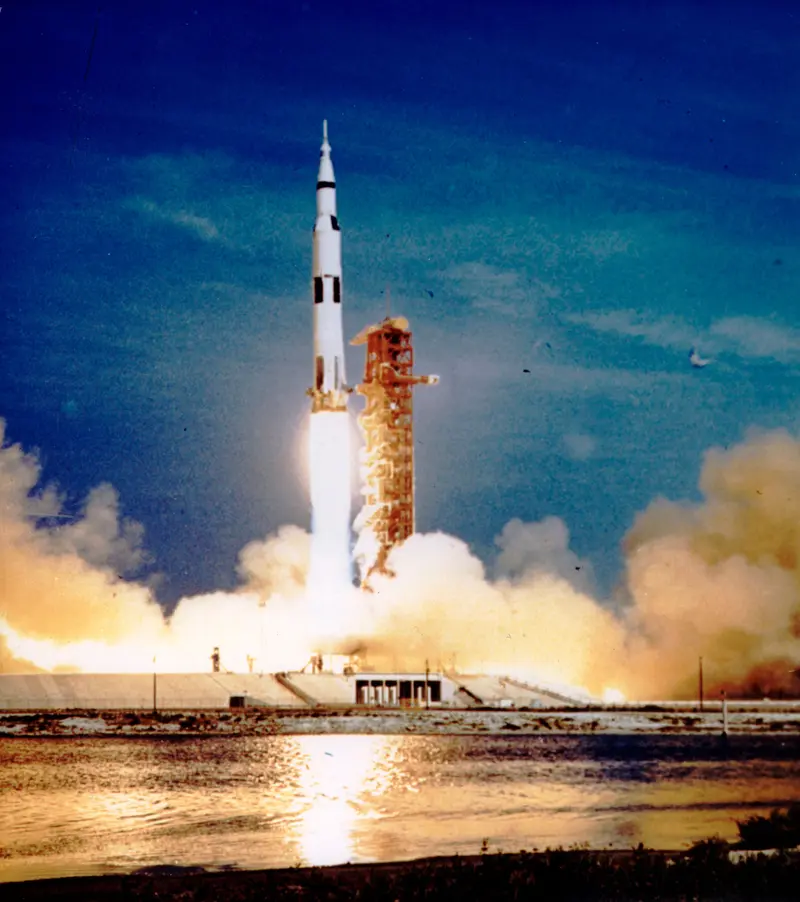
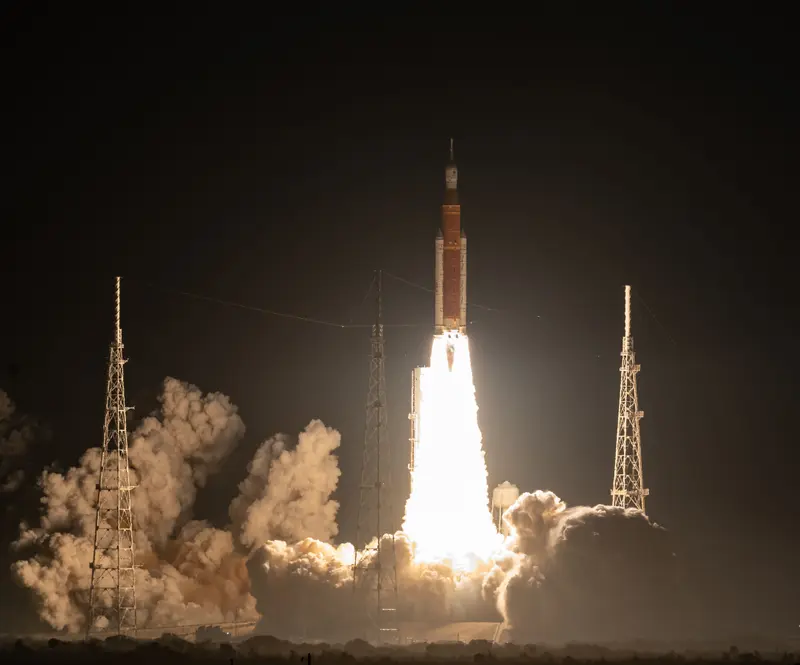
This is the reason for the combinations we see: Saturn V with kerosene below and hydrogen above; SLS with hydrogen and dense solid boosters; Falcon 9 with kerosene in both stages (cheaper and simpler, less Isp at the top); Starship, New Glenn and Vulcan with methane in the first stage.
Game
Design your rocket
Cryogenics
| Property | LOX | LH₂ | LCH₄ | RP-1 (reference) |
|---|---|---|---|---|
| Boiling point (1 atm) | 90.2 K | 20.3 K | 111.7 K | ~450-550 K (distillation) |
| Liquid density | 1,141 kg/m³ | 70.8 kg/m³ | ~422 kg/m³ | ~810 kg/m³ |
| Latent heat of vaporization | ~213 kJ/kg | ~446 kJ/kg | ~510 kJ/kg | — |
Hydrogen. It is the best in Isp (engines of 450-465 s in vacuum) and the worst at everything else: at 20 K almost any insulation falls short, air liquefies on poorly insulated cold surfaces, it embrittles some metals, it escapes through the tiniest leaks, and it burns over an enormous range of concentrations in air (from 4 % to 75 %). On top of that, its density is so low that its tank dominates the vehicle.
Methane. It boils at 112 K, close to oxygen (90 K): the two tanks can share a common bulkhead with little heat transfer and similar insulation. Bulk density of about 830 kg/m³ with oxygen, hardly any soot (it does not coke cooling channels or turbines, key to engine reuse, see reusability), and it can be made on Mars with the Sabatier reaction from atmospheric CO₂ and water (see the future in space).
Oxygen. The universal oxidizer of launch vehicles: cheap, dense and non-toxic. It demands extreme cleanliness of everything it touches (grease and particles can ignite in pure oxygen) and compatible materials.
Boil-off and densification
Heat leaking through the walls boils off the cryogen. An LH₂ tank receiving 100 W loses 100 / 446,000 ≈ 2.2·10⁻⁴ kg/s, about 19 kg per day. On a launch vehicle that flies for minutes it does not matter (it is topped up until the last moment); in a stage that must wait weeks in orbit, such as a propellant depot or a lunar exploration stage, it is a first-order problem: it is fought with multilayer insulation, sunshields and active cryocoolers. The techniques are those of thermal control.
Densification goes the other way: cooling the propellant below its boiling point makes it denser. Falcon 9 loads oxygen at about 66 K (−207 °C) instead of 90 K, of the order of 8 % denser, and kerosene at about −7 °C. More propellant in the same tank, in exchange for a very tight countdown: the propellant warms while it waits.
Storables and hypergolics
For a spacecraft that must manoeuvre for years, cryogenics are no good. Storable propellants are liquid at room temperature:
| Propellant | Formula | Density (kg/m³) | Freezing point | Use |
|---|---|---|---|---|
| Nitrogen tetroxide (NTO) | N₂O₄ | ~1,440 | −11 °C | Oxidizer; boils at 21 °C, stored under pressure |
| Monomethylhydrazine (MMH) | CH₃NHNH₂ | ~875 | −52 °C | Fuel for spacecraft and upper stages |
| Unsymmetrical dimethylhydrazine (UDMH) | (CH₃)₂NNH₂ | ~790 | −57 °C | Russian and Chinese launch vehicles |
| Hydrazine | N₂H₄ | ~1,020 | +2 °C | Monopropellant, and fuel in bipropellant systems |
NTO with MMH or UDMH are hypergolic: they ignite on contact, with ignition delays of a few milliseconds. No ignition system: opening valves is enough, and that makes them extraordinarily reliable for thousands of restarts (the Apollo Lunar Module, the AJ10 of the Orion service module, apogee motors, Dragon's Dracos). The drawback is toxicity: hydrazine and its derivatives are suspected carcinogens and NTO is highly corrosive; loading a spacecraft requires sealed suits and very expensive protocols. Their vacuum Isp, 310-325 s, is below that of cryogenics.
Monopropellants and green propellants
A monopropellant releases energy by decomposing over a catalyst, with no need for a second liquid: one tank, one valve and one nozzle. Hydrazine decomposes over iridium on alumina (the Shell 405 catalyst and its successors) into ammonia, nitrogen and hydrogen, with an Isp of about 220-235 s. It has been the standard for satellite attitude and orbit control for sixty years, and powers the small thrusters that deliver the short pulses attitude control needs to desaturate the wheels.
In 2011 hydrazine was added to the list of substances of very high concern under the European REACH regulation, and replacements are being sought:
| Propellant | Basis | Density | Isp compared with hydrazine | Flight |
|---|---|---|---|---|
| LMP-103S | Ammonium dinitramide (ADN) | ~1.24 g/cm³ | Of the order of 6 % more; density impulse 30 % higher | PRISMA (Sweden, 2010) and dozens of satellites |
| AF-M315E (ASCENT) | Hydroxylammonium nitrate (HAN) | ~1.47 g/cm³ | Somewhat higher; density impulse of the order of 50 % higher | GPIM (NASA, 2019) |
| High-test hydrogen peroxide | 90-98 % H₂O₂ | ~1.4 g/cm³ | Lower (of the order of 150-180 s) | Used since the 1940s; returning in small satellites |
Their great advantage is operational: they are loaded without sealed suits. Their drawback is technical: they burn at much higher temperatures than hydrazine (they need catalysts and chambers of refractory materials) and the catalyst must be preheated more.
Solids and hybrids on the map
Composite solid propellants (ammonium perchlorate, aluminium, HTPB or PBAN) have the highest density of all, about 1.8 g/cm³, and an Isp of 265-290 s in vacuum: the highest density impulse available, at the cost of being unable to throttle or shut down. They are covered in depth in solid and hybrid rocket motors. In electric propulsion, the "propellant" is another world (xenon, krypton, argon, iodine), chosen for its atomic mass and ionization energy, as seen in electric propulsion.
Beyond the usual
- Fluorine: with hydrogen it gives higher theoretical temperatures and Isp than oxygen, of the order of 10-20 s more. It was stand-tested in the 1960s, but its extreme toxicity and reactivity (the combustion products include hydrogen fluoride) ruled it out.
- Gelled or metallized propellants: higher density and more safety against leaks; experimental.
- Hydrogen in a nuclear reactor: with no combustion, the exhaust is pure H₂ of molar mass 2, and Isp rises to 850-900 s at temperatures of about 2,500-3,000 K. The same
√(T/M), taken to the extreme. It has never flown.
How to choose: a checklist
| Criterion | Question | Winner |
|---|---|---|
| Isp | Is it a mass-limited upper stage or probe? | Hydrogen, then methane |
| Density | Is it a first stage or a strap-on booster? | Solids, kerosene, methane |
| Storage | Must it wait months or years? | Hypergolics, monopropellants, solids |
| Reusability | Will the engine fly again? | Methane (no soot), hydrogen |
| Restarts | Hundreds or thousands of firings? | Hypergolics, monopropellants |
| Safety and operations | How much does it cost to load and handle? | Oxygen, kerosene, methane, green propellants |
| Cost | Does price per kilogram matter? | Oxygen and kerosene or methane; propellant is less than 1 % of the cost of a typical launch |
| ISRU | Will it be made off Earth? | Methane and oxygen on Mars; oxygen and hydrogen on the Moon |
The answer for an entire launch vehicle comes from combining these questions with the stage architecture and with systems engineering: no propellant wins at everything, and almost every launch vehicle combines two or three.
Key points
- Isp depends on the propellant through
√(T_c/M): hot flame and light exhaust. Dissociation limits temperature to about 3,300-3,700 K. - All engines run fuel-rich: excess H₂ or CO lowers molar mass. LOX/LH₂ at O/F ≈ 6, methane ≈ 3.6, kerosene ≈ 2.3-2.7.
ρ_bulk = (1+r)/(r/ρ_ox + 1/ρ_f): LOX/LH₂ ≈ 360 kg/m³; LOX/CH₄ ≈ 830; LOX/RP-1 ≈ 1,020.- With fixed volume, density wins; with fixed mass, Isp wins. That is why first and upper stages usually carry different propellants.
- Hypergolics store for years and always ignite, but are toxic; green propellants (LMP-103S, ASCENT) are replacing hydrazine.
Further reading
- G. P. Sutton, O. Biblarz, Rocket Propulsion Elements, Wiley (9th ed., 2016), chapters 5 (thermochemistry) and 7 (liquid propellants).
- J. D. Clark, Ignition! An Informal History of Liquid Rocket Propellants, Rutgers University Press (1972; reissued 2017).
- S. Gordon, B. J. McBride, Computer Program for Calculation of Complex Chemical Equilibrium Compositions and Applications (CEA), NASA Reference Publication 1311 (1994-1996).
- D. K. Huzel, D. H. Huang, Modern Engineering for Design of Liquid-Propellant Rocket Engines, AIAA (1992).
- NASA, Green Propellant Infusion Mission (GPIM), mission documentation, NASA Goddard / Marshall (2019-2020).
Test yourself
What is the stoichiometric mixture ratio O/F, by mass, of oxygen with methane?
Why do hydrogen engines run with a large hydrogen excess (O/F ≈ 6 instead of 7.94)?
With O/F = 6, LOX at 1,141 kg/m³ and LH₂ at 70.8 kg/m³, what is the bulk density of the propellant?
A liquid hydrogen tank receives 100 W of heat through its walls. How much hydrogen boils off per day? (latent heat ≈ 446 kJ/kg)
Which green propellant flew on NASA's GPIM mission in 2019 as an alternative to hydrazine?