The next step in exploration is not to go farther once, but to stay: bases on the Moon that run for years, crewed trips to Mars, use of the resources already in space and propulsion that shortens the journeys. Almost everything needed is known in principle; what is missing is maturing specific technologies and bringing costs down. This page separates what has been demonstrated from what is in development and from what remains speculative, with the numbers that decide.
The logic: mass in orbit and in-situ resources
With the Tsiolkovsky equation (see how a rocket works), every kilogram needed on the lunar surface demands on the order of 4-6 kg in low Earth orbit with chemical propulsion, and every kilogram in LEO costs 9.3-9.8 km/s from the ground. Two levers change the equation: making the kilogram in LEO cheaper (reuse, getting to orbit) and not launching what can be made out there: in-situ resource utilization, ISRU.
The star resource is water: you can drink it, it shields against radiation and, by electrolysis, it yields oxygen to breathe and hydrogen and oxygen as propellant.
2 H₂O → 2 H₂ + O₂ ΔH ≈ 286 kJ/mol (≈ 15.9 MJ per kg of water, theoretical minimum)
In practice electrolyzers consume on the order of 50-55 kWh per kg of hydrogen. A kilogram of LOX/LH₂ propellant made on the Moon saves lifting that kilogram from the bottom of Earth's gravity well: the benefit depends on how much the plant weighs and costs, and how much it produces over its lifetime.
The Moon: bases at the south pole
| Resource | Where | Status |
|---|---|---|
| Water ice | Permanently shadowed craters, 25-40 K | Detected (LCROSS: on the order of 5.6 % by mass in Cabeus); distribution and concentration still to be mapped |
| Oxygen in the regolith | All lunar soil, in oxides (~40-45 % of regolith by mass) | Processes demonstrated in the lab: hydrogen reduction of ilmenite, molten regolith electrolysis |
| Metals (Fe, Ti, Al, Si) | Regolith and basalts | By-product of oxygen extraction |
| Near-continuous illumination | Some south polar ridges | Measured from orbit (LRO) |
| Helium-3 | Implanted by the solar wind, ppb | Speculative: no fusion reactors exist to use it |
A sustainable lunar base needs, in order of difficulty: power for the 14-day night (NASA is developing fission surface power reactors of tens to ~100 kW electric), habitats with shielding (on the order of one to several meters of regolith overhead against radiation and micrometeoroids), mobility (pressurized rovers), dust tolerance and, finally, ISRU. The engineering challenge of the south pole is the combination of extreme cold, grazing light and dust at a site with no infrastructure at all. This is detailed in traveling to the Moon.
Building with regolith (microwave or laser sintering, 3D printing with binders, geopolymer bricks) has been demonstrated at lab scale with simulants; it still has to be proven with the real material, in vacuum and in low gravity.
Epic moment · February 18, 2021
Perseverance Lands on Mars
For the first time we truly see how a landing on another planet happens, recorded by the rover's own cameras. The 70-foot (21.5-meter) parachute opens at supersonic speed, the heat shield drops away and, finally, a "sky crane" with rockets lowers Perseverance on cables until it touches down in Jezero Crater. It all lasts about seven minutes and happens on its own, with nobody at the controls: signals took more than eleven minutes to reach Earth.
Watch the full moment, with soundNASA/JPL-Caltech · Public domainMars
The journey
| Quantity | Value |
|---|---|
| Distance | ~55 to ~400 million km |
| Synodic period (windows) | |
| Hohmann-type transfer | ~259 days |
| Δv LEO → trans-Mars injection | ~3.6 km/s |
| Light-time delay | from ~3 to ~22 minutes one way |
| Surface pressure | ~0.6 kPa (95 % CO₂) |
| Gravity | 3.71 m/s² (0.38 g) |
| Surface dose | ~0.65 mSv/day |
Missions fall into two families: conjunction-class, with 6 months outbound, ~500 days on the surface waiting for the next window and ~6 months back (about 900 days in total), and opposition-class, with a short stay (30-60 days) but longer trips and higher delta-v, often with a Venus flyby. The dose for a full conjunction mission approaches 1 Sv, above NASA's career limit of 600 mSv (see surviving in space).
Entry, descent and landing
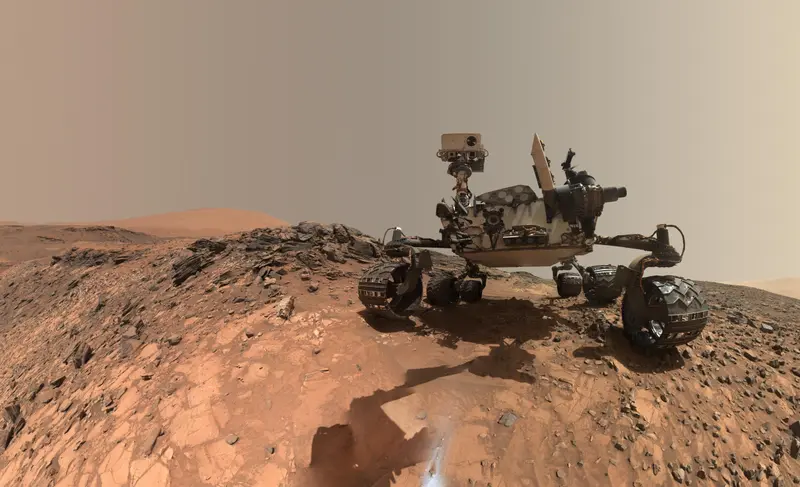
Mars has the worst possible atmosphere for landing: enough to heat the heat shield, not enough to slow to subsonic speed under parachutes before reaching the ground. The heaviest vehicle landed so far, Perseverance, weighs about 1,025 kg and needed a heat shield, a supersonic parachute and a powered sky crane. A crewed landing requires on the order of 20-40 t on the surface: it needs supersonic retropropulsion (firing engines into the flow, as Falcon 9 first stages do during reentry) or giant inflatable decelerators (NASA tested the 6 m LOFTID inflatable heat shield in 2022).
Resources on Mars
The MOXIE experiment aboard Perseverance produced, between 2021 and 2023, about 122 g of oxygen from atmospheric CO₂ by solid oxide electrolysis (2 CO₂ → 2 CO + O₂), up to about 12 g/h at better than 98 % purity. An ascent vehicle would need on the order of 25-30 t of oxygen: a scale-up factor of about 200 in hourly production, with power levels of tens of kW. With subsurface water, the Sabatier reaction (CO₂ + 4 H₂ → CH₄ + 2 H₂O) produces methane and oxygen: the technical reason the new generation of engines uses methane.
Asteroids: science, resources and defense
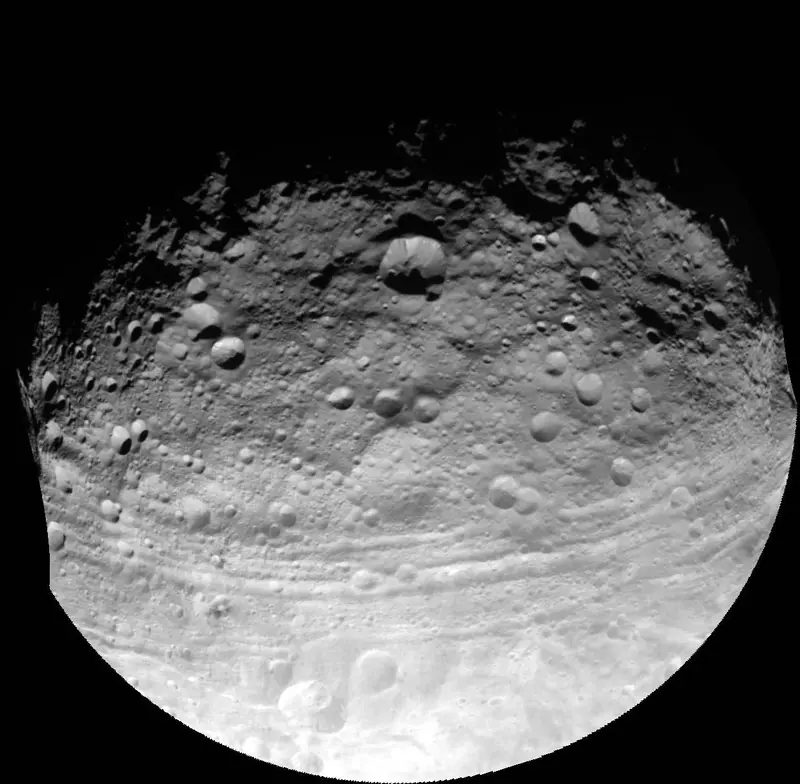
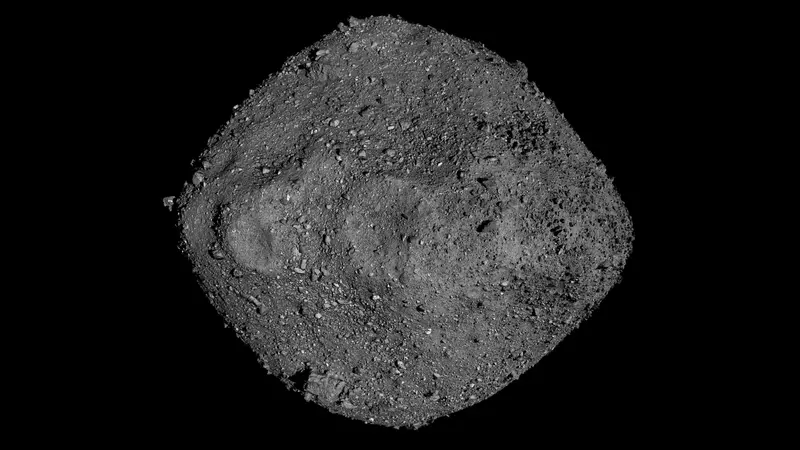
Near-Earth asteroids are, energetically, sometimes more accessible than the lunar surface: some require less than 5-6 km/s from LEO to reach and even less to return. Samples already returned: 5.4 g from Ryugu (Hayabusa2, JAXA, 2020) and 121.6 g from Bennu (OSIRIS-REx, NASA, 2023), with water bound in minerals and organic molecules, including amino acids. The Psyche probe (launched in 2023) is on its way to a metal-rich asteroid, which it will reach in 2029.
| Class | Typical composition | Interest |
|---|---|---|
| C (carbonaceous) | Hydrated clays (up to ~10 % water in minerals), carbon | Water and volatiles for propellant |
| S (siliceous) | Silicates, some metal | Construction materials |
| M (metallic) | Fe-Ni, platinum-group metals | Metals; economically doubtful to bring back to Earth |
The realistic medium-term business is not bringing platinum to Earth —that would crash its price— but selling water and propellant in orbit to whoever is already up there. The bottleneck is the usual one: autonomy of machinery in microgravity, power and handling loose material at gravities on the order of 10⁻⁴-10⁻² m/s².
To practice exactly that —prospecting for water with a hopping robot, electrolyzing it, making a nozzle and taking off from a 220 km asteroid with g = 0.092 m/s²— there is the Gamoras 3D Mission:
 ActivityGamoras 3D MissionLand a damaged ship on a 220 km asteroid, search for water with a hopping robot, make propellant and a glass-ceramic nozzle, and fly back up to dock with your ship in orbit. With real physics.Play the mission
New propulsion
Electric: already here
| Technology | Isp | Typical thrust | Status |
|---|---|---|---|
| Hall effect | 1,500-2,500 s | mN to ~1 N | Operational at scale (thousands of satellites, with xenon, krypton or argon) |
| Gridded ion | 3,000-4,200 s | tens to hundreds of mN | Operational (Dawn, BepiColombo, DART with NEXT-C) |
| Magnetoplasmadynamic, VASIMR | ~2,000-5,000 s | up to N | On the test stand |
Electric propulsion is power-limited: F = 2·η·P / vₑ. With 20 kW, η = 0.6 and vₑ = 20 km/s (about 2,000 s), thrust is 1.2 N. Pushing crewed spacecraft in reasonable times needs power levels of hundreds of kW to MW, and therefore a low specific mass for the power system (kg/kW). That is where nuclear power comes in.
Nuclear: thermal and electric
- Nuclear thermal propulsion (NTP): a reactor heats hydrogen to ~2,500-3,000 K and expels it through a nozzle. With a molar mass of 2, Isp reaches 850-900 s, demonstrated on the stand with NERVA and Rover in the 1960s. For Mars it shortens the trip and reduces the dose. None has flown; demonstration programs such as DRACO (DARPA and NASA) never reached flight. Challenges: fuel that withstands hot hydrogen, ground testing with contained exhaust, and storing hydrogen for months.
- Nuclear electric propulsion (NEP): a reactor powers electric thrusters. Very high Isp, low thrust; it requires huge radiators because conversion efficiency is on the order of 20-30 %, and the waste heat can only leave by radiation (see what is space).
Solar and laser sails
Solar radiation pressure at 1 AU is about 4.5 µN/m² on an absorbing surface and about 9 µN/m² on a perfect reflector. A 1,000 m² sail gives on the order of 9 mN, free and forever. Demonstrated: IKAROS (JAXA, 2010), LightSail 2 (2019), ACS3 (NASA, 2024). The idea of using ground-based lasers to push gram-scale sails toward other stars (Breakthrough Starshot) is still a concept study with open problems in power, materials and pointing.
Beyond
Fusion propulsion, antimatter or "reactionless drives": the first two are speculative on a timescale of decades; the third contradicts conservation of momentum.
Long voyages: the real problems
- Radiation: ~1 Sv on a Mars mission; passive shielding is useful only against solar storms. Shorter trips (NTP) are the most effective countermeasure.
- Closed-loop life support, reliable for years with no spares from Earth, with onboard additive manufacturing for parts.
- Gravity: artificial gravity by rotation requires
a = ω²·r; for 1 g at 2 rpm, a radius of about 224 m. For 0.38 g (Mars) at 2 rpm, about 85 m. - Autonomy: with a 22-minute delay there is no real-time mission control.
- Psychology: isolation, confinement, no view of Earth. Analogs (Mars-500, HI-SEAS, CHAPEA) help, but do not reproduce the real danger.
Orbital sustainability
None of this will be possible if low Earth orbit becomes unusable. The Kessler collision cascade, the five-year deorbit rule (FCC, 2022), ESA's "Zero Debris" goal for 2030, active debris removal (such as ESA's ClearSpace-1 or Astroscale's ADRAS-J, which approached a derelict rocket stage in 2024) and space traffic coordination are as much a part of the future as rockets.
Why it is worth it
- Science: the origin of the solar system, the search for life (Mars, Europa, Enceladus), fundamental physics.
- Economy and infrastructure: almost everything in what space is for started out as exploration.
- Planetary defense: DART (2022) showed that an asteroid can be deflected.
- Technology: closed-loop life support, compact power and autonomous manufacturing have immediate applications on Earth.
- And the oldest reason of all: to know what is out there.
Game
How much would you weigh on other worlds?
Key points
- The economic key is not launching what can be made out there: water → oxygen, hydrogen, shielding.
- Mars: windows every 26 months, ~900 days for a conjunction-class mission, ~1 Sv of dose, heavy landing still unsolved.
- MOXIE demonstrated oxygen from Martian CO₂; it still has to be scaled up about 200 times.
- Electric propulsion: F = 2ηP/vₑ, power rules. Nuclear thermal: ~850-900 s, has never flown.
- Without orbital sustainability there is no future in space.
Further reading
- R. Zubrin, The Case for Mars, Free Press (1996; revised ed. 2011).
- J. A. Hoffman et al., "Mars Oxygen ISRU Experiment (MOXIE)—Preparing for human Mars exploration", Science Advances 8, eabp8636 (2022).
- B. G. Drake (ed.), Human Exploration of Mars Design Reference Architecture 5.0, NASA/SP-2009-566 (2009).
- D. M. Goebel, I. Katz, Fundamentals of Electric Propulsion: Ion and Hall Thrusters, JPL Space Science and Technology Series, Wiley (2008).
- D. S. Lauretta et al., "Asteroid (101955) Bennu in the laboratory: Properties of the sample collected by OSIRIS-REx", Meteoritics & Planetary Science 59, 2453-2486 (2024).
Test yourself
What did the MOXIE experiment aboard the Perseverance rover produce?
How often do favorable launch windows to Mars recur?
For a given electrical power, what happens to the thrust of an electric thruster if its exhaust velocity is doubled?
What specific impulse was demonstrated on the test stand with NERVA-type nuclear thermal engines?
What radius does a rotating spacecraft need to provide 1 g without exceeding 2 revolutions per minute?
Go deeper: engineering subjects
If you want to go beyond this lesson, these subjects develop it at university level.