A rocket is, at heart, a machine for throwing mass backwards very fast. It does not "push against the air": it works better in vacuum. What makes it hard is that it has to carry along the mass it throws, and that turns the problem into an exponential one. This page covers the relations that govern an engine and a vehicle —thrust, specific impulse, the Tsiolkovsky equation, staging— and the numbers for the propellants and engines flying today.
Thrust: conservation of momentum
Applying conservation of momentum to a control volume around the engine:
F = ṁ · vₑ + (pₑ − pₐ) · Aₑ
ṁ: exhaust mass flow rate (kg/s).vₑ: gas velocity at the nozzle exit (m/s).pₑ: pressure at the exit plane;pₐ: ambient pressure;Aₑ: exit area.
The second term is pressure thrust. Folding it in defines the effective exhaust velocity c = F/ṁ, and with it the specific impulse:
I_sp = F / (ṁ · g₀) = c / g₀, g₀ = 9.80665 m/s²
Isp is quoted in seconds by historical convention (impulse per unit weight of propellant). An Isp of 450 s corresponds to c ≈ 4.41 km/s.
Because pₐ changes with altitude, the same engine performs worse at sea level than in vacuum: the SLS's RS-25 delivers about 366 s at sea level and about 452 s in vacuum.
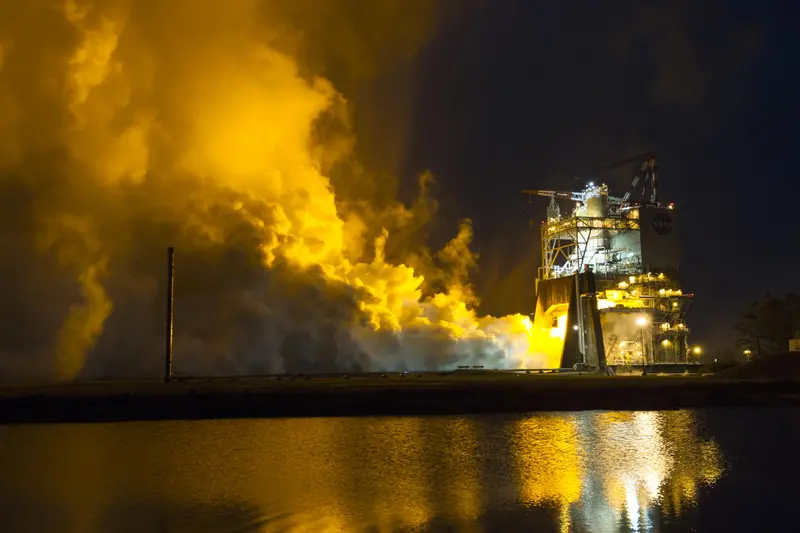
From the chamber to the nozzle
The combustion chamber converts chemical energy into the enthalpy of a gas at high pressure p_c and temperature T_c; the converging-diverging (de Laval) nozzle converts it into kinetic energy. For an ideal gas in isentropic expansion:
vₑ = √{ [2γ / (γ − 1)] · (R · T_c / M) · [1 − (pₑ / p_c)^((γ−1)/γ)] }
γ: ratio of specific heats of the gases (1.15-1.25 typical).R = 8.314 J/(mol·K);M: mean molar mass of the exhaust.pₑ/p_c: pressure expansion ratio, set by the area ratioε = Aₑ/A*.
The formula explains almost everything: you want high T_c (limited by wall cooling) and low M. That is why hydrogen wins: its exhaust (H₂O with plenty of leftover H₂, a fuel-rich mixture) has M ≈ 12-14 g/mol, against ~22-24 g/mol for kerosene. High chamber pressure allows smaller nozzles for the same thrust and larger expansion ratios without the jet separating at sea level.
First-stage nozzles use area ratios ε of ~15-40 (limited by flow separation at sea level); vacuum nozzles, from ~100 to more than 250 (the RL10B-2 reaches about 280 with an extendible skirt). Performance is split into two figures: the characteristic velocity c* = p_c · A* / ṁ, which measures combustion, and the thrust coefficient C_F = F / (p_c · A*), which measures the nozzle; c = c* · C_F.
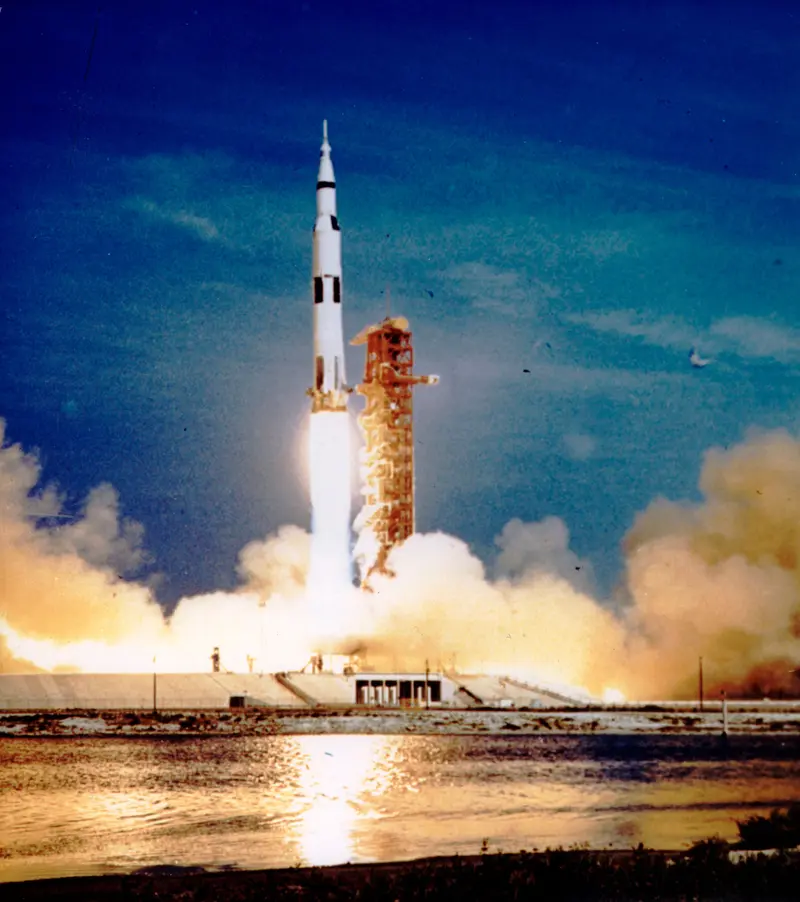
Epic moment · July 16, 1969
Saturn V Launch (Apollo 11)
High-speed cameras placed next to the launch pad filmed in slow motion as the five F-1 engines of the Saturn V ignite, while steel arms hold it down until it reaches full power. At 110 meters (363 feet) tall and almost 3,000 tonnes, it is still one of the most powerful rockets ever built. Up top, Armstrong, Aldrin and Collins were beginning a four-day journey to the Moon.
Watch the full momentNASA · Public domainThe rocket equation
Integrating m · dv = −vₑ · dm with no external forces:
Δv = vₑ · ln(m₀ / m₁)
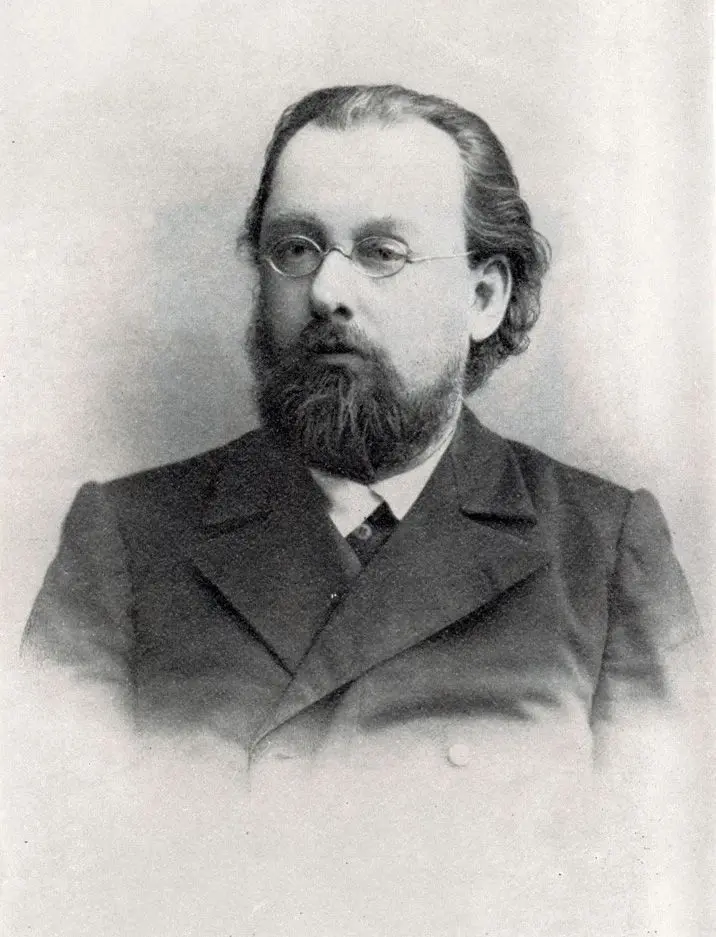
with m₀ the initial mass and m₁ the final mass. Konstantin Tsiolkovsky published it in 1903. Solving for it, the required mass ratio grows exponentially with delta-v:
m₀ / m₁ = exp(Δv / vₑ)
| Δv / vₑ | m₀/m₁ | Propellant as % of initial mass |
|---|---|---|
| 1 | 2.72 | 63 % |
| 2 | 7.39 | 86 % |
| 2.85 (9.4 km/s with vₑ = 3.3 km/s) | 17.3 | 94 % |
| 3 | 20.1 | 95 % |
Reaching low Earth orbit takes about 9.3-9.8 km/s including losses (see getting to orbit). With kerosene and oxygen, more than 94 % of the liftoff mass has to be propellant. That is the core of the problem.
Structural fraction and why staging is needed
Split a stage's mass into propellant m_p, structure m_s (tanks, engines, avionics) and payload m_L. With the structural coefficient ε = m_s / (m_s + m_p), the payload fraction λ = m_L/m₀ of a single stage is:
λ = (e^(−Δv/vₑ) − ε) / (1 − ε)
If e^(−Δv/vₑ) < ε, the payload comes out negative: the vehicle cannot even carry itself. With ε = 0.06 and vₑ = 3.3 km/s, a single stage needs m₁/m₀ ≈ 0.058 to deliver 9.4 km/s: less than its own structure. Hence staging: the dead mass of empty tanks is thrown away.
Two-stage example (ε = 0.06 for both, 9.4 km/s in total):
| Stage | vₑ | Δv | e^(−Δv/vₑ) | Stage λ |
|---|---|---|---|---|
| 1 | 3.0 km/s | 3.6 km/s | 0.301 | 0.257 |
| 2 | 3.4 km/s | 5.8 km/s | 0.182 | 0.129 |
| Total | 9.4 km/s | 0.033 |
About 3.3 % of liftoff mass reaches orbit: this is the real order of magnitude for current launch vehicles (2 to 4 %). Three stages gain a little more, but every separation adds engines, mechanisms and risk; almost all modern launchers have two stages, sometimes with strap-on boosters. The optimal delta-v split between stages is solved with Lagrange multipliers; in practice the upper stage takes more Δv than an "equal" split would give it when it has the better Isp.
Real propellant mass fractions are around 90-95 % for large stages with metallic tanks: the Shuttle's external tank reached 96 %, and a modern kerosene upper stage about 0.94-0.96. Every kilogram saved on the upper stage is one more kilogram of payload; on the first stage, a fraction of a kilogram.
Game
Design your rocket
Real propellants
| Combination | Typical O/F (mass) | Bulk density | Isp sea level / vacuum | Notes |
|---|---|---|---|---|
| LOX / LH₂ | 5.5-6 | ~0.32-0.36 g/cm³ | ~360-390 / 430-465 s | Cryogenic (LH₂ at 20 K); bulky tanks; RS-25, Vulcain, Vinci, RL10 |
| LOX / methane | ~3.5-3.7 | ~0.82 g/cm³ | ~310-330 / 350-380 s | Cleaner than kerosene, suited to reuse and to production on Mars; Raptor, BE-4 |
| LOX / RP-1 (kerosene) | ~2.3-2.7 | ~1.0 g/cm³ | ~280-310 / 310-350 s | Dense and cheap; soot (coking) in engines; Merlin, RD-180 |
| N₂O₄ / MMH or UDMH | ~1.6-2.2 | ~1.15-1.2 g/cm³ | — / 310-325 s | Hypergolic, storable for years; highly toxic; maneuvering and probes |
| APCP solid (ammonium perchlorate, aluminum, HTPB) | — | ~1.75-1.8 g/cm³ | ~240-250 / 265-290 s | High thrust, no shutdown or throttling; P120C, strap-on boosters |
| Hydrazine (monopropellant) | — | 1.0 g/cm³ | — / 220-235 s | Iridium catalyst; attitude control |
| Electric propulsion (Hall, ion) | — | — | — / 1,500-4,000 s | Thrust from mN to N; power-limited |
Isp is not the only figure. What counts on a first stage is density impulse (ρ · I_sp): a hydrogen tank takes up almost three times the volume per kilogram of propellant of a kerosene tank, with more structure, more insulation and more drag. That is why the current trend is methane on the first stage (a compromise between density, Isp and cleanliness) and hydrogen on high-energy upper stages.
Engine cycles
Propellants have to be moved from tanks at a few bar into a chamber at hundreds of bar. How the turbopump is driven defines the cycle:
| Cycle | How the turbine is driven | Examples | Advantage / drawback |
|---|---|---|---|
| Pressure-fed | No pump: pressurized gas in the tanks | Maneuvering engines, AJ10 | Simple and reliable / heavy tanks, low p_c (~10-20 bar) |
| Gas generator | A fraction of the propellant is burned and dumped | Merlin, F-1, Vulcain | Simple / loses a few % of Isp |
| Expander | Fuel heated in the chamber wall drives the turbine | RL10, Vinci | Very efficient and smooth / limited in size and thrust |
| Oxidizer-rich staged combustion | Oxygen-rich preburner; everything ends up in the chamber | RD-180, BE-4 | Very high p_c / hot oxidizing gas: very demanding metallurgy |
| Fuel-rich staged combustion | Hydrogen-rich preburners | RS-25 | High Isp / complex |
| Full-flow staged combustion | Two preburners, one of each type | Raptor | p_c of ~300 bar or more, cooler turbines / maximum complexity |
| Electric pump | Electric motors and batteries | Rutherford (Electron) | Simple / small engines only |
Chamber pressures range from about 100 bar (Merlin 1D, gas generator) to 250-350 bar (RD-180, Raptor). Regenerative cooling —the fuel flows through channels in the wall before being injected— keeps the copper wall (for example alloys such as GRCop-42, made by powder bed fusion) below about 800-900 K against gases at ~3,500 K and heat fluxes of tens of MW/m² at the throat. Materials are covered in materials for space.
Losses and liftoff thrust
The Tsiolkovsky equation assumes no external forces. In a real ascent:
Δv_required = Δv_orbital + Δv_gravity + Δv_drag + Δv_steering − Δv_rotation
Δv_gravity = ∫ g · sin γ dt          (γ: flight path angle above the horizon)
(required = orbital + gravity + drag + steering − Earth rotation.) While the rocket climbs vertically, every second of burn loses about 9.8 m/s to gravity. That is why liftoff thrust-to-weight sits at 1.2-1.5: with less, gravity losses soar; with more, engine and structure weigh too much and drag grows. Typical gravity losses are 1-1.5 km/s; drag losses, 0.1-0.3 km/s.
State of the art
- Reuse of first stages as the norm (Falcon 9, with Starship, New Glenn and others in development or early flights); this demands engines with restart, deep throttling and lives of dozens of cycles. Covered in getting to orbit.
- Methane as the main propellant of the new generation.
- Additive manufacturing of injectors, chambers and turbopumps, cutting part counts and lead times.
- Aerospike and rotating detonation engines: tested on the stand, not yet in operational use on launch vehicles.
- Nuclear thermal propulsion: Isp on the order of 850-900 s demonstrated on the stand with NERVA in the 1960s; never flown. See the future in space.
Key points
F = ṁvₑ + (pₑ − pₐ)AₑandI_sp = c/g₀: Isp is propellant efficiency.Δv = vₑ ln(m₀/m₁): the required mass grows exponentially with delta-v.- If
e^(−Δv/vₑ)is smaller than the structural fraction, there is no payload: that is why stages exist. - Hydrogen = high Isp and low density; kerosene = density; methane = compromise.
- Only about 2-4 % of liftoff mass reaches orbit.
Further reading
- G. P. Sutton, O. Biblarz, Rocket Propulsion Elements, Wiley (9th ed., 2016).
- D. K. Huzel, D. H. Huang, Modern Engineering for Design of Liquid-Propellant Rocket Engines, AIAA (1992).
- K. E. Tsiolkovsky, "Исследование мировых пространств реактивными приборами" (Exploration of Outer Space by Means of Reaction Devices), Nauchnoye Obozreniye (1903).
- NASA Glenn Research Center, Beginner's Guide to Rockets (grc.nasa.gov).
Test yourself
In the Tsiolkovsky equation, Δv = vₑ · ln(m₀/m₁), what does m₁ represent?
Which propellant combination gives the highest specific impulse among commonly used chemical propellants?
Why do first stages usually use dense propellants even though their Isp is lower?
With a structural coefficient of 6 % and an average vₑ of 3.3 km/s, can a single stage deliver 9.4 km/s with a payload?
Which engine cycle does SpaceX's Raptor use?
Go deeper: engineering subjects
If you want to go beyond this lesson, these subjects develop it at university level.
Subject · 5 lessonsRocket propulsionHow a nozzle turns heat into speed, how liquid, solid and electric engines work, and how propellants are chosen.Nozzle · Liquid · Solid · Electric · Propellants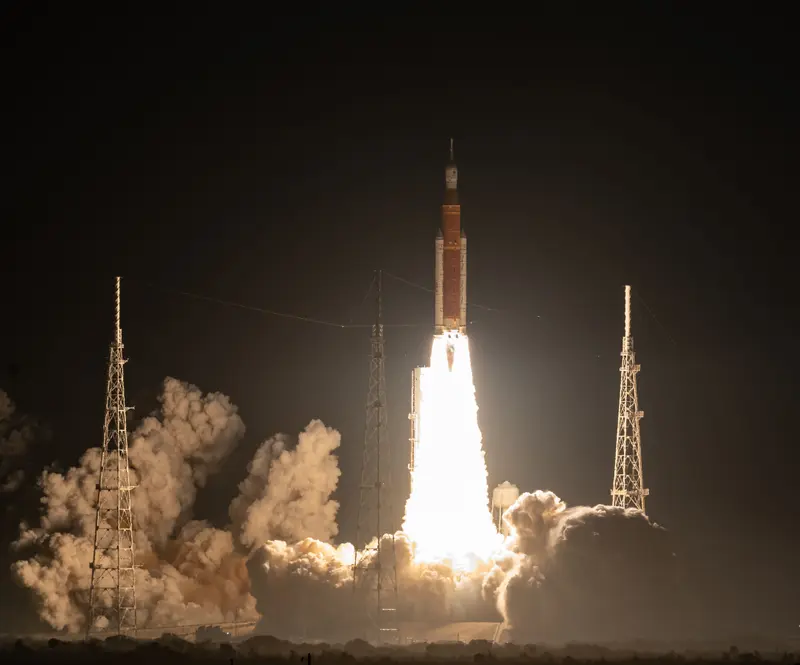 Subject · 5 lessonsLaunch vehicle designHow many stages and how big, how the ascent is flown, what loads the rocket must take, how it is reused, and where and when to launch.Staging · Ascent · Max-Q · Reuse · Windows