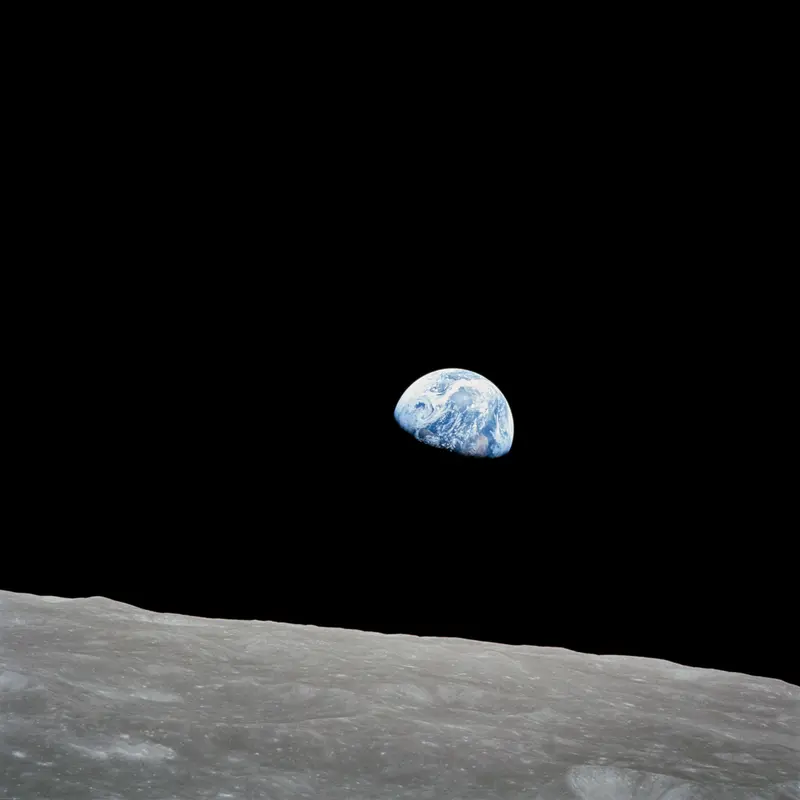
The Moon is about 384,400 km away, but the problem is not the distance, it is the chain of velocity changes: leaving Earth orbit, being captured by a body moving at 1 km/s around the Earth, landing with no atmosphere to slow you down, taking off again and coming home at 11 km/s. This page walks through the mission leg by leg, with the delta-v of each maneuver, the trade-offs of current architectures and the challenges still open.
Earth-Moon system data
| Quantity | Value |
|---|---|
| Mean distance | 384,400 km (perigee ~363,300 km, apogee ~405,500 km) |
| Mean lunar radius | 1,737 km |
| Lunar μ | 4.9028·10¹² m³/s² (1/81.3 of Earth's) |
| Surface gravity | 1.62 m/s² (≈ 1/6 g) |
| Escape velocity | 2.38 km/s |
| Moon's orbital velocity around the Earth | ~1.02 km/s |
| Lunar sphere of influence | ~66,000 km |
| Light-time delay | ~1.28 s one way |
| Lunar solar day | 29.5 Earth days |
| Circular velocity at 100 km | ~1.63 km/s, period ~118 min |
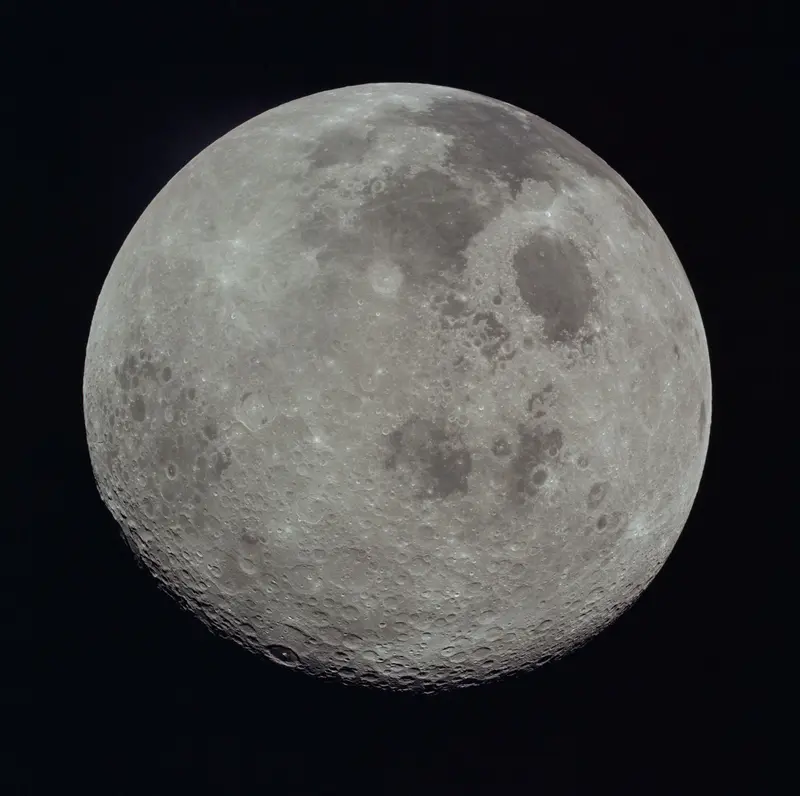
The delta-v budget of a landing mission
| Maneuver | Approximate Δv | Usually performed by |
|---|---|---|
| Surface → LEO | 9.3-9.8 km/s | Launch vehicle |
| Trans-lunar injection (TLI) | 3.1-3.2 km/s | Upper stage |
| Mid-course corrections | tens of m/s | Spacecraft |
| Lunar orbit insertion (LOI) into low lunar orbit | 0.8-0.9 km/s | Spacecraft or service module |
| Descent to the surface | 1.8-2.0 km/s | Lunar lander |
| Ascent to lunar orbit | 1.8-1.9 km/s | Ascent stage |
| Trans-Earth injection (TEI) | 0.8-1.0 km/s | Service module |
| Reentry | ~11 km/s dissipated by the air | Heat shield |
The sum from low Earth orbit to the surface and back to Earth is about 8-9 km/s, comparable to the ascent from the ground to LEO. With the Tsiolkovsky equation (see how a rocket works) that explains the sizes: the Saturn V put about 140 t into low orbit and sent about 45-48 t toward the Moon; about 5-6 t of capsule came back to Earth.
Epic moment · July 20, 1969
The Eagle's Moon Landing
This is the film that a 16 mm camera recorded through Buzz Aldrin's window as the Eagle lunar module descended toward the Sea of Tranquility. The computer alarms kept sounding and the planned spot was full of rocks, so Neil Armstrong took the controls and searched by hand for a flat place. At the end you can see the lunar dust swept up by the engine and the shadow of one of the leg probes: they touched the Moon with fuel for less than a minute.
Watch the full moment, with soundNASA · Public domainDeparture: trans-lunar injection
From a 185 km parking orbit (v ≈ 7.79 km/s), the orbit has to be stretched until its apogee reaches lunar distance. With vis-viva (see gravity and orbits):
a = (r_LEO + r_Moon) / 2 ≈ (6,563 + 384,400) / 2 ≈ 195,500 km
v_perigee = √(μ · (2/r_LEO − 1/a)) ≈ 10.93 km/s
Δv_TLI ≈ 10.93 − 7.79 ≈ 3.14 km/s
t ≈ π · √(a³ / μ) ≈ 5 days
(r_Moon is the lunar distance; v_perigee the perigee velocity.) That is only 2.5 % below local escape velocity: the spacecraft almost escapes from the Earth. The Apollo missions used somewhat more energetic trajectories, of about 3 days. There are also low-energy transfers, which pass near Sun-Earth L1 or L2 and exploit three- or four-body dynamics: they save part of the capture delta-v at the cost of 3-4 months of travel (GRAIL, CAPSTONE, several commercial landers).
The departure time is set by geometry: the plane of the parking orbit has to contain the arrival direction at the Moon, which opens launch windows of a few hours, on several days each month.
Free return
If the trajectory is designed to pass behind the Moon at the right distance, lunar gravity bends it and sends it back to Earth without maneuvers: a free return. It is the safe option in the early phases (Apollo 8, 10 and 11; Artemis II). Apollo 13 regained a free-return trajectory after its oxygen tank exploded. The price is that it restricts landing sites and arrival geometry.
Arrival: patched conics and lunar orbit insertion
In the patched conics method, the spacecraft crosses the lunar sphere of influence with a velocity relative to the Moon, the hyperbolic excess velocity v∞. On the Hohmann trajectory it reaches apogee at only ~0.19 km/s relative to the Earth, while the Moon moves at 1.02 km/s: the Moon "catches up with it" at v∞ ≈ 0.8-0.85 km/s. At the perilune of the hyperbola:
v_p = √(v∞² + 2μ_L / r_p)
Δv_LOI = v_p − √(μ_L / r_p)
For r_p = 1,837 km (100 km altitude) this gives v_p ≈ 2.46 km/s against a circular velocity of 1.63 km/s: Δv_LOI ≈ 0.8-0.85 km/s. If the engine fails to ignite, the spacecraft follows its hyperbola and flies away; that is why LOI is performed with the spacecraft behind the Moon and out of contact with Earth for low equatorial orbits.
Which lunar orbit
Low lunar orbits are unstable because of mascons, mass concentrations beneath the lunar maria that make most low orbits crash into the surface within months. Only a few "frozen" inclinations (about 27°, 50°, 76° and 86°) are stable in the long term. Artemis uses another solution: the near-rectilinear halo orbit (NRHO), from the family of halo orbits around Earth-Moon L2, with a perilune on the order of 3,000 km above the north pole, an apolune of about 70,000 km over the south and a period of ~6.5 days.
| Criterion | Low lunar orbit | NRHO |
|---|---|---|
| Δv to arrive from TLI and to depart | ~0.8-0.9 km/s each | on the order of 0.4 km/s each |
| Δv to descend to the surface | ~1.8-2.0 km/s | on the order of 2.5-2.7 km/s |
| Station-keeping | Considerable (mascons) | A few m/s per year |
| Contact with Earth | Interrupted every orbit | Almost continuous |
| Access to the poles | Depends on inclination | Very good to the south pole |
The trade-off is clear: the NRHO is cheap for the Orion spacecraft, which does not have enough delta-v to enter and leave a low orbit with margin, but it shifts the cost onto the lunar lander.
Landing on the Moon
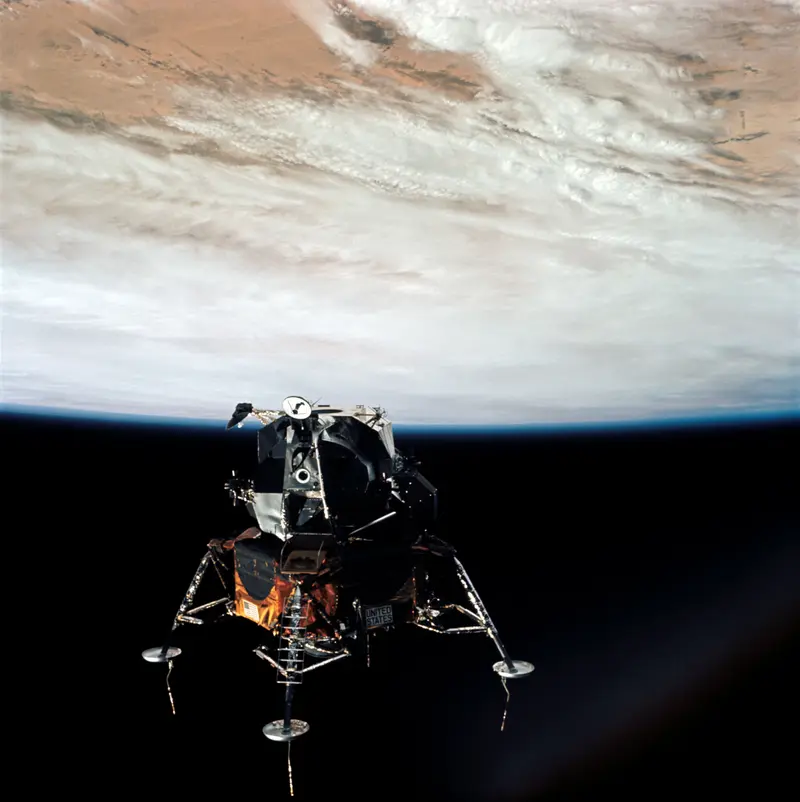
With no atmosphere there are no parachutes or heat shield: all the velocity is cancelled with the engine. From a 100 km circular orbit, the classic (Apollo) sequence is:
- Descent orbit insertion: a burn of ~20-25 m/s lowers perilune to about 15 km.
- Powered descent from perilune: about 11-12 minutes on a throttleable engine. First, almost horizontal braking, at maximum efficiency; then pitch-over toward vertical so the crew and sensors can see the site.
- Final approach: near-vertical descent at a few m/s, lateral correction of hundreds of meters, touchdown at less than about 1-3 m/s.
The ideal delta-v (two impulses, from 100 km to the surface) is ~1.73 km/s; the real one, 1.8-2.0 km/s, because of the gravity losses of a finite-thrust descent and the hover margin for choosing a site. The engine has to throttle over a wide range (the Apollo lunar module's went down to around 10 % thrust), because the lander's mass drops sharply during descent.
Game
Land the lunar module
Landing problems
- Navigation and precision: without GNSS, inertial navigation, laser or radar altimeters and velocimeters, and terrain-relative navigation (correlating images with orbital maps) are combined. Japan's SLIM probe (2024) landed less than 100 m from its target.
- Hazard detection: boulders and slopes that cannot be seen from orbit; scanning lidar in the last few hundred meters.
- Plume and regolith: the engine plume kicks up particles that leave at speeds that can reach the order of km/s and dig an erosion crater; with large landers, and even more at the south pole, this calls for prepared landing pads or landing engines mounted high up.
- Stability at touchdown: tall, narrow landers tip over easily on slopes; two of the first US commercial landers (Intuitive Machines, 2024 and 2025) ended up on their sides, while Blue Ghost (Firefly, 2025) landed upright.
- Lighting and dust: at the south pole the Sun sits almost on the horizon, with extremely long shadows and glare; lunar dust, abrasive, angular and electrostatically charged, gets into joints, seals and suits.
On the surface
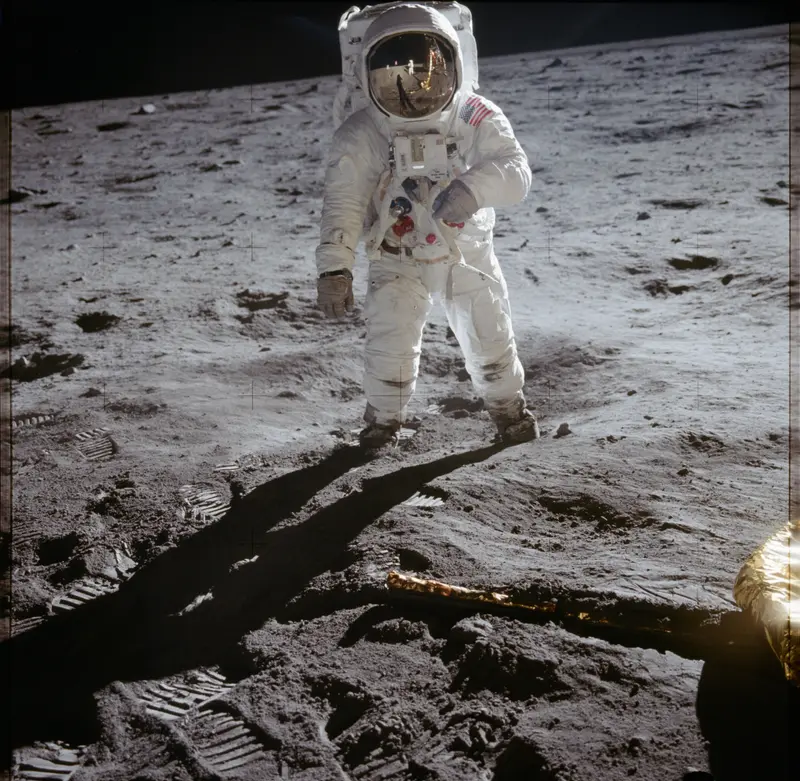
The surface goes from ~390 K by day to ~100 K at night; nights last about 14 Earth days, which forces huge batteries, radioisotope sources or fission power to survive. The interest of the south pole lies in its permanently shadowed craters (25-40 K), where the LCROSS mission (2009) detected on the order of 5.6 % water by mass in the material ejected from the crater Cabeus, and in some almost permanently illuminated ridges, good for solar power. India (Chandrayaan-3, 2023) landed at about 69° S; in 2024 China brought back the first samples from the far side (Chang'e 6).
Coming home
From low lunar orbit, the trans-Earth injection burn of ~0.8-1.0 km/s puts the spacecraft on a trajectory of about 3-5 days that reaches the atmosphere at about 11 km/s, with an entry angle that must hit a corridor a couple of degrees wide. The specific energy, ~60 MJ/kg, is double that of a return from LEO, and radiative heating from the shocked gas adds to convective heating. Orion uses a skip entry: it leaves the atmosphere after a first dip and enters again, which spreads the heat and allows the splashdown zone to be chosen. On Artemis I the Avcoat heat shield lost more char than expected, because of gases trapped in the material; Artemis II flew with the same design and a modified reentry trajectory. This is detailed in getting to orbit and materials for space.
Apollo in two sentences, Artemis today
Between 1969 and 1972 six Apollo missions landed twelve astronauts on the Moon with a lunar orbit rendezvous architecture: a single Saturn V, a command module waiting in orbit and a two-stage lunar module that was left behind, and they brought back 382 kg of samples. It was possible with a NASA that, in 1966, received on the order of 4 % of the US federal budget.
Artemis splits the mission among several vehicles:
- SLS (Block 1): more than 27 t toward the Moon, in a single launch with the Orion spacecraft and its European Service Module (ESA, Airbus).
- NRHO as the rendezvous point; the Gateway station is planned for that orbit, although its future is under debate.
- Commercial lunar landers: Starship HLS (SpaceX), which needs refueling in Earth orbit with several tanker launches (estimates range from about ten to almost twenty), and Blue Moon (Blue Origin), with hydrogen and oxygen. Both require storing and transferring cryogens in space for weeks: a new and critical technology.
- Surface: south pole, stays of days to weeks, new suits (AxEMU) and pressurized rovers in the long-term plan.
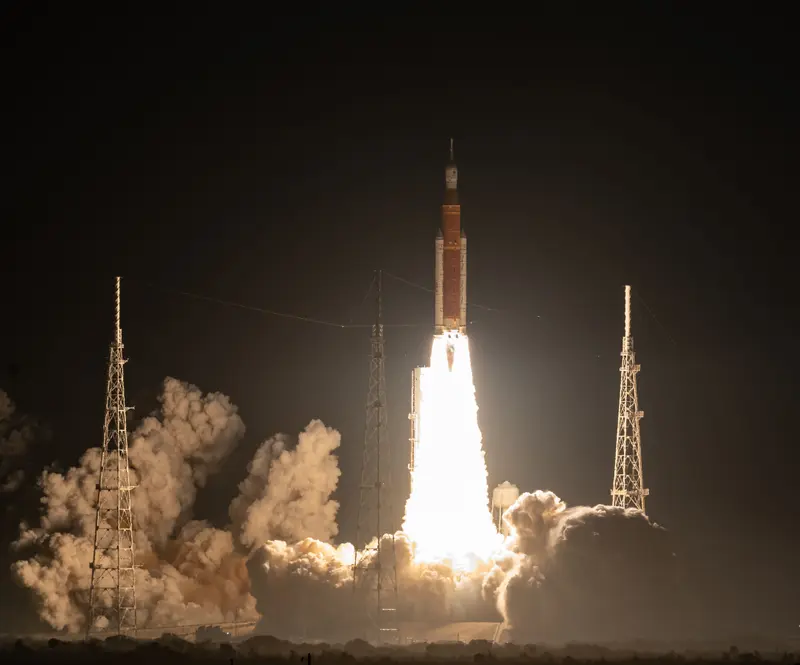
Artemis I (2022) flew uncrewed around the Moon; in 2026 Artemis II took four astronauts on a free-return lunar flyby. The first Artemis landing is planned, according to current plans, toward the end of this decade.
Key points
- TLI ~3.1 km/s, LOI ~0.8-0.9 km/s, descent ~1.8-2.0 km/s, ascent ~1.8 km/s, TEI ~0.8-1.0 km/s.
- The minimum-energy transfer takes ~5 days; Apollo, ~3; low-energy transfers, months.
- Free return = safety; NRHO = cheap for the spacecraft, expensive for the lander.
- Landing means braking 1.7 km/s with a throttleable engine, terrain-relative navigation and hazard detection.
- Returning at 11 km/s doubles the reentry energy of a LEO mission.
Further reading
- W. D. Woods, How Apollo Flew to the Moon, Springer-Praxis (2nd ed., 2011).
- R. Whitley, R. Martinez, "Options for Staging Orbits in Cislunar Space", IEEE Aerospace Conference (2016).
- A. Colaprete et al., "Detection of Water in the LCROSS Ejecta Plume", Science 330, 463-468 (2010).
- NASA, Artemis Plan: NASA's Lunar Exploration Program Overview (2020).
- NASA Office of Inspector General, NASA's Readiness for the Artemis II Crewed Mission to Lunar Orbit, IG-24-011 (2024).
Test yourself
Roughly how much delta-v does trans-lunar injection from low Earth orbit cost?
How long does a minimum-energy Hohmann-type transfer from Earth to lunar distance take?
What is the advantage of a free-return trajectory?
Why does Artemis use a near-rectilinear halo orbit (NRHO) instead of a low lunar orbit?
What is the minimum ideal delta-v to descend from a 100 km circular orbit to the lunar surface?
Go deeper: engineering subjects
If you want to go beyond this lesson, these subjects develop it at university level.
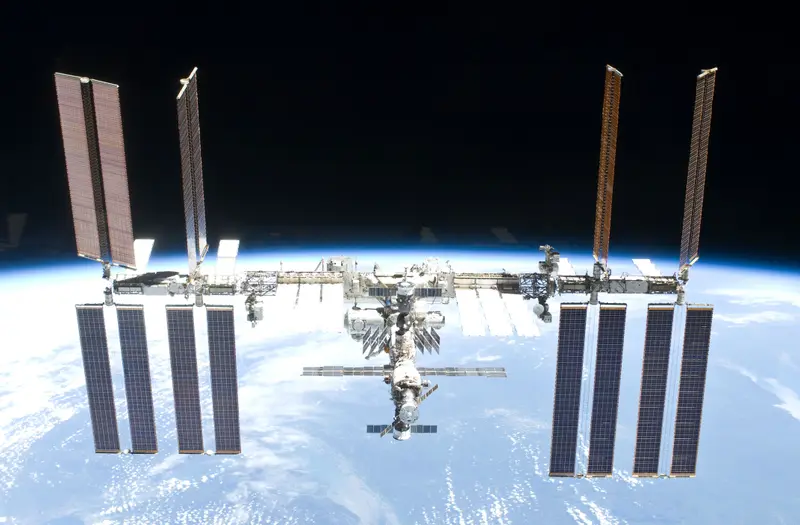 Subject · 5 lessonsOrbital mechanicsKepler, orbital elements and the manoeuvres used to change orbit, travel between planets and dock one spacecraft with another.Kepler · Elements · Hohmann · Plane change · Docking
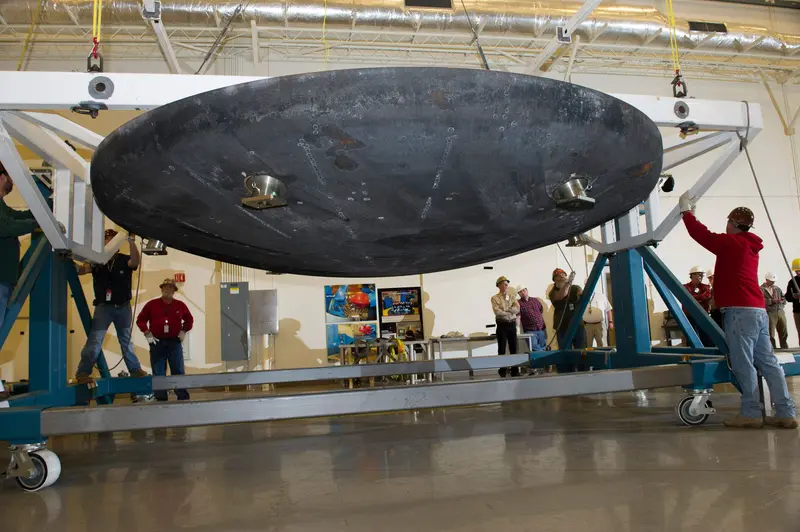 Subject · 5 lessonsAtmospheric entryHow spacecraft come home: entry trajectories, the heat they generate, the shields that survive it and the descent down to land or water.Dynamics · Heating · Ablators · Reusable · Landing
More to practise
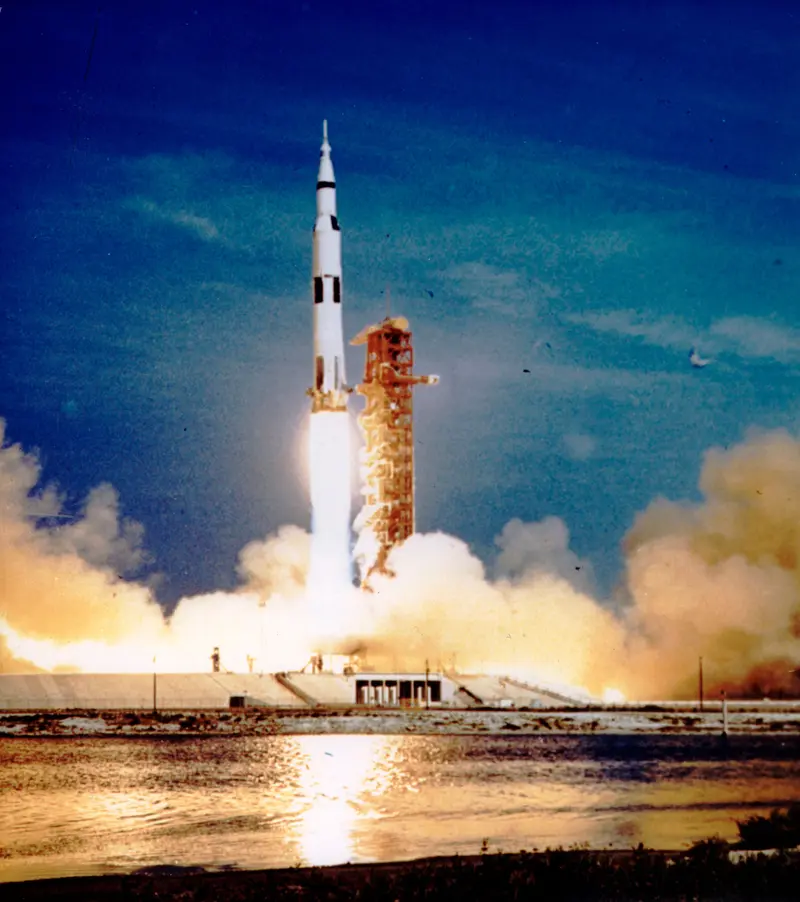 GameDesign your rocketChoose the propellant, the stages and the payload, and see whether your rocket reaches orbit or the Moon. The rocket equation in action.GameThe heat shieldChoose the material and thickness of the heat shield of a capsule coming home at 8 km/s, or from the Moon at 11 km/s. Does it survive?