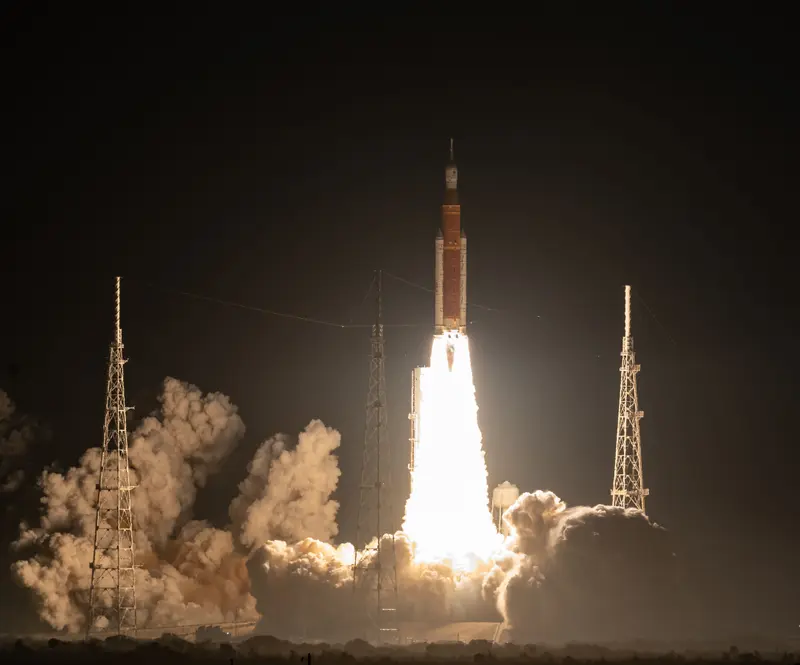
A launch vehicle is, above all, a mass-allocation problem. The Tsiolkovsky equation tells you how much delta-v a tank of propellant buys; staging optimization tells you how to slice the vehicle so that the payload is as large as possible for the delta-v the mission demands. This lesson sets up the problem in its standard notation, solves it with Lagrange multipliers, applies it to real vehicles (Falcon 9, Saturn V, Ariane 6, SLS) and shows why engineers end up choosing something other than the blackboard optimum. The staging section of how a rocket works is assumed; here we go straight to the general solution.
Notation: the rocket as a chain of sub-rockets
Stages are numbered from the bottom up, i = 1, …, N. Sub-rocket i is stage i plus everything it carries (the upper stages and the payload). For each stage:
m_pᵢ: usable propellant mass.m_sᵢ: structural or "dry" mass (tanks, engines, avionics, interstage, unusable propellant residuals).m₀ᵢ: mass of sub-rocket i when stage i ignites.m_L: final payload (in practice including the fairing or adapter if they are carried all the way).
From these, three dimensionless ratios are defined:
Structural coefficient:  εᵢ = m_sᵢ / (m_sᵢ + m_pᵢ)
Payload ratio:           λᵢ = m₀,ᵢ₊₁ / m₀ᵢ        (with m₀,N₊₁ = m_L)
Mass ratio:              nᵢ = m₀ᵢ / (m₀ᵢ − m_pᵢ)
The three are linked: the mass at stage i burnout is its structure plus whatever it carries, so
1 / nᵢ = εᵢ + (1 − εᵢ) · λᵢ ⇔ λᵢ = (1/nᵢ − εᵢ) / (1 − εᵢ)
and the overall payload ratio is the product of the stage ratios:
m_L / m₀ = λ₁ · λ₂ · … · λ_N
Δv = Σ cᵢ · ln nᵢ
with cᵢ the stage's mean effective exhaust velocity (Isp · g₀). That is the whole model: masses, one exhaust velocity per stage and the delta-v sum. There is no gravity, no air and no thrust; those losses are folded into the required Δv (about 9.3-9.5 km/s for low Earth orbit; see getting to orbit) and are studied in ascent trajectory.
The single-stage ceiling
With zero payload, the maximum mass ratio of a stage is 1/ε, and therefore
Δv_max (single stage) = −c · ln ε
| Propellant (mean ascent c) | ε = 0.05 | ε = 0.08 | ε = 0.10 |
|---|---|---|---|
| Kerosene/LOX, c ≈ 3.0 km/s | 8.99 km/s | 7.58 km/s | 6.91 km/s |
| Methane/LOX, c ≈ 3.3 km/s | 9.89 km/s | 8.33 km/s | 7.60 km/s |
| Hydrogen/LOX, c ≈ 3.9 km/s | 11.68 km/s | 9.85 km/s | 8.98 km/s |
The table explains why single stage to orbit (SSTO) is a recurring dream that has never flown. With hydrogen, a mean ascent c of about 3.9 km/s (sea-level Isp is far below vacuum Isp) and an ε of 0.10 — realistic for bulky hydrogen tanks, engines with enough thrust-to-weight and thermal protection for the return — the ceiling falls below 9.3 km/s. For the payload to come out positive you need ε < 0.092 with hydrogen (e^(−9.3/3.9) = 0.092); with ε = 0.08, 1.3% of the mass would reach orbit, and every kilogram of design error eats that entire payload. NASA's X-33/VentureStar programme was cancelled in 2001 after the composite hydrogen tank that was meant to make that ε possible failed in 1999.
Identical stages: how much each one buys
If the N stages are identical (same c, same ε), the optimum, by symmetry, splits the delta-v equally, and
m_L / m₀ = [ (e^(−Δv / (N·c)) − ε) / (1 − ε) ]^N
For Δv = 9.3 km/s and c = 3.3 km/s:
| N | ε = 0.08 | ε = 0.10 |
|---|---|---|
| 1 | impossible | impossible |
| 2 | 3.19% | 2.57% |
| 3 | 3.86% | 3.38% |
| 4 | 4.11% | 3.69% |
| 5 | 4.25% | 3.85% |
| ∞ | 4.67% | — |
Going from one stage to two takes you from nothing to something; from two to three gains 20-30% in payload; from three to four, 6-9%. Beyond that the improvement does not pay for the engines, the separations (each one a failure mode), the in-flight ignitions and the integration complexity. That is why modern launchers settle on two stages, sometimes with strap-on boosters, while three- and four-stage vehicles (Saturn V, Minotaur, Vega, Electron with its kick stage) are justified by high-energy missions or by the use of size-limited solid motors.
Game
Design your rocket
The Lagrange solution for dissimilar stages
When the stages have different c and ε, an equal split is no longer optimal. We maximize
ln(m_L / m₀) = Σ [ ln(1 − εᵢ·nᵢ) − ln nᵢ − ln(1 − εᵢ) ]
subject to the constraint Σ cᵢ · ln nᵢ = Δv. Introducing a multiplier η and differentiating with respect to each nᵢ:
−εᵢ / (1 − εᵢ·nᵢ) − 1/nᵢ + η·cᵢ/nᵢ = 0
⇒  nᵢ = (η·cᵢ − 1) / (η·cᵢ·εᵢ)
The procedure is: (1) choose η; (2) compute all the nᵢ; (3) check whether Σ cᵢ ln nᵢ gives the required Δv; (4) adjust η (a single-variable root search, by bisection or Newton's method) and repeat. The nᵢ give the λᵢ and, starting from the top with m_L, all the masses. The second derivative confirms a maximum provided η·cᵢ > 1 for every stage. The full derivation is in the rocket vehicle dynamics chapter of Curtis.
The expression has a clear physical reading: a stage with high c receives a larger mass ratio, and so does one with low ε. The upper stage usually has better Isp (vacuum engine) and lower ε, so it takes the larger share of delta-v.
Why real rockets are not at the optimum
In the example, the first stage provides only 2.8 km/s. The real Falcon 9 stages with considerably more accumulated ideal velocity. Using unofficial public estimates of its masses (first stage: about 25.6 t dry and about 411 t of propellant; second: about 4 t dry and about 107 t of propellant; fairing of about 1.9 t), a 15 t payload and the c values above:
m₀ = 25.6 + 411 + 4 + 107.5 + 1.9 + 15 ≈ 565 t
Δv₁ = 2.89 · ln(565 / 154) ≈ 3.76 km/s
Δv₂ = 3.41 · ln(128.4 / 20.9) ≈ 6.19 km/s
The ideal sum, about 9.9 km/s, leaves margin for losses and for the landing reserve. The reasons for departing from the Lagrange optimum are engineering, not mathematics:
- Losses are not shared equally. Almost all of the gravity loss and all of the drag fall on the first stage, which flies steep and slow. The optimum with losses shifts delta-v downwards.
- Liftoff thrust is a hard constraint. The full vehicle needs a thrust-to-weight ratio of 1.2-1.5. If the first stage is small and the second large, the first must lift a lot of mass with little propellant: engines oversized for its size.
- The upper stage needs thrust too. With an initial thrust-to-weight below ~0.5-0.7 the second stage suffers large gravity losses, because at separation it does not yet have orbital velocity. A huge second stage with a single vacuum engine is sluggish.
- Reusability. Recovering the first stage forces it to separate lower and slower, or to hold propellant in reserve (see reusable rockets).
- Manufacturing and logistics. Falcon 9's 3.66 m diameter is set by road transport in the US; sharing diameter, tooling, welding and engine (Merlin at the bottom and the top) saves more than leaving the optimum costs.
- Cost. The function that is really minimized is cost per kilogram to orbit, not liftoff mass. A cheap, somewhat heavier stage can beat an optimal, expensive one.
Trade factors: where each kilogram hurts
The question every structures engineer asks is how much payload is lost for each extra kilogram in their part. This is the trade factor (payload exchange ratio) ∂m_L / ∂m_sᵢ. In the upper stage it is almost exactly −1: a kilogram of structure that reaches orbit is a kilogram of payload that does not. In the first stage it is much smaller, because that kilogram is thrown away halfway.
The same reasoning applies to specific impulse: one second of Isp in the upper stage is worth several times more payload than one in the first. In practice, every programme builds its sensitivity table (kg of payload per kg of structure, per second of Isp, per kg of propellant residual) and uses it to decide every change.
Parallel staging: strap-on boosters
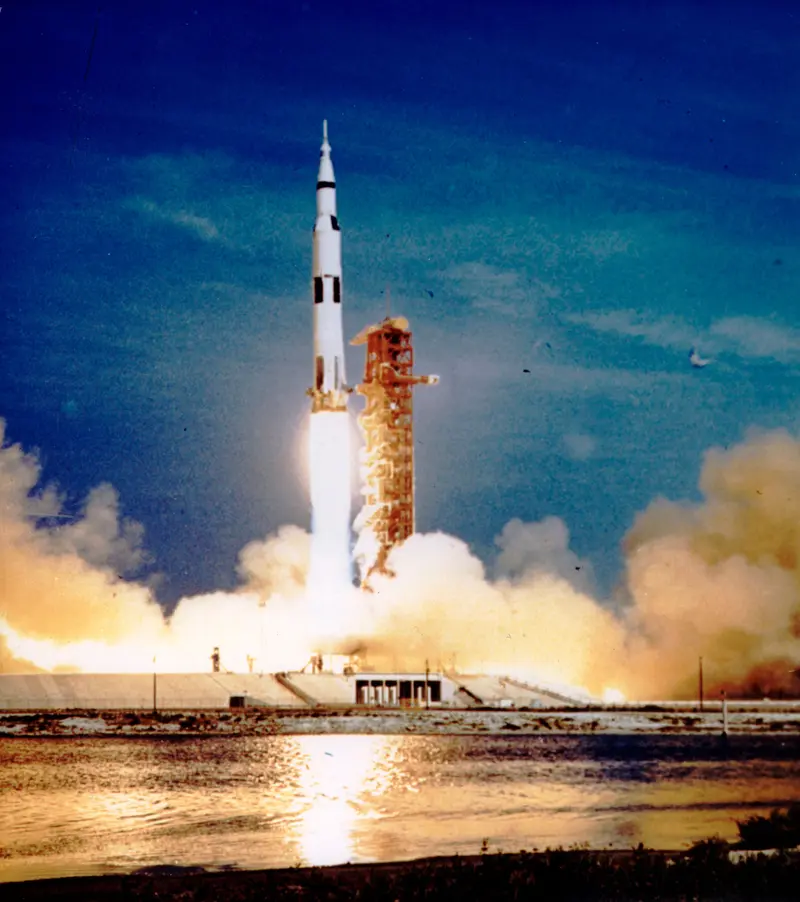
In parallel staging, several bodies ignite together on the ground and the side ones are dropped first. The core starts full and keeps burning after separation: in the model it counts as a "stage 0" (boosters + core together) followed by the core stage alone, with a mass-flow-weighted mean c during the common phase:
c_common = (ṁ_bst · c_bst + ṁ_core · c_core) / (ṁ_bst + ṁ_core)
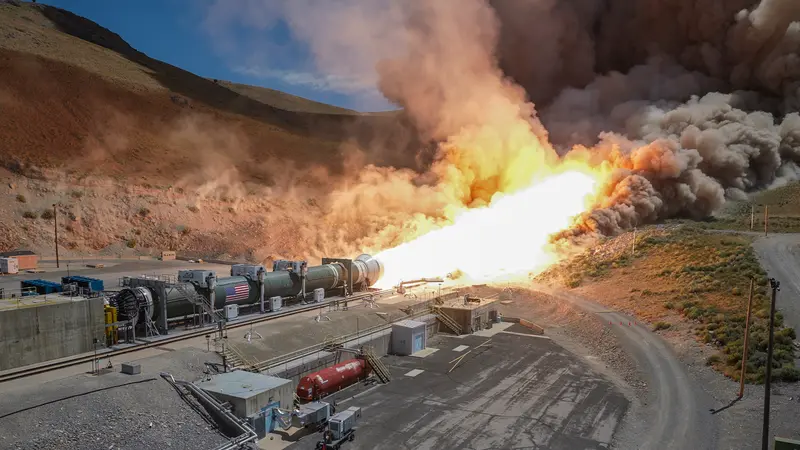
The advantages are operational: every engine is ignited and checked out on the pad (no in-flight ignition of the critical stage), the vehicle is shorter and stiffer, and a modular family covers several payload classes with the same core. Ariane 6 flies with two (Ariane 62) or four (Ariane 64) P120C solid boosters; Falcon Heavy with two Falcon 9 first stages on the sides; SLS with two five-segment solid rocket boosters that provide more than 75% of the liftoff thrust. The drawbacks: the core burns propellant while carrying the boosters (it is usually throttled down so it reaches separation with more propellant left), the side loads at the attachment points are large, and separating the boosters inside the atmosphere is delicate.
Propellant crossfeed — feeding the core engines from the booster tanks so that the core starts "full" after separation — is the ideal version of parallel staging. It was studied for Falcon Heavy but has never flown.
Comparison of real launchers
| Vehicle | Stages | Propellants | Liftoff mass | Reference payload |
|---|---|---|---|---|
| Saturn V | 3 | LOX/RP-1, LOX/LH₂, LOX/LH₂ | ~2,900-3,000 t | on the order of 45-48 t to translunar injection |
| Falcon 9 Block 5 | 2 | LOX/RP-1 in both | ~549 t | 22.8 t to LEO expendable |
| Ariane 64 | 2 + 4 solids | APCP solids, LOX/LH₂, LOX/LH₂ | ~860 t | ~21.6 t to LEO, ~11.5 t to GTO |
| SLS Block 1 | 2 solids + core + ICPS | APCP, LOX/LH₂, LOX/LH₂ | ~2,600 t | more than 27 t to translunar injection |
| Starship | 2 | LOX/CH₄ in both | on the order of 5,000 t | target of more than 100 t reusable |
Two patterns stand out immediately. The European, US government and Apollo architectures combine a high-thrust first phase (solids or kerosene) with hydrogen on top, which is what theory calls for with high-energy payloads. The SpaceX architecture uses the same propellant and the same engine family in both stages, giving up part of the optimum to gain in cost, launch cadence and reusability. Engine and propellant data are in liquid-propellant rocket engines, solid and hybrid rocket motors and propellants.
Design trade-offs
| Decision | For | Against |
|---|---|---|
| More stages | More payload per kilogram at liftoff | More separations, ignitions and engines; lower reliability |
| Hydrogen in the upper stage | Isp of 450-465 s; large payload gain | Bulky tanks, boil-off, expensive engines, worse ε |
| Same propellant throughout | One engine, one infrastructure, cheaper | Upper stage far from the optimum |
| Strap-on solid boosters | Lots of cheap liftoff thrust; modularity | Low Isp, no shutdown, vibration loads, expendable |
| Large first stage (late staging) | Smaller, cheaper upper stage | Worse for first-stage recovery |
| Small first stage (early staging) | Easy recovery | Large upper stage; more gravity losses higher up |
In the conceptual design phase these decisions are swept with a model like the one in this lesson (minutes of computation), the viable architectures are filtered out, and only then does the work move on to three-degree-of-freedom trajectory integration, which adds gravity, air, thrust and load constraints such as maximum dynamic pressure.
Beyond low Earth orbit
For high-energy missions the same approach is extended with an extra stage or with a restarted upper stage. Geostationary transfer orbit requires about 2.45 km/s more from a 200 km LEO; translunar injection, about 3.1-3.2 km/s. With that added Δv the optimal split changes: the weight of the upper stage on the payload is even greater and hydrogen gains still more ground. That is why kerosene launchers that perform well to LEO lose a lot to GTO, and why SLS carries a hydrogen stage, the ICPS with an RL10B-2, for Orion's translunar injection. Subsequent orbital manoeuvres (circularization, plane change) are covered in Hohmann transfer and plane change.
Key points
λᵢ = (1/nᵢ − εᵢ)/(1 − εᵢ)andm_L/m₀ = Π λᵢ: payload ratios multiply.- A single stage cannot exceed
−c · ln ε; with chemical propellants and realistic structures, that does not reach orbit with a payload. - Lagrange optimum:
nᵢ = (η·cᵢ − 1)/(η·cᵢ·εᵢ), with a single η tuned to the total Δv; the stage with the better c and lower ε takes more Δv. - One kilogram of structure in the upper stage costs ~1 kg of payload; in the first stage, on the order of a tenth of that.
- Real launchers depart from the optimum because of thrust-to-weight, losses, reusability, manufacturing and cost, and lose almost no payload because the optimum is a plateau.
Further reading
- H. D. Curtis, Orbital Mechanics for Engineering Students, Butterworth-Heinemann (4th ed., 2020), chapter "Rocket vehicle dynamics" (staging and optimization with Lagrange multipliers).
- G. P. Sutton, O. Biblarz, Rocket Propulsion Elements, Wiley (9th ed., 2016), chapter on flight performance and multistage vehicles.
- R. W. Humble, G. N. Henry, W. J. Larson (eds.), Space Propulsion Analysis and Design, McGraw-Hill (1995).
- S. J. Isakowitz, J. B. Hopkins, J. P. Hopkins Jr., International Reference Guide to Space Launch Systems, AIAA (4th ed., 2004).
- ArianeGroup / Arianespace, Ariane 6 User's Manual (arianespace.com) and SpaceX, Falcon User's Guide (spacex.com).
Test yourself
With c = 3.3 km/s and a structural coefficient of 8%, what is the maximum delta-v of a single stage with no payload?
In the Lagrange solution for serial staging, what is fixed for all stages at once?
On a Falcon 9-type launcher, roughly how much payload does one extra tonne of first-stage structure cost?
Why do real launchers give the first stage more delta-v than the ideal optimum says?
If each of two identical stages has a payload ratio λ = 0.18, what fraction of the liftoff mass reaches orbit?