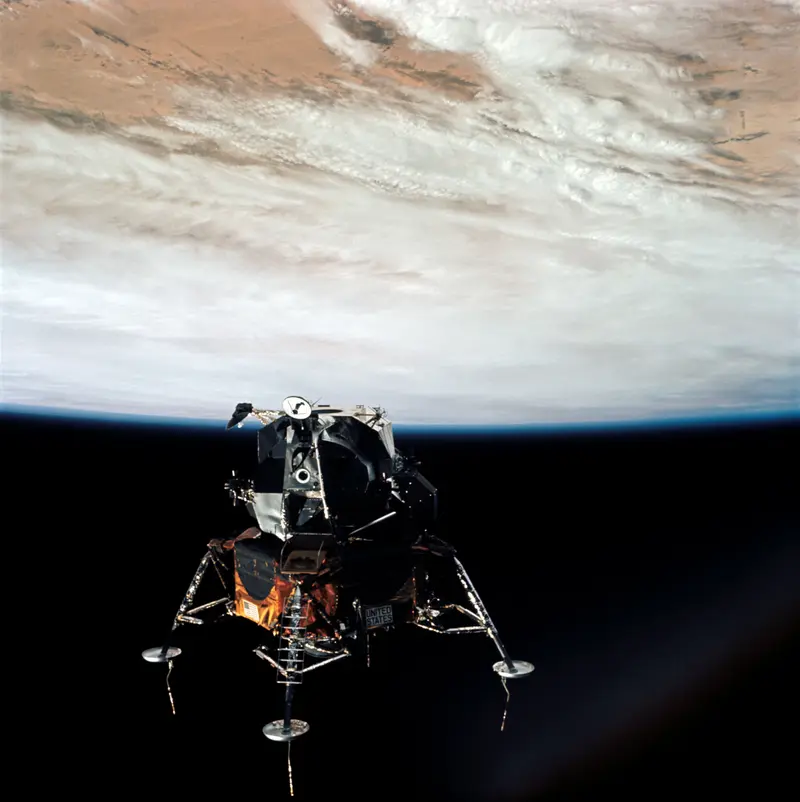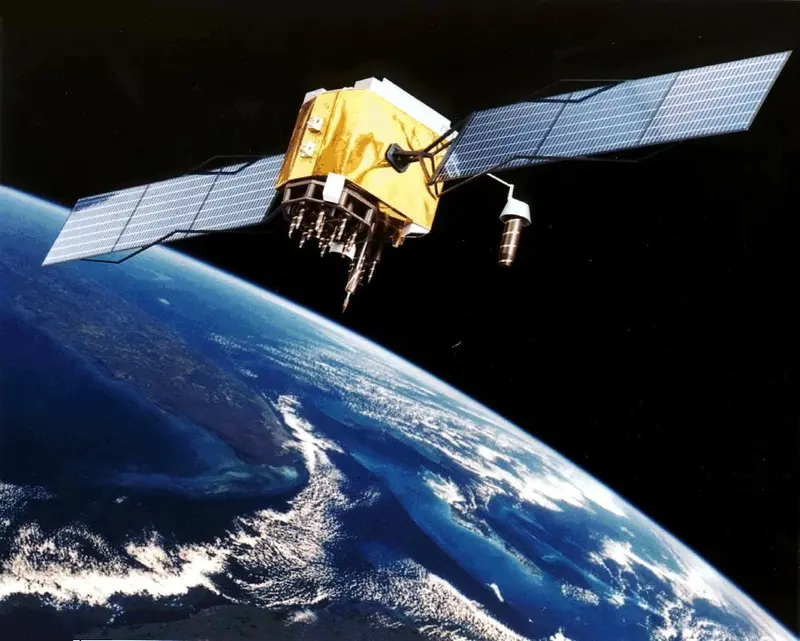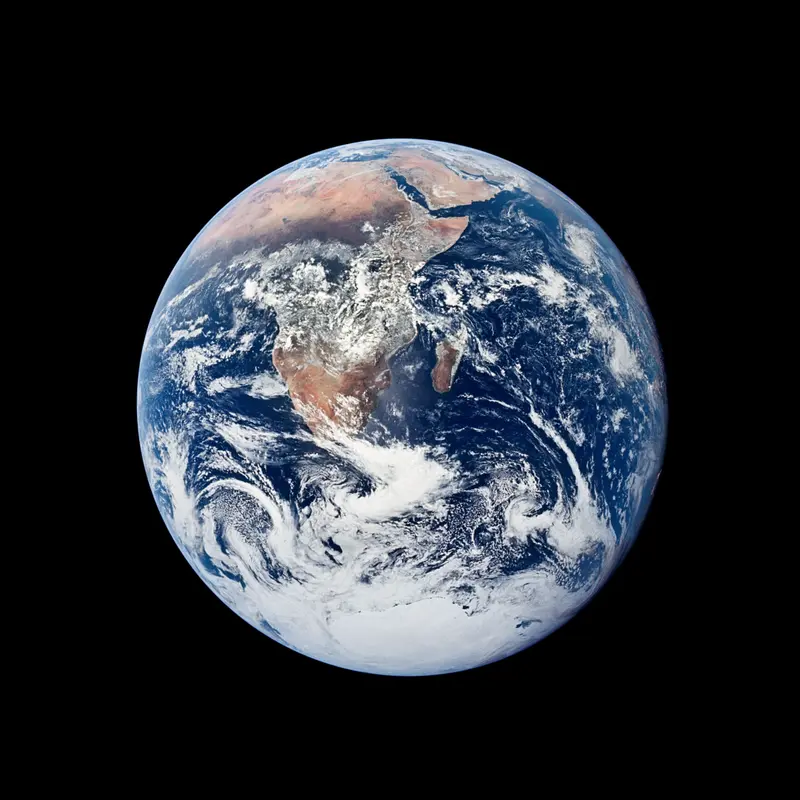
An orbit is a free-fall trajectory in which the vehicle moves sideways so fast that the curvature of its fall matches the curvature of the planet. Everything else —why the Space Station goes around once every hour and a half, why TV satellites seem to stand still, why climbing to 36,000 km costs more than going down to the Moon— follows from a few equations of the two-body problem plus its perturbations. Here they are, with the values used in mission design.
Gravitation and the gravitational parameter
Newton's law gives the acceleration a = −μ · r / r³, with the standard gravitational parameter μ = G·M. Orbital mechanics uses μ directly, because it is known far more precisely than G or M separately.
| Body | μ (m³/s²) | Mean radius | Surface g | Escape velocity |
|---|---|---|---|---|
| Earth | 3.986004·10¹⁴ | 6,371 km | 9.81 m/s² | 11.19 km/s |
| Moon | 4.9028·10¹² | 1,737 km | 1.62 m/s² | 2.38 km/s |
| Mars | 4.2828·10¹³ | 3,390 km | 3.71 m/s² | 5.03 km/s |
| Sun | 1.32712·10²⁰ | 696,000 km | 274 m/s² | 618 km/s |
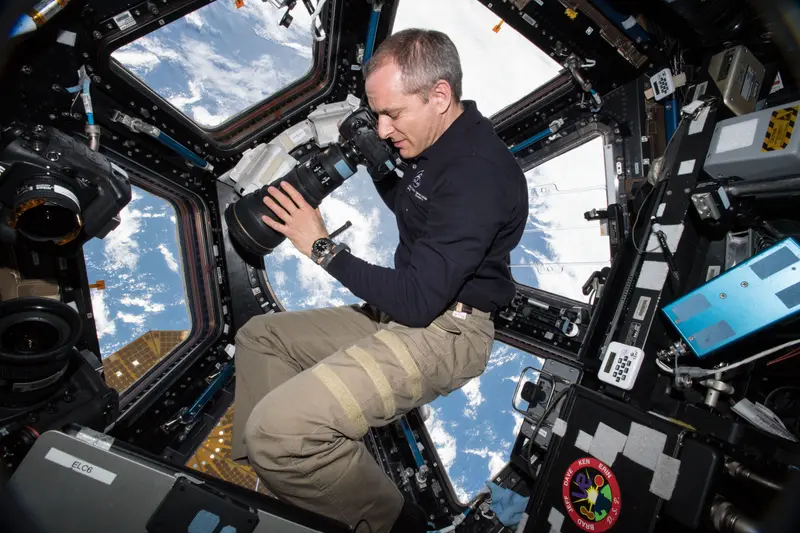
Because gravity falls off as 1/r², at 400 km altitude it is still 89 % of its surface value. The weightlessness of astronauts is not an absence of gravity: the spacecraft and its contents fall together with the same acceleration and there is no contact force between them. What remains is residual microgravity, from 10⁻⁶ to 10⁻⁴ g, due to drag, tidal gradient and vibration; its effects on the body are covered in surviving in space. For how these velocities are reached, see getting to orbit.
Game
How much would you weigh on other worlds?
Newton's cannon and circular velocity
Newton explained it with a cannon on a mountain: the faster the ball, the farther it falls, until the Earth "curves away underneath" as fast as the ball falls. Equating centripetal and gravitational acceleration:
v_circ = √(μ / r)          circular orbital velocity
T = 2π · √(r³ / μ)         period (Kepler's third law)
v_esc = √(2μ / r) = √2 · v_circ
At 400 km (r = 6,778 km): v ≈ 7.67 km/s and T ≈ 92.6 min. At 200 km: 7.78 km/s and 88.5 min. Geostationary orbit requires T equal to the sidereal day (86,164 s, not 86,400 s), which gives r = 42,164 km, an altitude of 35,786 km and v ≈ 3.07 km/s.
Game
Newton’s cannon
Epic moment · August 2, 1971
The Hammer and the Feather
On the Moon, Apollo 15 commander David Scott holds a hammer in one hand and a falcon feather in the other, and drops them at the same time. With no air to slow the feather, both fall at exactly the same rate and hit the ground together. It is live proof of what Galileo had guessed almost four centuries earlier: gravity accelerates all objects equally, whatever they weigh.
Watch the full moment, with soundNASA · Public domainKeplerian orbits and the vis-viva equation
The solutions of the two-body problem are conic sections. For elliptical orbits, conservation of specific energy gives the most useful equation in all of orbital mechanics:
v² = μ · (2/r − 1/a)                 vis-viva
ε  = v²/2 − μ/r = −μ / (2a)           specific energy (J/kg)
h  = r × v,   |h| = √(μ · a · (1 − e²))   specific angular momentum
r_p = a(1 − e),   r_a = a(1 + e)          perigee and apogee
Here r is the distance from the center of the body, a the semi-major axis and e the eccentricity. Energy depends only on a; e gives the shape; three angles give the orientation.
The six orbital elements
| Element | Symbol | What it sets |
|---|---|---|
| Semi-major axis | a | Size and energy |
| Eccentricity | e | Shape (0 circle, 0-1 ellipse, 1 parabola) |
| Inclination | i | Angle of the plane to the equator |
| Right ascension of the ascending node | Ω | Rotation of the plane about the polar axis |
| Argument of perigee | ω | Orientation of the ellipse within its plane |
| True (or mean) anomaly | ν (M) | Position on the orbit at a given instant |
Position as a function of time requires solving Kepler's equation, M = E − e · sin E, with M = n·(t − t_p) and mean motion n = √(μ/a³). It has no closed-form solution; Newton-Raphson solves it in a few iterations.
Maneuvers: Hohmann transfer and plane change
The minimum-energy transfer between two coplanar circular orbits (for radius ratios below 11.94) is the Hohmann transfer: an ellipse tangent to both, with two impulses.
a_t = (r₁ + r₂) / 2
Δv₁ = √(μ/r₁) · [ √(2r₂/(r₁+r₂)) − 1 ]
Δv₂ = √(μ/r₂) · [ 1 − √(2r₁/(r₁+r₂)) ]
t_transfer = π · √(a_t³ / μ)
(t_transfer is the transfer time.) From a 200 km parking orbit to GEO: Δv₁ ≈ 2.46 km/s (injection into geostationary transfer orbit, GTO), Δv₂ ≈ 1.48 km/s, total ≈ 3.93 km/s, in about 5 h 15 min.
A plane change is extremely expensive: a pure rotation Δi at velocity v costs Δv = 2 v · sin(Δi/2). Turning 28.5° (the latitude of Cape Canaveral) in LEO would cost almost 3.8 km/s; doing it at GTO apogee, where v ≈ 1.6 km/s, and combined with circularization, raises the second burn only to about 1.8 km/s. That is why launchers from high latitudes pay in GEO payload, and why Kourou (5.2° N) is such a good site.
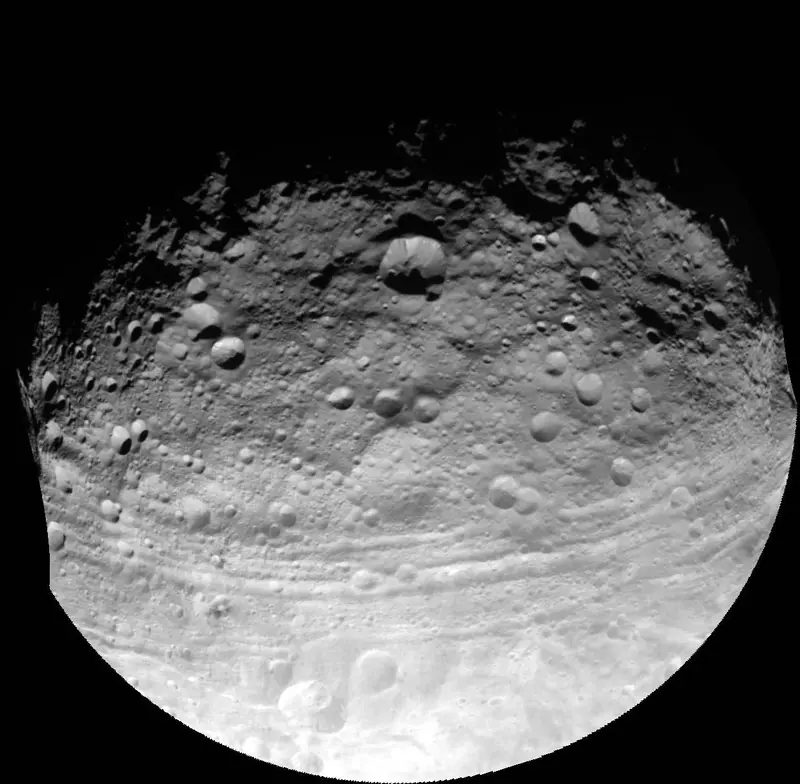 ActivityGamoras 3D MissionLand a damaged ship on a 220 km asteroid, search for water with a hopping robot, make propellant and a glass-ceramic nozzle, and fly back up to dock with your ship in orbit. With real physics.Play the mission
Perturbations: the real orbit
The Keplerian model is only the first approximation. The dominant perturbations, from largest to smallest in low orbit:
| Perturbation | Main effect | Importance |
|---|---|---|
| Earth's oblateness (J2 = 1.0826·10⁻³) | Nodal regression, apsidal precession | Dominates in LEO |
| Atmospheric drag | Decay of the semi-major axis, circularization | Decisive below ~600 km |
| Third body (Moon, Sun) | Slow variation of i and e | Dominates in GEO and high orbits |
| Solar radiation pressure | Variation of e, effect on torques | Important with high area-to-mass |
| Higher-order and tesseral harmonics | Longitudinal drift in GEO | Station-keeping |
The J2 nodal regression is:
dΩ/dt = −(3/2) · n · J2 · (R_T / p)² · cos i, where p = a(1 − e²)
(R_T is Earth's radius.) Choosing i ≈ 97-98° for altitudes of 500-800 km gives dΩ/dt ≈ +0.9856°/day: the orbital plane follows the Earth in its annual motion and the satellite crosses each latitude at the same local solar time. This is the sun-synchronous orbit, the standard for Earth observation (see what space is for). Apsidal precession, dω/dt ∝ (2 − 2.5 sin² i), vanishes at i = 63.4°: the critical inclination of Molniya orbits.
In GEO, lunisolar attraction makes the inclination grow by about 0.75-0.95° per year; correcting it costs about 45-50 m/s per year, and longitude station-keeping a few m/s more. That budget, not electronics wear-out, usually sets the 15-year service life of a chemically propelled geostationary satellite. That is why electric propulsion has taken over this segment.
Orbit types actually in use
| Orbit | Typical altitude | Period | Use |
|---|---|---|---|
| LEO | 300-2,000 km | 90-127 min | Stations, observation, broadband constellations |
| SSO (sun-synchronous) | 500-800 km, i ≈ 97-98° | ~95-100 min | Observation with constant lighting |
| MEO (GNSS) | 19,100-23,222 km | 11-14 h | GPS (20,200 km), GLONASS, Galileo (23,222 km) |
| GTO | perigee ~200 km, apogee ~35,786 km | ~10.5 h | Transfer to GEO |
| GEO | 35,786 km, i ≈ 0° | 23 h 56 min | Communications, meteorology |
| Molniya | 500 × 39,900 km, i = 63.4° | ~12 h | High-latitude coverage |
| Lunar NRHO | ~3,000 × 70,000 km (perilune × apolune) | ~6.5 days | Gateway, Artemis program |
| Halo at Sun-Earth L1 / L2 | ~1.5 million km | ~6 months | SOHO (L1), James Webb and Gaia (L2) |
Beyond two bodies: Lagrange points and patched conics
In the circular restricted three-body problem (two large masses in circular orbit and a third of negligible mass), five equilibrium points appear in the rotating frame. For the Sun-Earth system, L1 and L2 lie ~1.5 million km from Earth, roughly at the Hill radius r_H ≈ a·(m/3M)^(1/3). They are unstable (requiring station-keeping of a few m/s per year), but their halo orbits give a continuous view of the Sun (L1) or a stable thermal environment with Earth and Sun behind (L2). The Jacobi constant, the only integral of motion, bounds which regions are reachable with a given energy.
Preliminary design uses patched conics: within each body's sphere of influence the two-body problem is solved, and the velocity is matched at the boundary. For a trip to the Moon it gives errors of a few percent in delta-v, enough to size the mission; the final design is done by numerical integration with full ephemerides. This is how transfers are treated in traveling to the Moon.
Orbital rendezvous
Near a target in circular orbit, linearized relative motion obeys the Clohessy-Wiltshire (or Hill) equations, with x radial, y along-track and z orbit-normal:
ẍ − 3n²x − 2nẏ = 0
ÿ + 2nẋ = 0
z̈ + n²z = 0
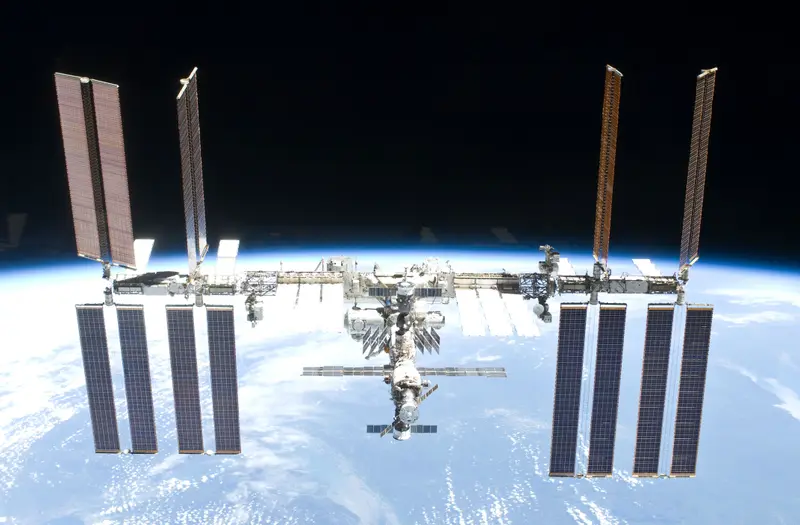
A small radial impulse makes the chaser trace a 2:1 ellipse around the target; an along-track impulse produces a secular drift. Real dockings chain phasing maneuvers, an approach along the velocity vector (V-bar) or the radius vector (R-bar), and a final phase at a few cm/s, with laser and optical sensors. Soyuz and Progress now reach the Station in about 3 hours on few-orbit profiles; traditional cargo vehicles took one or two days.
Orbital lifetime and end of life
Drag dissipates energy: the semi-major axis decays as da/dt = −√(μa) · ρ · C_D · A / m (for a circular orbit). Sensitivity to density makes orbital lifetime depend enormously on the solar cycle and on the ballistic coefficient m/(C_D·A). Indicative values for a small compact satellite: 300 km, weeks to months; 400 km, one to a few years; 550 km, on the order of 5-10 years; 800 km, decades to more than a century. The US FCC rule (2022) requires retired LEO satellites to deorbit within five years, and ESA promotes a "Zero Debris" policy for 2030.
Key points
- Everything starts with
v² = μ(2/r − 1/a): energy depends only on the semi-major axis. - LEO at 400 km: 7.67 km/s and 92.6 min; GEO: 3.07 km/s and one sidereal day.
- Plane changes are the most expensive maneuvers; they are done where velocity is lowest.
- J2 is not an error: it is the tool behind sun-synchronous and Molniya orbits.
- Weightlessness is continuous free fall, not a lack of gravity.
Further reading
- H. D. Curtis, Orbital Mechanics for Engineering Students, Butterworth-Heinemann (4th ed., 2020).
- D. A. Vallado, Fundamentals of Astrodynamics and Applications, Microcosm Press (4th ed., 2013).
- R. R. Bate, D. D. Mueller, J. E. White, Fundamentals of Astrodynamics, Dover (1971; 2nd ed., 2020).
- NASA Jet Propulsion Laboratory, Basics of Space Flight (science.nasa.gov/learn/basics-of-space-flight).
Test yourself
Roughly what circular velocity corresponds to an orbit at 400 km altitude?
According to the vis-viva equation, what does the specific energy of a Keplerian orbit depend on?
Roughly how strong is gravity at the altitude of the Space Station compared with the surface?
Which perturbation is exploited to create sun-synchronous orbits?
What is the approximate total cost of a coplanar Hohmann transfer from LEO (200 km) to GEO?
Go deeper: engineering subjects
If you want to go beyond this lesson, these subjects develop it at university level.
Subject · 5 lessonsOrbital mechanicsKepler, orbital elements and the manoeuvres used to change orbit, travel between planets and dock one spacecraft with another.Kepler · Elements · Hohmann · Plane change · Docking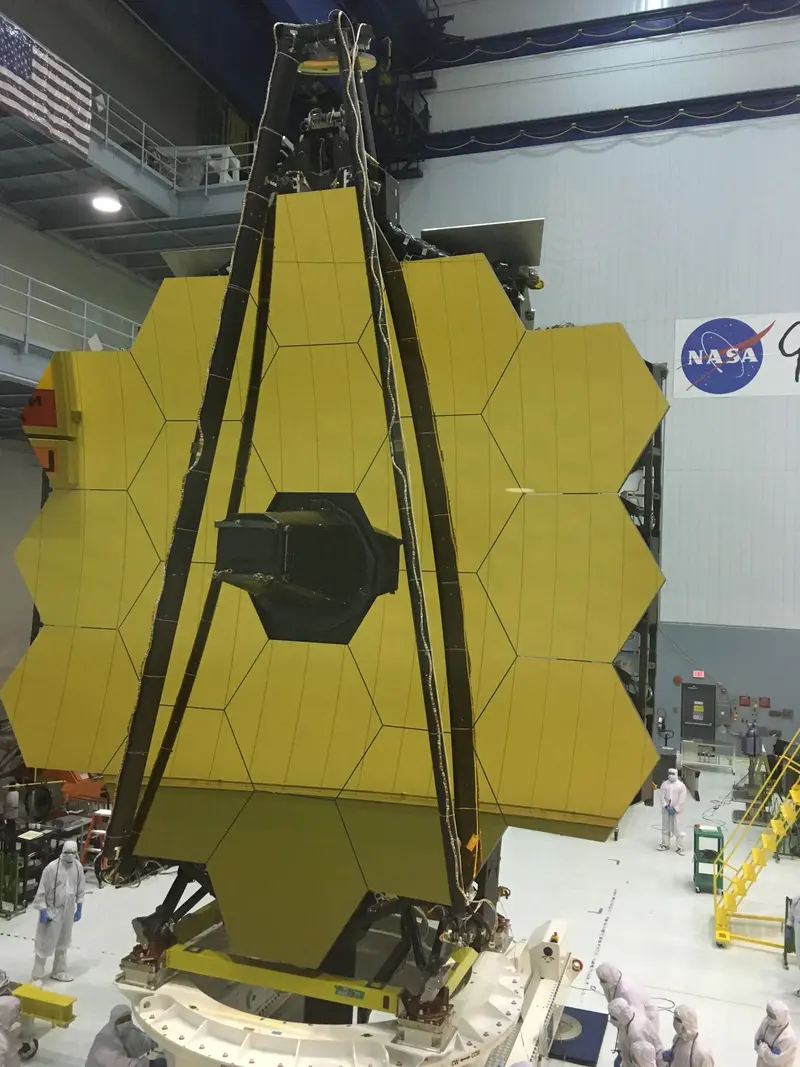 Subject · 5 lessonsAttitude control and navigationHow a spacecraft knows where it points and where it is, and how it turns and aims precisely: quaternions, sensors, reaction wheels and control laws.Attitude · Sensors · Actuators · Navigation · Control