Knowing your position anywhere on the planet to within a few meters, seeing a storm coming days before it arrives, talking live with someone on the other side of the globe: all of this is now part of daily life, and much of it depends on machines circling the Earth, satellites. This page explains what space is actually used for, how those machines work, and what we have learned by observing from orbit.
What a satellite is
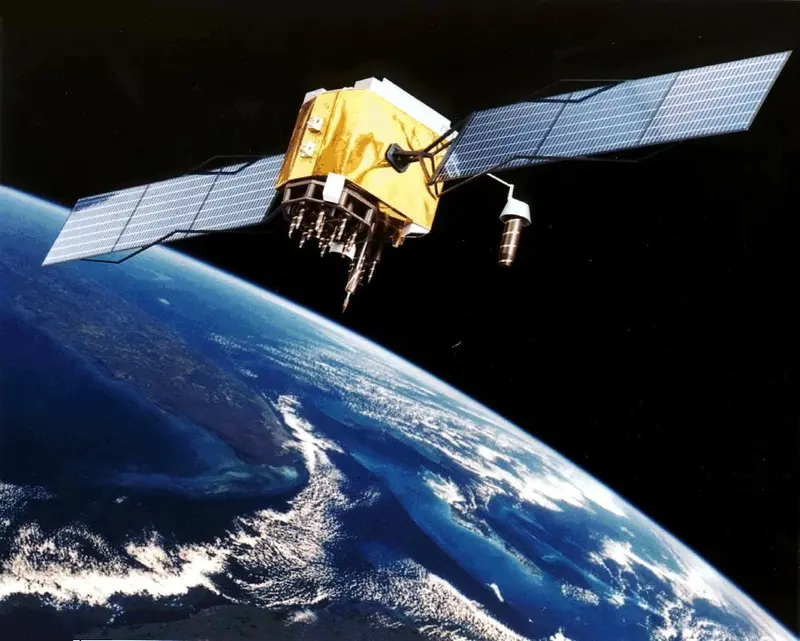
An artificial satellite is a machine placed in orbit around the Earth. It is constantly falling but never reaches the ground, like the cannonball in Newton's thought experiment described in gravity and orbits. Once in orbit, it needs no fuel to keep circling; it only uses small thrusters to correct its position from time to time. It runs on electricity generated by solar panels, and it communicates with the ground by radio.
Radio is worth explaining. Visible light is just one member of a broad family of waves, called electromagnetic waves, which all travel through empty space at the same speed: about 300,000 km per second. Radio waves belong to that family. They are invisible, they can be generated with electric currents, sent over very long distances and picked up by an antenna. By varying them in a controlled way, they can carry voice, images and data.
Thousands of satellites are in operation today. Here is what they do.
Talking to the other side of the world
Because the Earth is round, a radio signal sent out in a straight line from London heads off into space long before it could reach New York. The solution is to place a relay very high up, which receives the signal and sends it back down to a distant point, acting as a mirror in the sky.
The first communication satellites were placed in geostationary orbit, about 36,000 km above the equator, where they appear to stand still in the sky. From that height, a single satellite can see almost half the planet. A ground antenna can point at it and never needs to move: that is why satellite TV dishes on rooftops are fixed in place. The drawback is distance: a signal takes about a quarter of a second to go up and come back down, a delay that is noticeable in a phone conversation.
Today, constellations of thousands of small satellites in low orbit, much closer to the ground, are also used. Because each one passes overhead quickly, a receiver switches from one satellite to the next, and this is how internet access reaches ships in mid-ocean, remote mountain villages and areas hit by natural disasters.
Epic moment · 2017
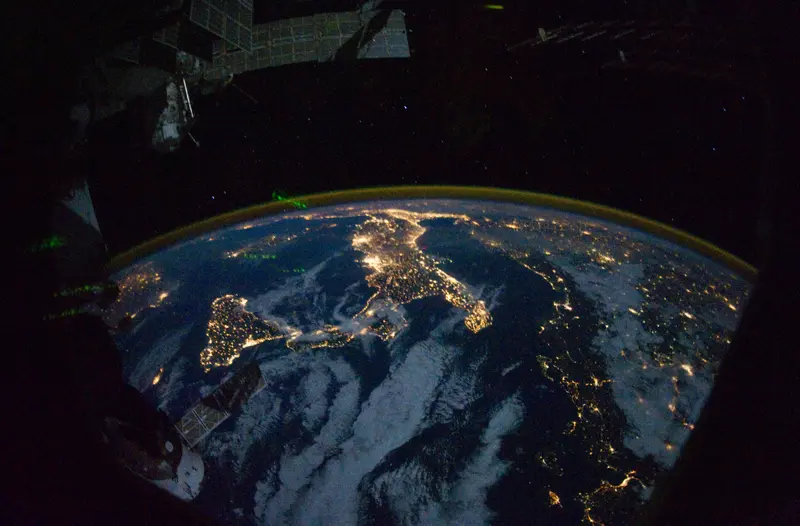
Earth at Night from the Space Station
A green and violet aurora borealis ripples over Canada while, below, the lights of cities across the United States switch on all the way down to Florida. They are hundreds of photos that the Expedition 53 astronauts took one after another from the Space Station, about 400 kilometers up. The Station moves so fast, about 28,000 km/h (17,500 mph), that it circles the world every hour and a half and its crew sees 16 sunrises a day.
Watch the full momentNASA (Crew Earth Observations, Johnson Space Center) · Public domainGPS: knowing where you are
For centuries, navigators at sea worked out their position by measuring the angle of the Sun or the stars above the horizon and timing it with an accurate clock. GPS also relies on precise timing, but it uses satellites, works at any hour in any weather, and is accurate to within a few meters.
This is how it works. About thirty satellites orbit at an altitude of about 20,000 km, arranged so that several are always above the horizon from anywhere on Earth. Each one carries atomic clocks, so precise that they would not gain or lose a second in millions of years, and continuously broadcasts a message: "I am satellite such-and-such, this is my position, and this is the exact time."
A receiver (today, any smartphone) picks up that message a tiny fraction of a second late, because the signal takes time to travel. That delay gives the distance. It is the same reasoning as counting the seconds between lightning and thunder to estimate how far away a storm is, but using the speed of light and millionths of a second.
- Knowing your distance from one satellite places you somewhere on a sphere centered on it.
- With two, you are on the circle where the two spheres intersect.
- With three, only two points remain, and one of them is usually out in space or deep inside the Earth: the other is your position.
- A fourth satellite is used to correct the receiver's own clock, which is far less accurate than the satellites' clocks.
The precision required is astonishing: an error of one millionth of a second in timing would mean an error of 300 meters in position. The satellites' clocks even have to be corrected for an effect predicted by Albert Einstein's theory of relativity: at that altitude, time passes very slightly faster than on the ground. Without that correction, GPS positions would drift by several kilometers every day.
Game
Find yourself with GPS
Alongside the American GPS there are other systems that work the same way: Galileo, the European system, and others operated by Russia and China. Modern phones use several at once.
Seeing the weather coming
Before satellites, forecasters had to rely on scattered measurements from ground stations, ships and weather balloons, which left vast areas of ocean and wilderness unobserved. Today, weather satellites monitor the entire atmosphere continuously.
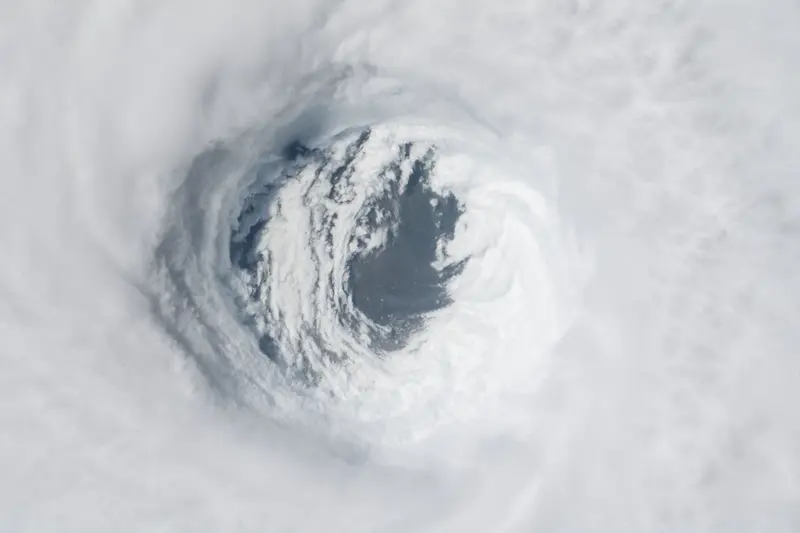
- Those in geostationary orbit photograph half the planet every few minutes. The images show clouds moving, storms forming and hurricanes advancing.
- Those in polar orbit pass much closer and measure, layer by layer, the temperature and humidity of the air all over the globe.
Those data feed powerful supercomputers that simulate how the atmosphere will evolve over the following days. As a result, forecasts have gained roughly one day of useful range every decade: a five-day forecast today is about as reliable as a two- or three-day forecast was a few decades ago. When a hurricane approaches, its path is known days in advance, which allows timely evacuations and saves thousands of lives.
Watching the Earth from above
From orbit, the whole planet can be observed regularly, without regard to borders. Earth-observation satellites are used for:
- Agriculture: identifying which crops are thriving and which are suffering from drought, so that water is applied only where it is needed.
- Fires and floods: detecting them early and guiding emergency teams.
- The climate: measuring polar ice, sea temperature, forest loss and sea level, which satellites measure to within centimeters and which is rising by a few millimeters a year.
- Rescue at sea: ships and aircraft carry emergency beacons that, in a disaster, send a signal to dedicated satellites, which relay the position to rescue services. This system has helped save tens of thousands of lives.
Europe operates one of the most complete systems, called Copernicus, whose data are freely available to anyone.
Looking at the universe without air in the way
The atmosphere, which protects us so well, is an obstacle for astronomers. Its constant motion distorts starlight, which is why stars twinkle, and it absorbs part of the light reaching us from space. From orbit, by contrast, the sky is sharp.
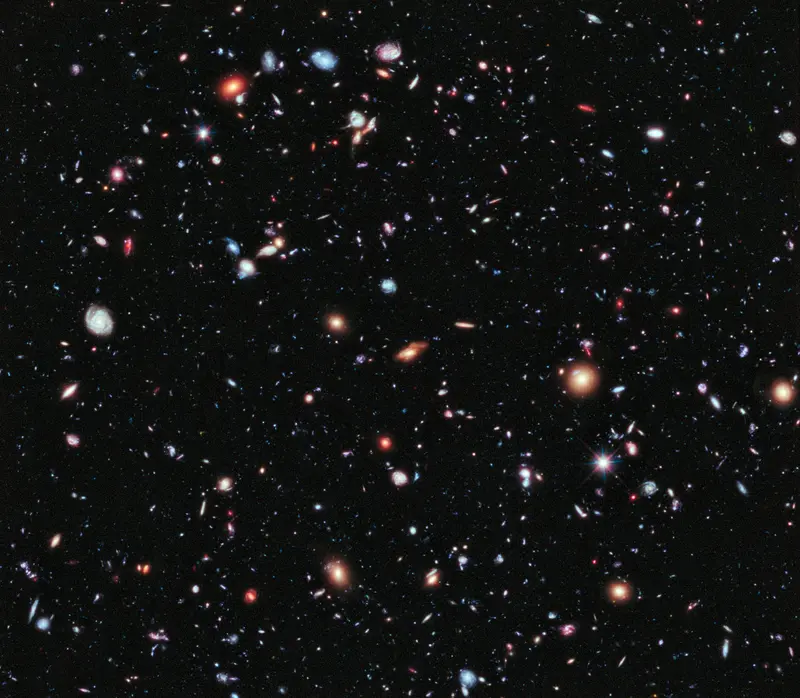
That is why space telescopes have been launched. Hubble, in orbit since 1990, was pointed at a patch of sky that looked empty, smaller than a grain of sand held at arm's length, and revealed thousands of galaxies, each containing billions of stars. Webb, launched in 2021, sees even farther and therefore further back in time.
Probes (uncrewed spacecraft) have also been sent out. They have visited every planet in the solar system, landed on the Moon, on Mars, on a comet and on asteroids, and have even brought samples of rock back to Earth. What we learn about other worlds helps us understand our own.
What space brought home
Solving the problems of spaceflight led to inventions that later found their way into everyday life. Some genuine examples:
- The image sensor in almost every phone camera, developed at a NASA laboratory to create small, low-power cameras.
- The memory foam used in many mattresses and pillows, originally designed for aircraft seats.
- The ear thermometer, which takes a temperature in a second, based on instruments that measure the heat of stars.
- Scratch-resistant coatings on eyeglass lenses.
- Improvements in water purification and in freeze-dried food.
To find out what comes next, from bases on the Moon to mines on asteroids, continue to the future in space.
Key points
- A satellite is a machine in orbit that runs on solar power and communicates with the Earth by radio.
- Communication satellites carry calls, television and internet access to every corner of the world.
- GPS calculates your position by measuring the delay of signals from several satellites carrying atomic clocks.
- Weather and Earth-observation satellites monitor the weather, the climate, fires and the oceans.
- Space telescopes observe the universe without the atmosphere getting in the way.
Test yourself
How does a GPS receiver know how far it is from each satellite?
Why can a satellite TV dish stay fixed, always pointing at the same spot?
Why are telescopes put in space?
Which of these inventions really did come out of space research?