Choosing materials for a spacecraft is one of the hardest problems in engineering. On Earth, a bridge or a car can be built from whatever is strong and affordable. In space, the conditions are far harsher: every kilo is extremely expensive to launch, temperatures swing between oven and freezer, there is no air, invisible radiation slowly degrades everything, and tiny particles strike at speeds far greater than a bullet. This page explains what spacecraft are made of today, and why.
The first enemy: weight
As explained in how a rocket works, about 90% of a rocket's mass is propellant, and only a small fraction reaches orbit. That means every extra kilo on the spacecraft requires many more kilos of propellant to lift it. This is why space engineers are obsessed with weight: a lighter screw, a slightly thinner wall, a shorter cable.
But lightness is not enough. A material also has to be strong (to survive the vibrations and acceleration of launch, which can load the structure with several times its own weight), stiff (so that it does not bend or flex) and able to withstand extreme temperatures. Finding all of those properties at once is the central challenge.
The light metals
Aluminum, and aluminum with lithium
Aluminum is a silvery metal that weighs about a third as much as iron. It was first isolated in a laboratory in the 1820s and, for decades, was so difficult to produce that it was more expensive than silver. Only in the late 19th century did a new industrial process, using electricity, make it cheap. Today it is the most widely used metal in spacecraft and rockets: tanks, walls and structures are made from it. It is not used pure, but as an alloy, mixed with small amounts of other metals to make it stronger, in the same way that bronze is copper alloyed with tin.
One of the best alloys contains lithium, the lightest of all metals, discovered in 1817. A small proportion of lithium makes aluminum both lighter and stiffer, and the tanks of several rockets are made of it today. When the Space Shuttle's large orange external tank was switched to aluminum-lithium, it became several tonnes lighter, and that saving could be used to carry more cargo.
Titanium
Titanium is almost as strong as steel but about 40% lighter, tolerates heat much better than aluminum and does not corrode. It is expensive and difficult to machine, so it is reserved for the most demanding parts: engine mounts, critical bolts and high-pressure gas tanks.
Steel, making a comeback
Stainless steel (the kind used for kitchen cutlery) is heavier, but it is cheap, easy to weld and copes very well with both high temperatures and the extreme cold of liquefied propellants. That is why some giant rockets currently being tested have returned to it: sometimes cheap and tough beats light and delicate.
Epic moment · April 10, 2026
Coming Home from the Moon: Artemis II Reentry
A camera attached to the pilot's window of the Orion capsule records the return of the four Artemis II astronauts after looping around the Moon. The spacecraft enters the atmosphere at almost 40,000 km/h (25,000 mph) and the air, compressed in front of the heat shield, becomes a glowing plasma at about 2,700 °C: that is why the window turns pink and orange and sparks of burning material fly off. Minutes later the red and white parachutes open, slowing the capsule until it settles gently in the Pacific Ocean.
Watch the full moment, with soundNASA · Public domainComposites: fibers and glue
A composite material combines two different materials so that each makes up for the other's weakness. Reinforced concrete is a familiar example: concrete resists being squeezed but cracks easily when pulled, so steel bars are embedded in it to carry the pulling forces. Fiberglass, used in boat hulls and surfboards, works the same way: glass fibers held in a hard plastic.
The best-known composite in aerospace is carbon fiber: carbon filaments about ten times thinner than a human hair, extremely strong when pulled, laid in layers and bonded with a resin (a liquid plastic that hardens permanently, much like a two-part epoxy glue). The result is a part that is strong, stiff and much lighter than a steel part that could carry the same load. Rocket nose fairings, satellite structures and gas tanks are made of it. Its drawbacks: it is expensive, and a small air bubble trapped between layers can weaken it without any visible sign on the surface.
Heat: from oven to freezer
As explained in what is space?, in orbit the side of a spacecraft facing the Sun can exceed 100 °C while the shaded side drops below −100 °C, and a spacecraft in low orbit passes from sunlight to shadow every hour and a half. Materials expand when heated and contract when cooled, which is why bridges and railway tracks have small gaps built into them. If two joined parts expand by different amounts, they strain against each other until something cracks.
The main solution is multilayer insulation: dozens of extremely thin plastic sheets, each coated with a microscopic film of reflective metal (often gold-colored), separated by a fine mesh. Each layer reflects heat back, like a mirror, and the effect is multiplied many times over. This is the shiny "gold foil" seen wrapped around satellites.
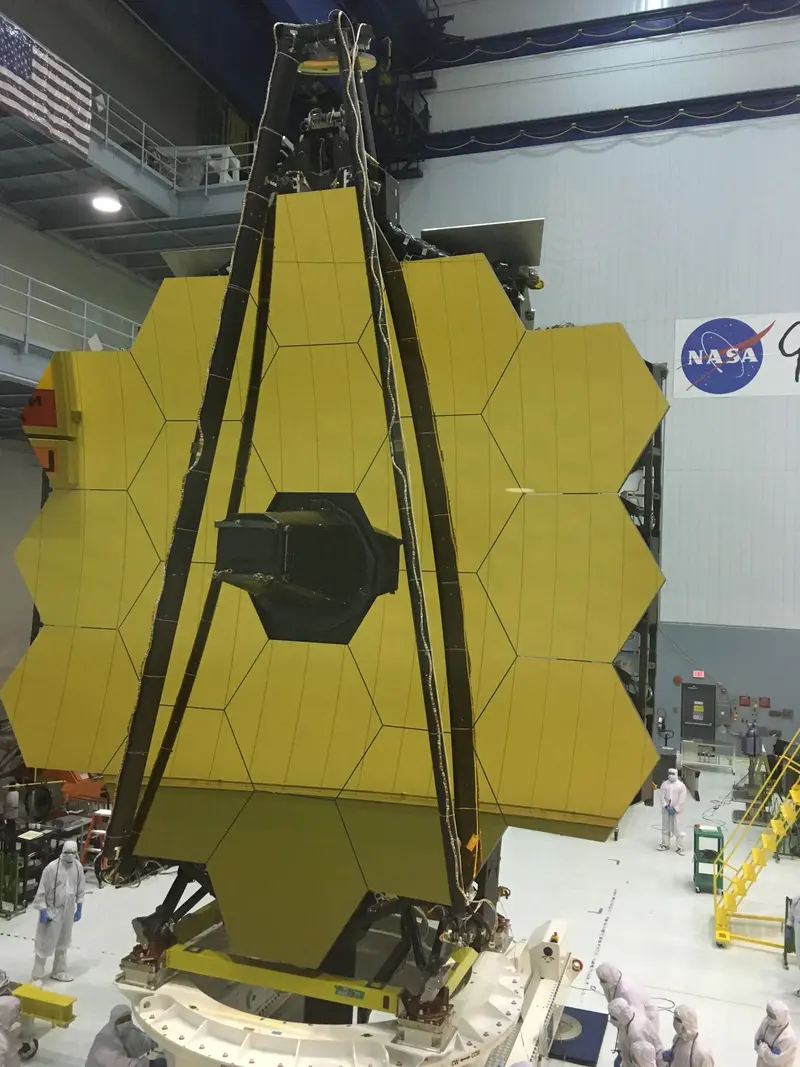
The most extreme example is the Webb Space Telescope. Its sunshade has five layers of this kind of plastic, each the size of a tennis court. The side facing the Sun is about as hot as a low oven, while the other side is more than 200 °C below zero, because the telescope's instruments need intense cold to work properly.
The fire of the return: heat shields
The hardest test comes on returning to Earth, when the air compressed in front of the spacecraft reaches thousands of degrees (see reaching orbit). Three kinds of material are used:
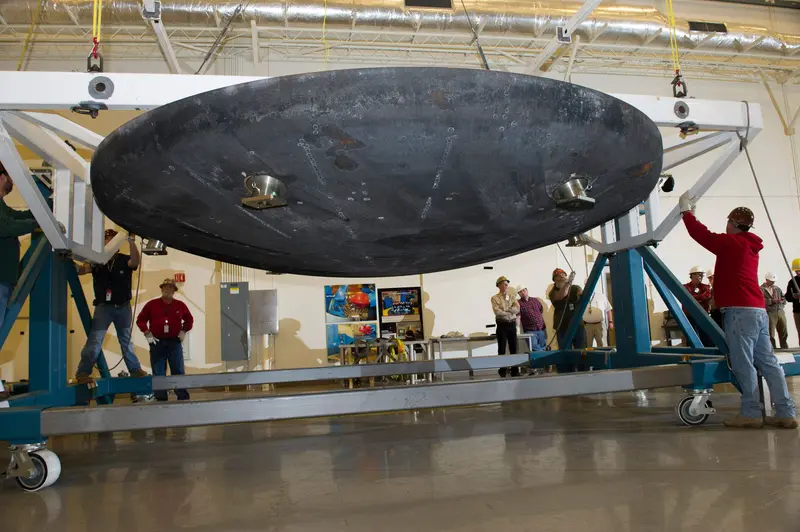
- Ablative: resins reinforced with fibers that char and erode layer by layer, carrying the heat away with them, much as a log chars on the outside while its core stays cool. These are used on capsules returning from the Moon. Some modern ones are made of carbon fiber soaked in resin and are extremely light.
- Ceramic tiles: made of very pure silica (glass) fibers and consisting mostly of empty space inside. They withstand more than 1,000 °C and conduct so little heat that one can be held by its edges moments after being taken out of a furnace.
- Reinforced carbon-carbon: carbon fibers embedded in a carbon matrix, baked repeatedly. It withstands more than 1,500 °C and is used on the nose and the leading edges of the wings, the hottest areas. In 2003, a piece of insulating foam that broke off during launch punched a hole in this material on the leading edge of one wing of the Space Shuttle Columbia. During reentry, hot gas entered through the hole, and the spacecraft was destroyed with its seven crew.
Game
The heat shield
The engine: surviving inside the fire
The combustion chamber of a rocket engine reaches more than 3,000 °C, hotter than almost any metal can withstand. So why does it not melt? The chamber walls, usually made of a copper alloy (copper conducts heat extremely well), are lined with tiny channels through which the super-cold liquid propellant flows before it is burned. The propellant cools the wall and, at the same time, warms up so that it burns more efficiently. The principle is similar to the water-cooling system of a car engine, but far more intense.
The bell-shaped nozzles are made of metals that tolerate very high temperatures, such as niobium, or of ceramic and carbon materials. A glass-ceramic, a glass that has been treated so that part of it crystallizes internally, can withstand sudden, extreme temperature changes without cracking: it is the material used in many modern cooktops. More and more engine parts are now produced by 3D printing in metal, in which a laser melts metal powder layer by layer. This makes it possible to form those intricate internal cooling channels.
In the Gamoras 3D Mission you have to make exactly that, a glass-ceramic nozzle, in a workshop, using what you find on an asteroid.
 ActivityGamoras 3D MissionLand a damaged ship on a 220 km asteroid, search for water with a hopping robot, make propellant and a glass-ceramic nozzle, and fly back up to dock with your ship in orbit. With real physics.Play the mission
The vacuum does strange things
With no air around them, materials behave in ways that are never seen on Earth.
- Outgassing. Many plastics, adhesives and varnishes slowly release gases trapped inside them; the smell of a new car or freshly painted room comes from this. In a vacuum the release is much stronger, and the vapors condense on lenses and sensors, fogging them. That is why, before flight, components are "baked" in vacuum chambers so that they release those gases on the ground.
- Cold welding. On Earth, every metal surface is covered by an extremely thin layer of oxide (the first stage of rust), which keeps it from bonding with other metal. In a vacuum, if that layer wears away, two very clean metal surfaces in contact can fuse together with no heat at all. That is why moving parts are coated or made of dissimilar materials.
- Lubricants that evaporate. Ordinary oil evaporates in a vacuum. Special greases or dry lubricants are used instead, such as graphite, the same material as the "lead" in a pencil.
Radiation, loose oxygen and shrapnel
Radiation turns plastics yellow and brittle, in the same way that strong sunlight yellows paper or fades a plastic garden chair left outdoors, and it can disrupt onboard computers. Radiation-resistant plastics are chosen, and sensitive electronics are shielded with metal.
Loose oxygen. In low orbit a trace of atmosphere remains, and at that altitude oxygen does not exist as pairs of atoms bonded together, as in the air we breathe, but as single, highly reactive atoms. Striking the spacecraft at 8 km/s, they gradually erode plastics, much as wind-blown sand wears down rock. Exposed surfaces are protected with extremely thin coatings of glass.
Shrapnel. Tiny particles of natural dust and, above all, debris from old rockets and satellites circle the Earth at speeds of about 10 km/s. At that speed, a fleck of paint once left a small pit in a Space Shuttle window. The defense is the Whipple shield: a thin outer sheet, a gap, and then the real wall. The outer sheet does not stop the projectile, but it shatters it into a cloud of fragments that spreads out and can no longer penetrate the wall. The energy of a single concentrated impact is spread over a wide area.

Key points
- In space every kilo counts: engineers look for materials that are light, strong, stiff and heat-resistant.
- Aluminum-lithium, titanium, steel and carbon fiber are the key materials of rockets and spacecraft.
- Multilayer insulation protects against the Sun and the cold; ablative shields, tiles and carbon-carbon protect against the heat of reentry.
- The engine does not melt because the super-cold propellant itself cools its walls.
- The vacuum brings outgassing, cold welding and evaporating lubricants; orbit brings radiation, loose oxygen and shrapnel.
Test yourself
Why is lithium added to the aluminum in the tanks of some rockets?
What is a composite material such as carbon fiber?
What can happen in a vacuum to two very clean pieces of metal that touch?
How does the so-called Whipple shield protect a spacecraft from particles flying at enormous speed?