Imagine spending six months inside a sealed building with no windows that open, no water supply, no garden and no shops, and with no air at all outside the walls. That is how astronauts live on the International Space Station, which circles the Earth about 400 km up and has been continuously occupied since the year 2000. This page explains how the most basic needs are met (breathing, drinking, eating, avoiding extreme heat and cold), what space does to the human body, and what a spacesuit is really like.
A house that circles the Earth
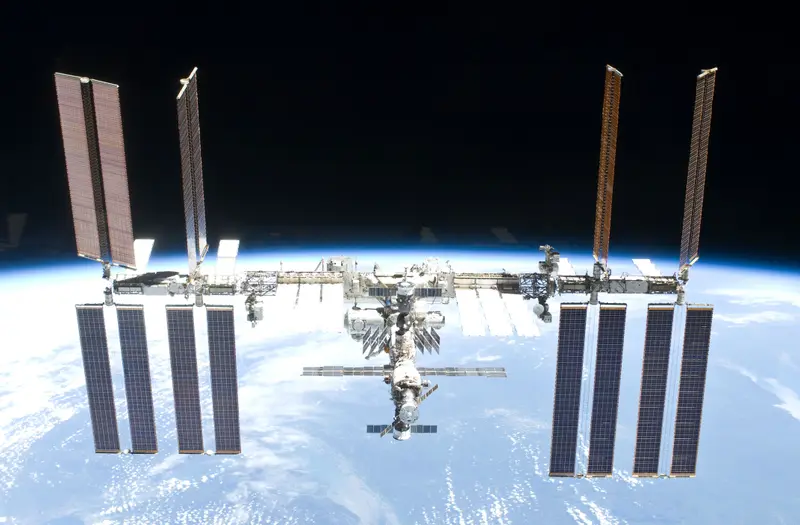
The Station is enormous: including its large wings of solar panels, it is about as long as a football pitch (about 110 meters) and weighs about 420 tonnes. Inside, the habitable space is similar to that of a large multi-storey house, spread through a series of connected cylindrical modules. Usually about seven people live on board.
The solar panels convert sunlight into electricity, which powers everything on board: lighting, fans, water-processing equipment and computers.
The air: making oxygen and removing waste gases
Breathing is the most urgent need: without air, a person dies within minutes. Inside the Station the air is kept the same as at sea level: the same pressure and the same proportion of oxygen. That requires two separate processes.
Producing oxygen. Water is made of two elements: hydrogen and oxygen. Passing an electric current through water splits it into those two gases, a process called electrolysis, first demonstrated in 1800. The Station does this continuously: it splits water and supplies the oxygen to the cabin.
Removing stale air. Every breath we exhale contains a gas called carbon dioxide, the same gas that forms the bubbles in fizzy drinks. In a closed room it builds up, causing headaches and drowsiness and, in high concentrations, it is lethal. The Station captures it with special filters that absorb it like a sponge, and some of it is combined with the leftover hydrogen to produce water again.
There is one detail few people would think of: the fans. On Earth, the warm air you breathe out rises on its own, because it is lighter, and fresh air takes its place. In weightlessness nothing rises or sinks: exhaled air would linger around your head like an invisible cloud. That is why the fans are never switched off, and astronauts sleep near one.
Epic moment · April 4, 2026
A Floating Ball of Water
Without gravity, water doesn't fall or spill: its own surface tension pulls it into an almost perfect sphere that floats in the air. Aboard the Orion capsule, on the way to the Moon, the Artemis II astronauts play with one of these balls. Notice the detail: the sphere works like a magnifying glass and shows the astronaut's face upside down, just like the lens of an eye or a camera.
Watch the full moment, with soundNASA · Public domainThe water: yesterday's coffee is tomorrow's coffee
Sending water up from Earth is extremely expensive: every liter is a kilo of cargo that has to be launched into orbit. So the Station recycles almost all of it. It collects the moisture from breath and sweat that ends up in the air, and also the crew's urine. A machine distils it at low pressure, filters it and purifies it until it is cleaner than most tap water. Today about 98% of the water is recovered.
Astronauts sum it up with a well-known line: yesterday's coffee is tomorrow's coffee. The process mirrors the water cycle on Earth (seawater evaporates, is purified, and falls as rain into rivers), but inside a metal module and within a few hours.
Food: from the pantry to the floating plate
Food cannot be recycled (not yet), so it arrives on uncrewed cargo spacecraft every few months, much like supply flights to a remote research base in Antarctica. Each astronaut uses almost two kilos of food a day, packaging included.
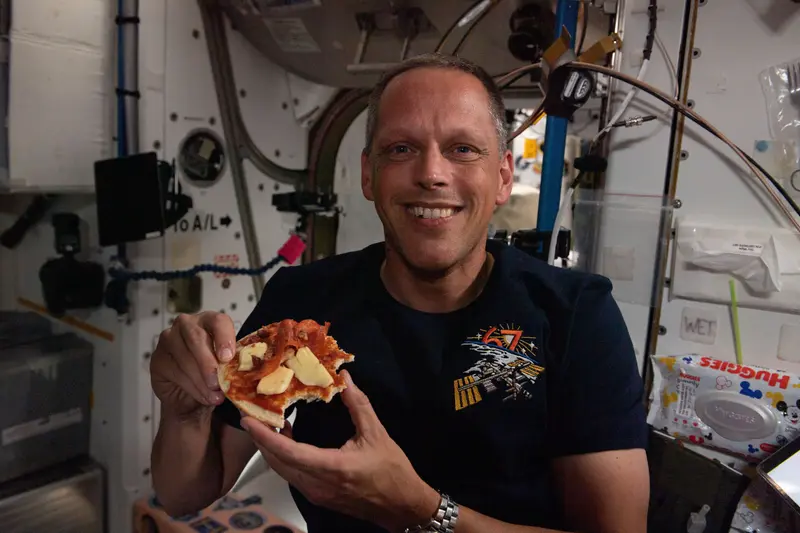
Almost all of it is dehydrated (the water is removed so it weighs less and keeps longer, like instant soup or dried fruit), thermally preserved in cans, or sealed in pouches. Hot water is added and the food is eaten with a spoon straight from the pouch. There are some unusual rules:
- No bread: crumbs would float everywhere and could get into eyes or equipment. Flour tortillas, which do not crumble, are used instead.
- Liquid salt and pepper, suspended in oil or water, because loose grains would drift away.
- Plenty of spicy food: in weightlessness the nose becomes congested and food tastes bland, as it does when you have a cold.
Game
Keep the crew alive
You can test this in the game: with a crew in your care, do you recycle or bring supplies from Earth? You will see why recycling water and air becomes essential as soon as missions get longer.
Neither roasting nor freezing
As explained in what is space?, with no air around, whatever faces the Sun bakes and whatever is in shade freezes. On top of that, the people and equipment inside generate heat all the time, like a kitchen with the oven on.
The Station handles this in two ways. On the outside, it is wrapped in blankets made of many very thin, reflective layers that reflect sunlight and retain heat. On the inside, pipes filled with liquid run through the walls, collecting excess heat (much as blood carries heat around the body) and carrying it to large white radiators that release it into space on the shaded side. This keeps the interior at about 22 °C, a comfortable room temperature.
Radiation: a rain you cannot see
The Station is still protected by the Earth's magnetic field, but it flies above the atmosphere. The people on board receive considerably more radiation than they would on the ground: in a single day, roughly what they would receive on Earth in several months.
This is how the risk is managed: each astronaut wears a radiation monitor; missions are limited in length (usually six months, sometimes a year) so as not to exceed a safe cumulative dose; and when the Sun releases a strong solar storm, the crew moves to the best-shielded areas, where more metal, water and equipment stand between them and the outside, much as people take shelter in a basement during a severe storm. Farther from the Earth, on the way to the Moon or Mars, radiation levels are higher, and this remains one of the major unsolved problems of long-distance spaceflight (see the future in space).
The body in weightlessness
The human body is adapted to living with weight. When weight disappears for months, many things change.
- Bones lose strength. The body only maintains bones that are under load. Without weight, the bones of the legs and hips lose about 1% of their mass a month.
- Muscles weaken, especially those of the legs and back, which no longer have to hold the body up.
- Blood and other fluids shift toward the head. With no gravity pulling them toward the feet, astronauts develop puffy faces and thinner legs. Some experience changes in their eyesight.
- They grow a few centimeters taller, because the spine stretches when it is not supporting weight. They lose the extra height after returning.
- The sense of balance is disrupted for the first few days, and many astronauts feel nauseous, similar to seasickness.
The main countermeasure is exercise: about two hours a day. Astronauts run on a treadmill wearing a harness with elastic straps that holds them against it (otherwise they would float away at the first stride), pedal an exercise bike and lift "weights" on a machine that uses vacuum cylinders for resistance, because an ordinary dumbbell weighs nothing up there. Even so, after returning to Earth they need weeks of rehabilitation before they walk normally again.
The spacesuit: a spacecraft made to measure
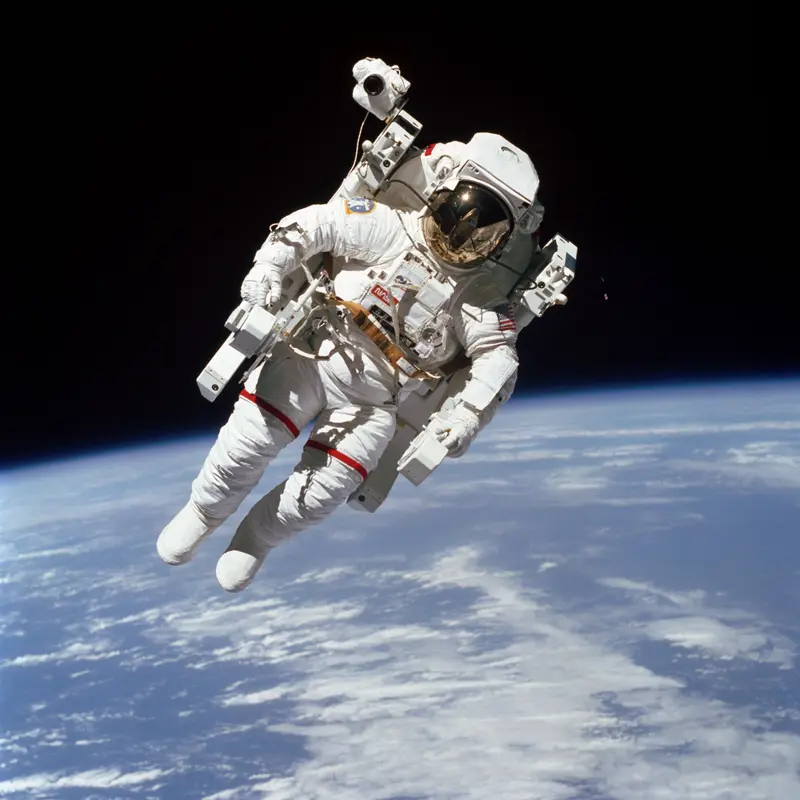
To go outside to carry out repairs, an astronaut puts on a spacesuit, which is effectively a small spacecraft shaped like a person. It has:
- Many layers, more than a dozen: some keep it pressurized (without pressure, the body's fluids would begin to boil), others insulate against heat and cold, and the outermost ones protect against tiny particles of debris travelling faster than a bullet.
- A backpack containing oxygen, filters to remove carbon dioxide, a battery and a radio. It is a portable life-support system that lasts about seven or eight hours.
- An undergarment threaded with small tubes of cold water, because the wearer sweats heavily inside the suit and the heat has nowhere else to go.
- A helmet with a gold-coated visor, which filters out the intense sunlight.
On the ground, the complete suit weighs more than an adult person: about 130 kilos or more. In orbit it weighs nothing, but it is still hard to move in, and working in the pressurized gloves tires the hands like squeezing a rubber ball for hours. Before going outside, the astronaut breathes pure oxygen for a long period to flush nitrogen, another gas in normal air, out of the blood. Otherwise it would form bubbles when the pressure drops, like the bubbles that appear when a bottle of fizzy water is opened.
Astronauts are always attached to the Station by a tether, like a climber clipped to a safety rope.
And to try surviving far from home, with little fuel and only your own resources, the Gamoras 3D Mission leaves you stranded on an asteroid with a damaged spacecraft.
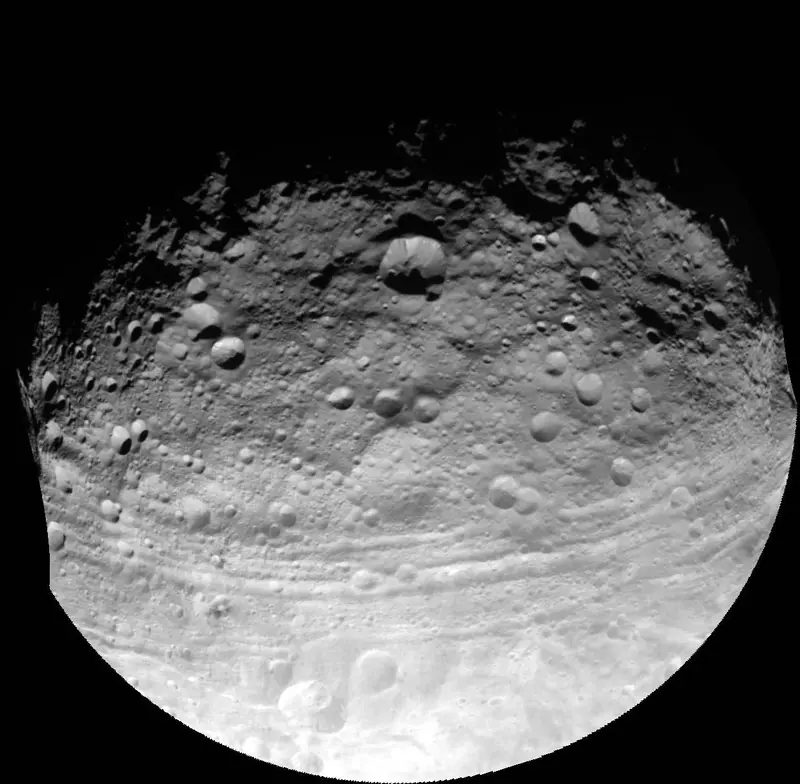 ActivityGamoras 3D MissionLand a damaged ship on a 220 km asteroid, search for water with a hopping robot, make propellant and a glass-ceramic nozzle, and fly back up to dock with your ship in orbit. With real physics.Play the mission
Key points
- The Station keeps the same air as at sea level: it makes oxygen by splitting water and removes carbon dioxide with filters.
- It recycles about 98% of its water, urine included; food arrives on cargo ships.
- Blankets, pipes and radiators keep it at about 22 °C between the scorching Sun and the freezing shade.
- Weightlessness weakens bones and muscles: astronauts exercise for two hours a day.
- The spacesuit is a small spacecraft: pressure, air, cold water, radio and about eight hours of endurance.
Test yourself
Where does most of the oxygen breathed by the astronauts on the Space Station come from?
Why does the Station need fans running all the time?
What happens to an astronaut's bones after months of weightlessness without exercise?
How much of the Station's water is recycled, urine included?