Two ideas from earlier lessons come together here: an orbit is falling without ever reaching the ground (see gravity and orbits), and a rocket produces thrust by throwing gas backward (see how a rocket works). This lesson combines them: how a vehicle gets from the launch pad to circling the Earth, how much speed that requires, why the climb takes only about nine minutes and, finally, the most dangerous phase of all: coming back.
The key number: 8 kilometers every second
To stay in low orbit, at about 400 km, a spacecraft must travel at about 7.8 kilometers per second. At that speed it would cover the distance from London to Edinburgh in a little over a minute, and go right around the world in an hour and a half.
The surprising part is this: the height is the easy part. Lifting something to 400 km takes far less effort than giving it that sideways speed. Of the total effort needed to reach the Space Station, about nine tenths goes into gaining speed and only one tenth into climbing. A rocket that rose straight up to 400 km and stopped would simply fall back down, like a bullet fired vertically.
First up, then sideways
If what matters is sideways speed, why do rockets lift off vertically? Because of the air. Near the ground the air is dense, and pushing through it at high speed is like trying to run while waist-deep in water: it slows you down enormously and generates heat. So a launch follows this sequence:
- The rocket lifts off vertically and climbs slowly at first, because it is extremely heavy. For the first few seconds it moves more slowly than a car pulling away from traffic lights.
- It gradually tilts over, following a smooth curve as it leaves the dense air. About one minute after liftoff it passes through the point of maximum stress, when the air, though already thinner, strikes it hardest because the rocket is now moving very fast.
- After two or three minutes it is more than 60 km up, above almost all of the atmosphere, and the first stage separates.
- The second stage keeps firing almost horizontally, building up sideways speed, until eight or nine minutes after liftoff it reaches 7.8 km/s. The engine shuts down. The vehicle is in orbit: from then on it falls around the Earth indefinitely.
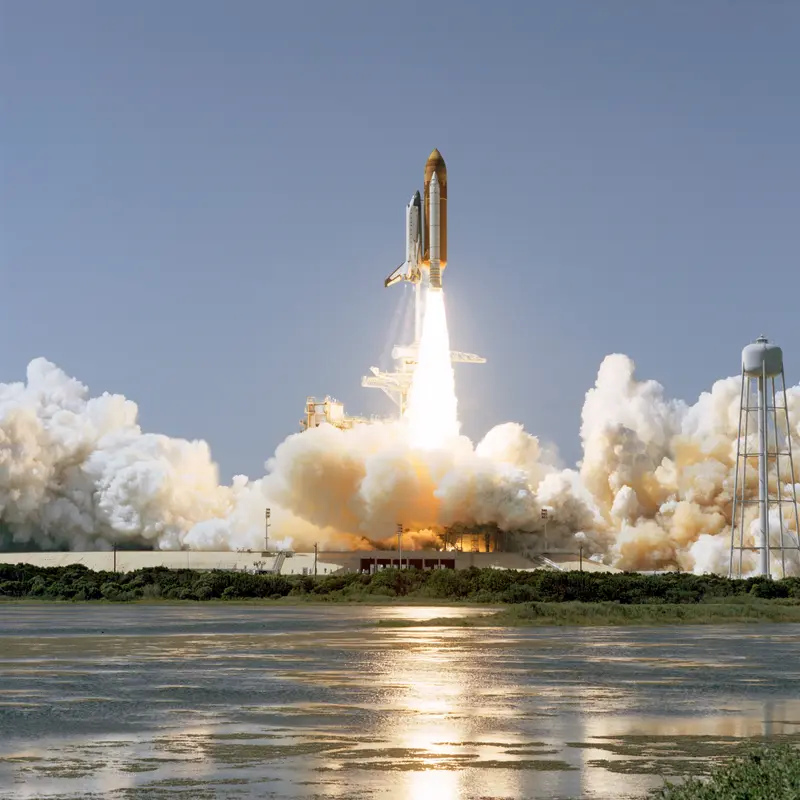
Epic moment · November 16, 2022
Artemis I Launch
At 1:47 a.m. Eastern Time (7:47 a.m. in Spain), in the dead of night in Florida, the SLS rocket ignites its four engines and its two side boosters and turns darkness into day. With about 39 million newtons of thrust, it was then the most powerful rocket ever launched. It carried the uncrewed Orion capsule on a 25-and-a-half-day trip around the Moon: the dress rehearsal for sending people back there.
Watch the full moment, with soundNASA · Public domainThe speed budget
Engineers do not plan in terms of distance travelled but in terms of speed that must be gained or lost. They call it delta-v (from "change in velocity"). It works like a travel budget: each leg of a journey costs a certain amount, and the propellant on board is the money available to spend.
To reach low orbit, the figures are roughly:
- 7.8 km/s for the orbital speed itself.
- About 1.5 to 2 km/s more lost along the way: partly to air resistance and, above all, because while the rocket climbs, gravity pulls it downward and robs it of speed (as a cyclist loses speed going uphill).
- In total, about 9 or 10 km/s.
That is why, as explained in how a rocket works, almost the whole rocket has to be propellant. Travelling farther (to geostationary orbit, or to the Moon) adds more to the budget, as explained in the journey to the Moon.
Coming back: the problem of slowing down
Reaching orbit required all that speed. Coming back requires losing it. In principle the engine could be used to brake, but that would mean carrying as much propellant into orbit as was used to launch: impossible. Instead, spacecraft rely on the atmosphere to slow them down.
The spacecraft fires its engine for a few minutes to slow down slightly, just enough for its orbit to dip into the upper atmosphere. From that point, the air does the rest. But slowing down from 7.8 km/s using air has a severe cost: heat.
How much? Every kilo of spacecraft moving at that speed carries as much energy as about seven kilos of TNT. All of that energy has to be shed within a few minutes. If it all reached the spacecraft, it would melt like wax in an oven.
Where does the heat come from? Not so much from friction as from compression. When you pump up a tyre with a hand pump, the pump gets warm, because compressing air heats it. A returning spacecraft slams into the air so fast that it compresses it in front of itself and heats it to several thousand degrees, hotter than the surface of some stars. The air glows like white-hot metal and forms a fireball around the spacecraft. For several minutes, that superheated air even blocks radio contact with the ground.
The heat shield
The solution is a protective layer on the front of the spacecraft: the heat shield. There are two main types.
The shield that burns away: ablative
This type is used on capsules returning from the Moon. It is made of a mixture of resins and fibers that, as they heat up, char and flake away layer by layer. Each fragment that breaks off carries heat away with it. It is similar to a thick log on a fire: the outside turns black and burns away, but the core stays cool for a long time. It works only once, but it is very reliable.
The shield that endures: reusable tiles
The Space Shuttle was covered in thousands of tiles made mostly of very pure silica fibers and, internally, almost entirely of air. They conduct heat so poorly that one can be held by its edges moments after being taken out of a red-hot furnace. They do not burn away, so they can be reused many times, but they are fragile and each one has to be inspected individually.
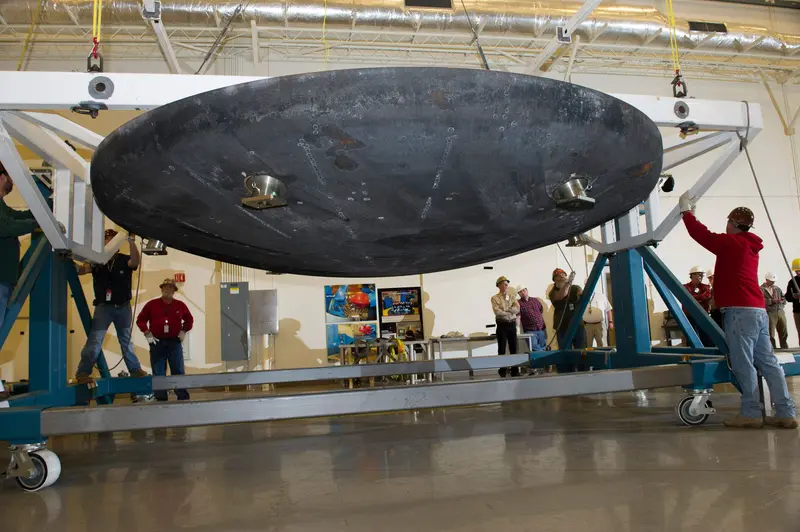
Shape matters too. Capsules are not pointed like an arrow: they have a wide, rounded base, like the bottom of a frying pan. That shape holds the layer of glowing air slightly ahead of the spacecraft, so that it does not touch the shield directly.
Game
The heat shield
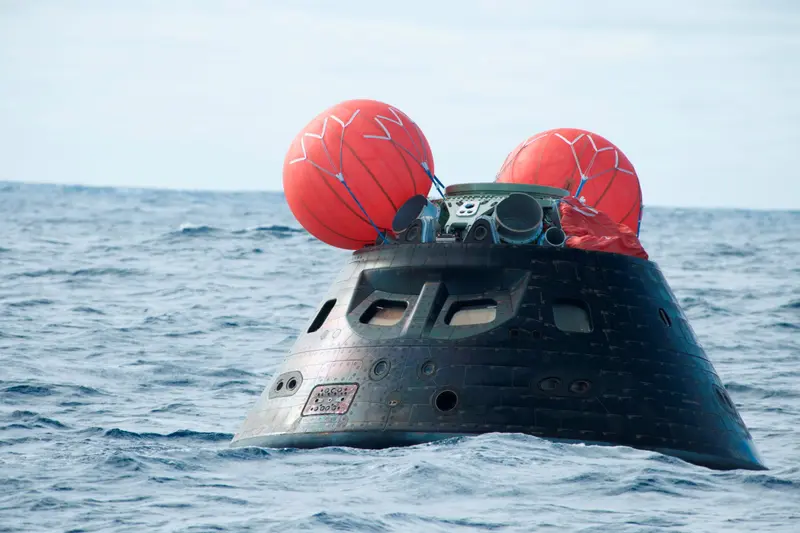
Once the worst is over, below 10 km and slower than the speed of sound, the parachutes open: first small ones to stabilize the capsule, then the large main ones. The capsule splashes into the sea at about 25 or 30 km/h, the speed of a car on a quiet residential street, or touches down on land, firing small rockets at the last moment to soften the impact.
Rockets that come back and land
For half a century, rockets were used once and discarded: the first stage, an extremely expensive machine the size of a building, fell into the sea after a few minutes of use. It was as if every airliner were scrapped after a single flight.
That is now changing. Some rockets recover their first stage: after separation, it reignites its engines to turn around and slow down, deploys landing legs and lands upright on a pad on land or on a ship at sea. It is then inspected, refuelled and flown again. Some boosters have already flown more than twenty times. As a result, putting a kilo into orbit now costs several times less than it did twenty years ago. Giant rockets are also being tested that would be fully reusable, including the upper stage.
For anyone who wants to experience it, the Gamoras 3D Mission ends in exactly this way: you have to take off from an asteroid, reach precisely the right speed to enter orbit, and approach the mothership carefully to dock.
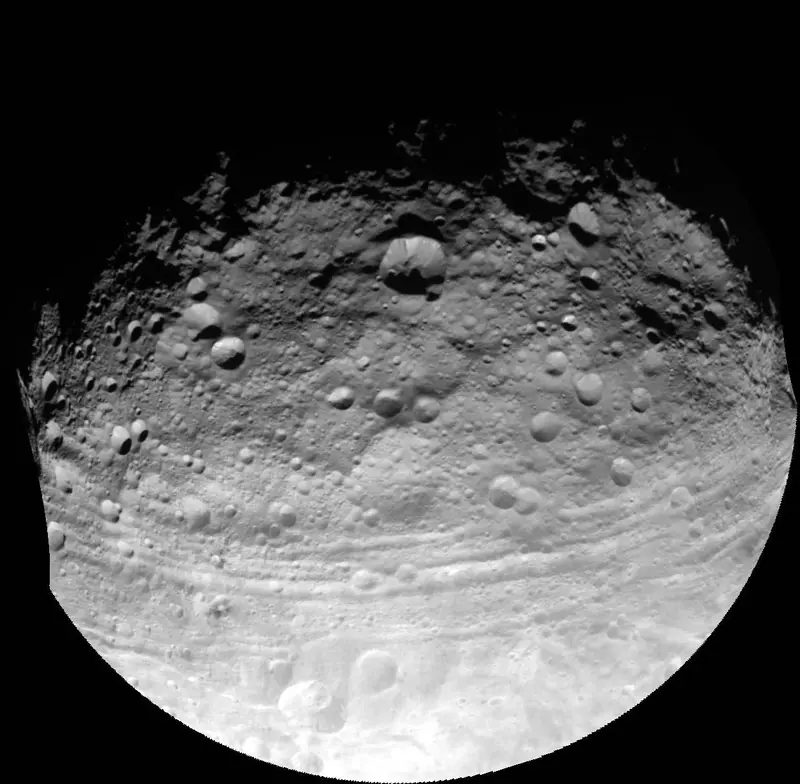 ActivityGamoras 3D MissionLand a damaged ship on a 220 km asteroid, search for water with a hopping robot, make propellant and a glass-ceramic nozzle, and fly back up to dock with your ship in orbit. With real physics.Play the mission
Key points
- Low orbit demands about 7.8 km/s sideways: the height is the easy part, the speed is the hard part.
- The rocket climbs straight up to get out of the thick air and then leans over to gain speed; it takes about nine minutes.
- Counting the losses, the budget for reaching orbit is about 9 or 10 km/s.
- On the way back, the air slows the spacecraft and heats it; the heat shield (ablative or tiles) and a wide shape protect it.
- Today some rockets land upright and are reused, which makes the trip much cheaper.
Test yourself
What is the hardest part of reaching orbit?
Why does a rocket first go straight up and then gradually tilt over?
Where does most of the terrible heat of reentry come from?
How does an ablative heat shield protect a capsule?
More to practise
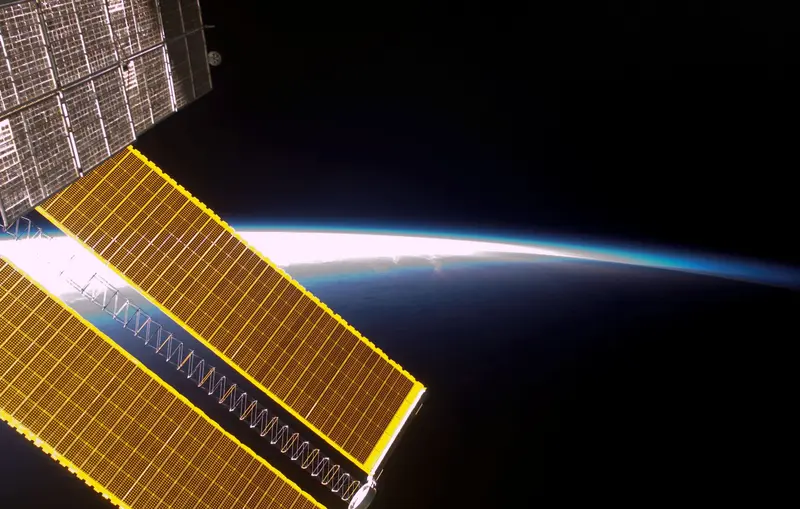 GameClimb through the atmosphereRise from the ground to 1,000 km: clouds, airliners, balloons, the Kármán line, the auroras and the Space Station.
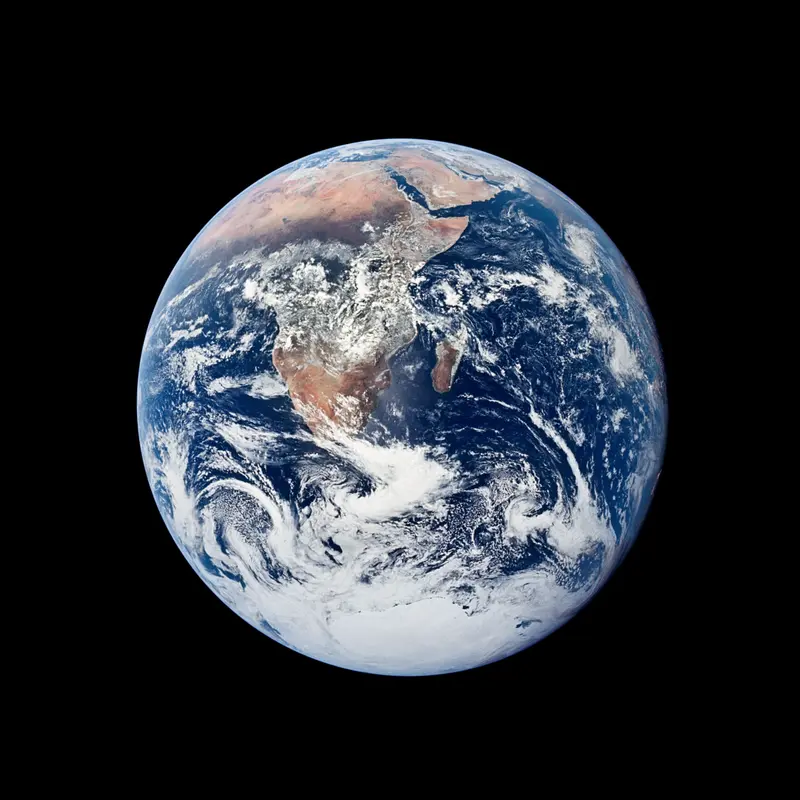 GameNewton’s cannonFire a cannonball from an impossibly tall mountain at the speed you choose: does it fall, circle the Earth or escape forever?
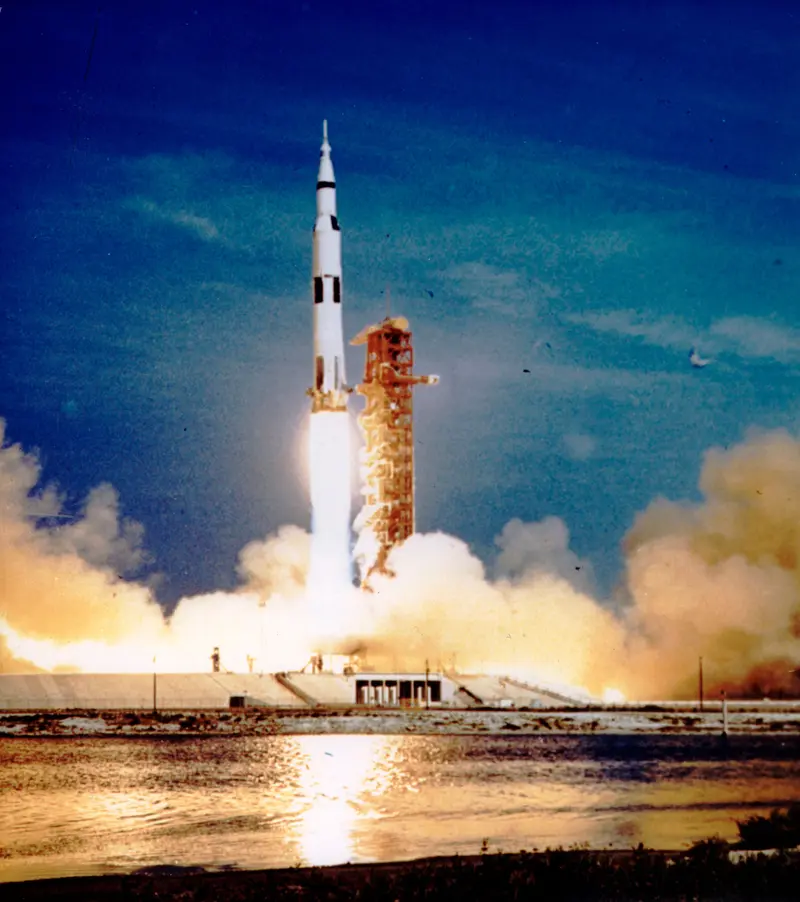 GameDesign your rocketChoose the propellant, the stages and the payload, and see whether your rocket reaches orbit or the Moon. The rocket equation in action.