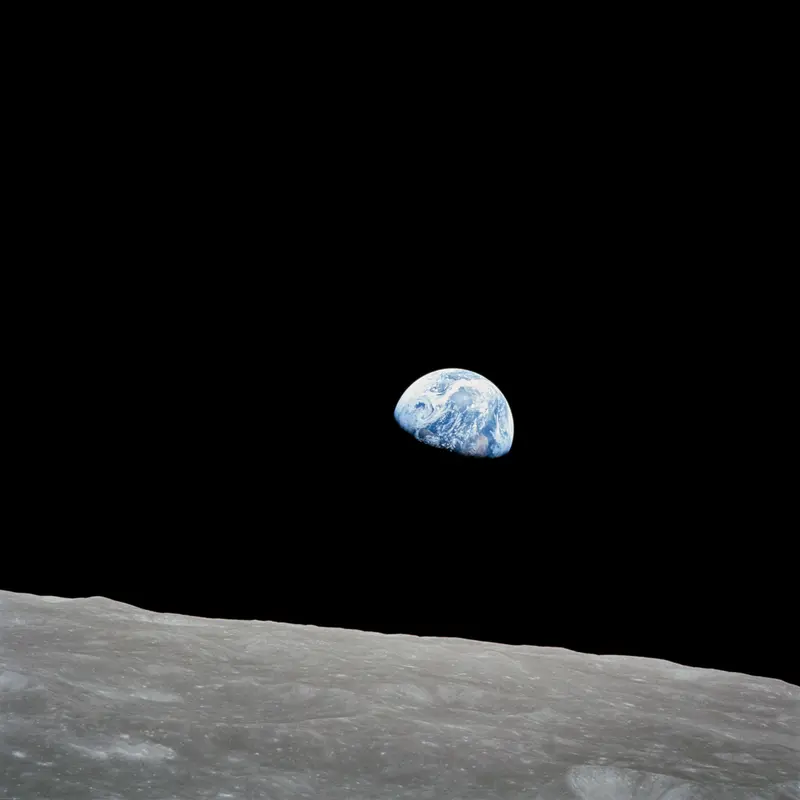
The Moon is the only place beyond the Earth where human beings have set foot. Twelve men walked on it between 1969 and 1972, and a return is now being prepared. This page explains how the journey is made, step by step: how far away the Moon is, why spacecraft do not travel there in a straight line, how they brake on arrival, how they land where there is no air, and how they get back. It also explains what makes each of those steps so difficult.
How far away it is
The Moon is about 384,000 km from the Earth. To put that in perspective, about thirty Earths lined up side by side would fit in the gap. The light we see from the Moon is sunlight reflected off its surface, and it takes a little over one second to reach us.
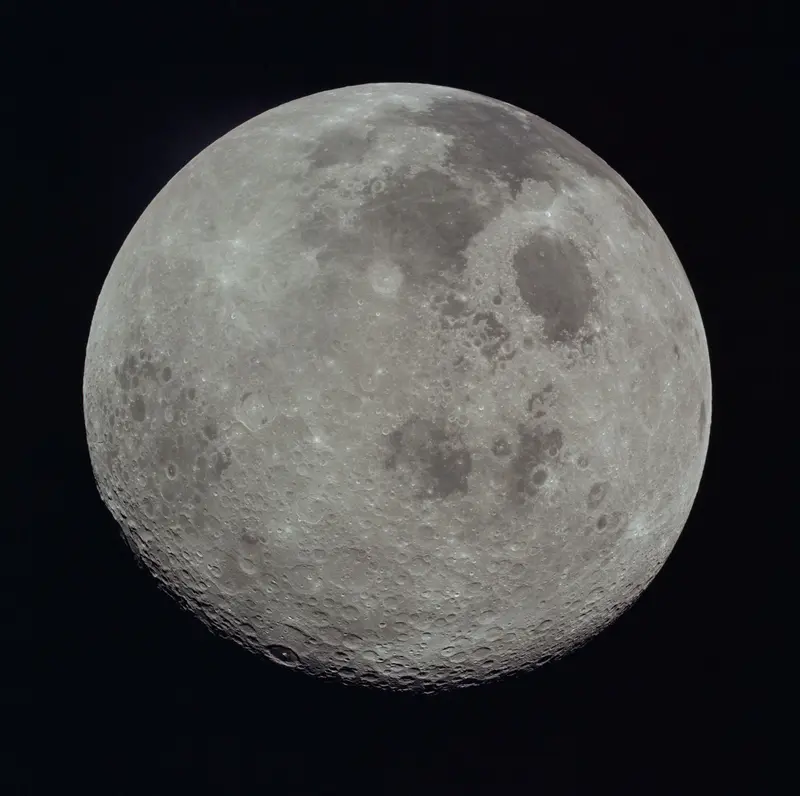
The Moon is much smaller than the Earth: about a quarter as wide, with a surface gravity one sixth of ours (see gravity and orbits). It has no air, no liquid water and no life. Its surface is a layer of gray dust and rock, marked with craters left by billions of years of impacts from objects falling out of space.
Steps one and two: climb to orbit and head for the Moon
The first part of the journey is the same as for any other launch, described in reaching orbit: a large rocket lifts the spacecraft until it is circling the Earth at about 8 km/s. That first orbit works as a staging point. Mission controllers use it to check that every system is working before committing to the trip.
When everything is ready, the rocket's last stage fires its engine for a few minutes and the spacecraft accelerates from about 8 to about 11 km/s, close to the Earth's escape velocity. Its orbit stretches into a very long ellipse whose far end reaches the distance of the Moon.
For about three days the spacecraft coasts with its engine switched off. It slows down steadily the whole way, because the Earth's gravity keeps pulling back on it. Only when it gets close to the Moon does the Moon's gravity become the stronger of the two, and the spacecraft starts to speed up again as it falls toward it.
There is an important detail: the spacecraft is not aimed at the Moon, but at where the Moon will be. The Moon moves along its orbit around the Earth at a little over one kilometer per second, so in three days it covers a large stretch of that path. The principle is the same as passing a ball to someone who is running: you throw it to where they are going to be, not to where they are now.
Epic moment · July 20, 1969
The Eagle's Moon Landing
This is the film that a 16 mm camera recorded through Buzz Aldrin's window as the Eagle lunar module descended toward the Sea of Tranquility. The computer alarms kept sounding and the planned spot was full of rocks, so Neil Armstrong took the controls and searched by hand for a flat place. At the end you can see the lunar dust swept up by the engine and the shadow of one of the leg probes: they touched the Moon with fuel for less than a minute.
Watch the full moment, with soundNASA · Public domainStep three: brake and stay in lunar orbit
If it did nothing, the spacecraft would sweep past the Moon at high speed and carry on into space. To stay, it has to brake: it turns around so that its engine points in the direction of travel and fires it for several minutes. That removes just enough speed for it to be captured into orbit around the Moon, constantly falling toward it and constantly missing, exactly as a satellite does around the Earth.
This maneuver is usually performed over the far side of the Moon, the side that never faces the Earth. While the spacecraft is there, the Moon itself blocks radio signals and no communication is possible. Mission control can only wait for the spacecraft to reappear around the edge.
Step four: landing with no air
Descending to the Moon is very different from returning to Earth. With no atmosphere there is no friction heating, so no heat shield is needed. But there is a serious drawback: parachutes are useless. The only way to slow down is to fire the engine downward, all the way to the surface.
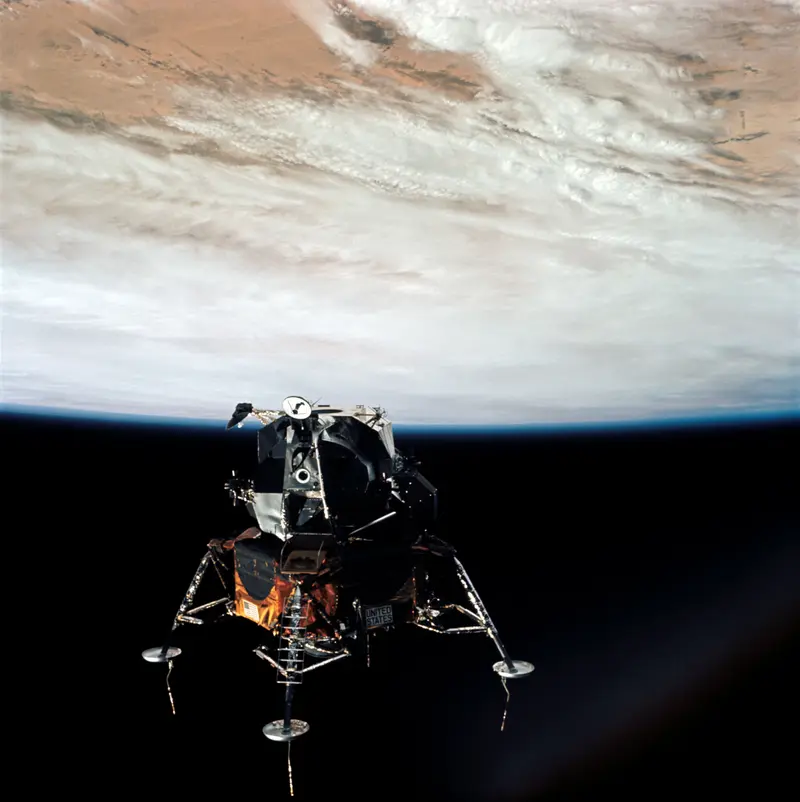
That is why a dedicated vehicle is used, the lunar module, with landing legs and an engine pointing at the ground. It descends from orbit braking gradually and, over the last few hundred meters, almost hovers on its engine's thrust while the pilot looks for a flat spot clear of boulders and holes. It has to touch down slowly and upright. If it lands tilted, it can tip over; if it comes down too fast, the legs can collapse; and if the search for a landing site takes too long, the fuel runs out.
Game
Land the lunar module
Try it in the game: with a limited amount of fuel, arriving slowly and upright is harder than it looks.
Step five: living on the Moon for a few days
On the surface, astronauts face problems that do not exist on Earth.
- Extreme temperatures. A full day-night cycle on the Moon lasts almost a month: about fourteen Earth days of sunlight followed by fourteen of darkness. In full sunlight the ground rises above 100 °C; at night it drops below −150 °C.
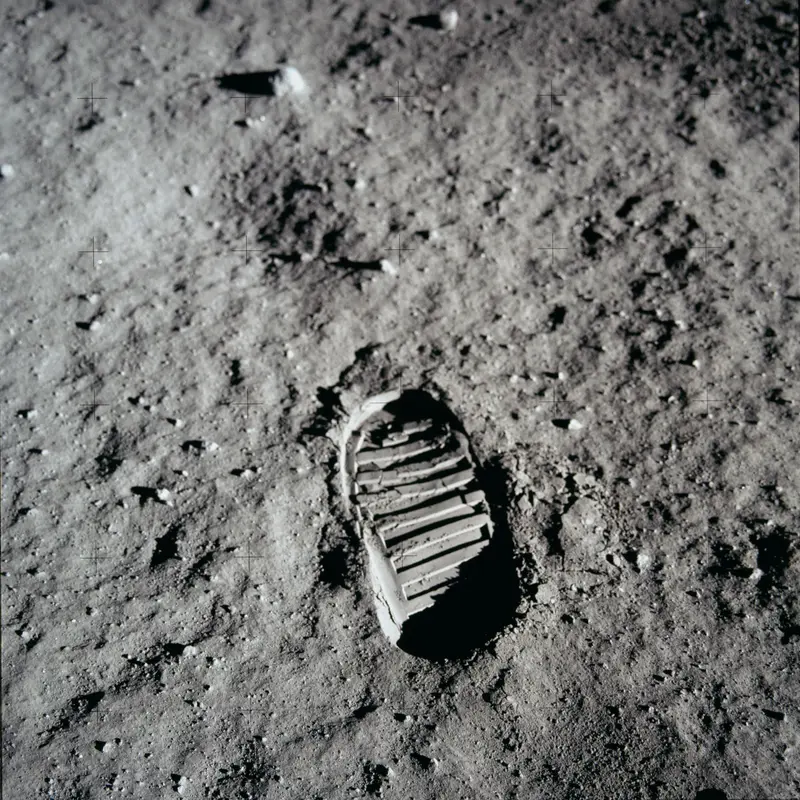
- The dust. Lunar dust is unlike any dust on Earth. It has never been worn smooth by wind or water, so its grains are jagged and sharp, like crushed glass. It clings to everything, scratches helmet visors, damages the seals of spacesuits and irritates the lungs if inhaled.
- Radiation. Beyond the Earth's magnetic field, which deflects much of the radiation coming from the Sun and from deep space, astronauts receive a far higher dose.
- Distance from help. If something goes wrong, the nearest hospital is three days away.
Step six: coming home
Taking off from the Moon is much easier than taking off from the Earth: its gravity is six times weaker and there is no air to push through. A speed of about 2 km/s is enough to return to lunar orbit, which is why the upper part of the Apollo lunar module could be so small. In orbit it docked with the main spacecraft, the astronauts moved across into it, and the lunar module was released.
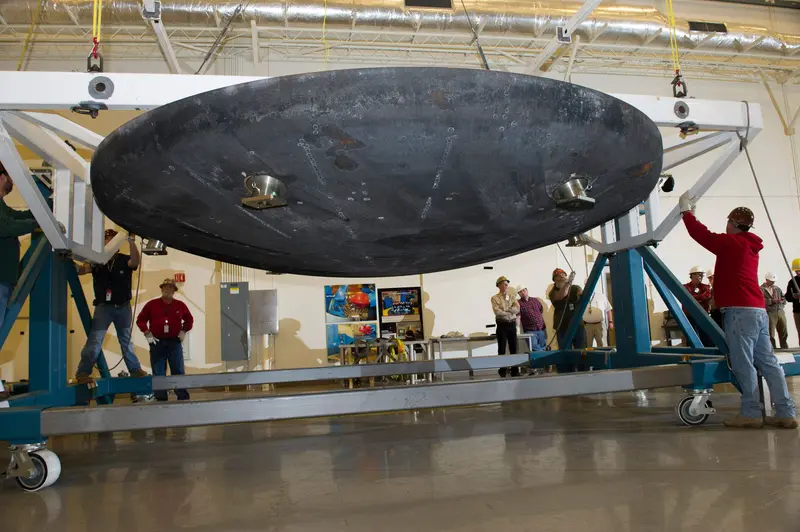
Another engine burn, again over the far side of the Moon, then sends the spacecraft back toward the Earth: three more days of travel. Then comes the most dangerous moment, reentry. Having fallen from so far away, the spacecraft meets the atmosphere at about 11 km/s, considerably faster than on a return from low orbit, and the heating is much more intense. The heat shield (explained in reaching orbit) has to withstand almost 3,000 °C on its outer face while the crew, a few tens of centimeters away, stays at room temperature. The spacecraft must also enter at precisely the right angle. Too steep, and the heating and deceleration become unsurvivable; too shallow, and the spacecraft skips off the upper atmosphere, like a flat stone skimming across water.
The trip's budget
Engineers measure the effort of a space journey as a "budget" of changes in speed. Going to the Moon and back costs, roughly:
- About 9.5 km/s to reach Earth orbit.
- About 3 km/s more to head toward the Moon.
- Around 1 km/s to brake into lunar orbit.
- About 2 km/s to descend to the surface and another 2 to climb back up.
- Around 1 km/s to leave lunar orbit for the Earth.
- Braking on arrival home: free, because the atmosphere does it.
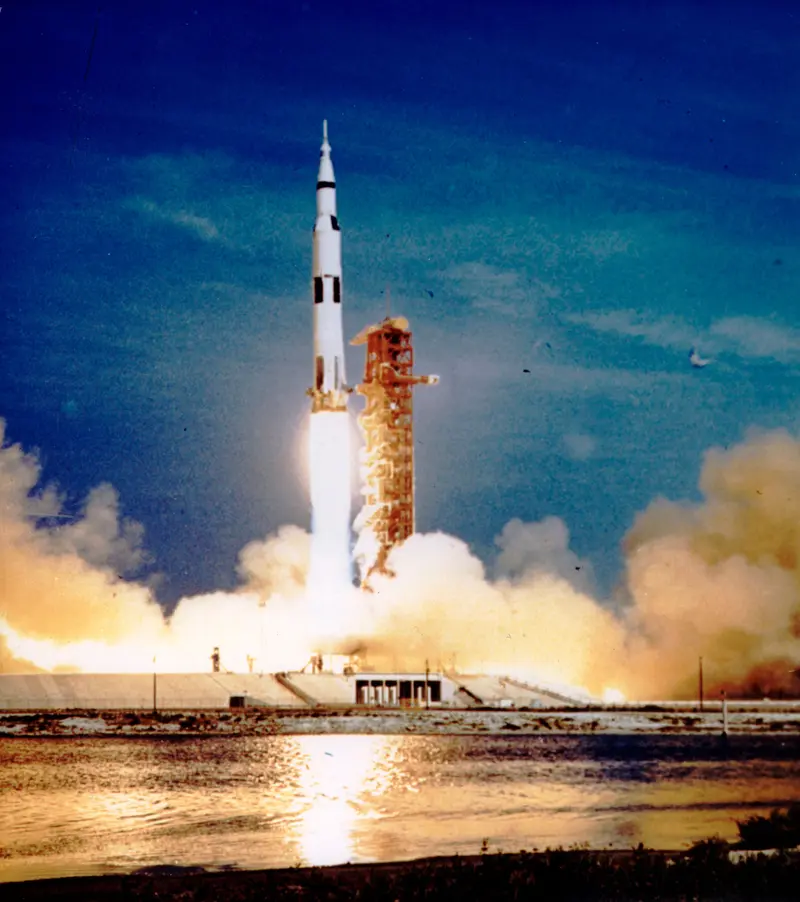
That is why such an enormous rocket is needed for a small spacecraft: of the nearly 3,000 tonnes of the Saturn V, only about 45 were the spacecraft that actually went to the Moon (see how a rocket works).
Apollo then, Artemis now
Between 1969 and 1972, the United States' Apollo program landed six spacecraft on the Moon, carrying twelve astronauts to its surface. Then, for more than half a century, nobody went back.
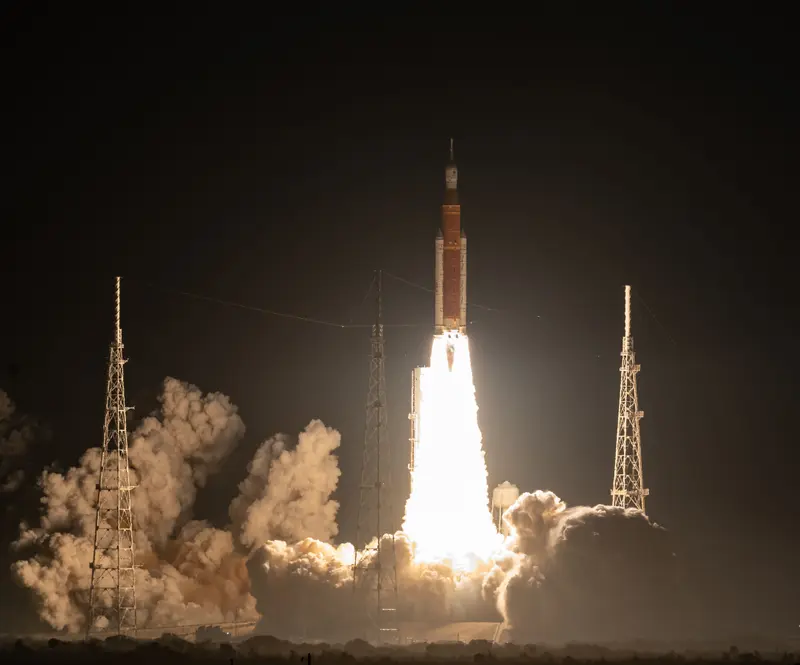
The return is now being prepared through the Artemis program, led by NASA with partners in Europe, Canada and Japan. It uses a new heavy rocket, SLS, and a capsule called Orion, whose service module (the section that supplies electricity, air and propulsion) is built in Europe. In 2022, Artemis I sent Orion around the Moon and back without a crew. In April 2026, Artemis II took four astronauts around the Moon and home again: the first crewed journey to the Moon since 1972.
The next missions aim to land people again, this time near the Moon's south pole, where water ice lies at the bottom of craters that never receive sunlight. Instead of a lander like Apollo's, they will use vehicles built by private companies, which will have to be refueled in orbit before the trip. China has also set itself the goal of landing people on the Moon before 2030. What these missions hope to do there is explained in the future in space.
Key points
- The Moon is about 384,000 km away: three days of travel.
- The spacecraft first reaches Earth orbit, then accelerates to about 11 km/s and aims at where the Moon will be.
- On arrival it must brake with its engine to enter lunar orbit, and it descends using the engine too: with no air, parachutes do not work.
- The return happens at 11 km/s, and the heat shield faces almost 3,000 °C.
- Apollo took twelve people to the Moon's surface; Artemis is preparing the return, near the south pole.
Test yourself
Why does the spacecraft not aim straight at the Moon when it sets off?
Why can't a spacecraft land on the Moon with a parachute?
Why is the return from the Moon harder on the heat shield than the return from the Space Station?
What did the Artemis II mission do in April 2026?
More to practise
 GameDesign your rocketChoose the propellant, the stages and the payload, and see whether your rocket reaches orbit or the Moon. The rocket equation in action.
 GameThe heat shieldChoose the material and thickness of the heat shield of a capsule coming home at 8 km/s, or from the Moon at 11 km/s. Does it survive?