Until now, every journey into space has followed the same pattern: carry everything you need, endure the trip, and come home. The great change ahead is a different approach: living off what can be found there, extracting water, air and fuel from the Moon, Mars or the asteroids instead of shipping everything up from Earth. This page describes the major projects of the coming decades, the problems that remain to be solved, and why so many people believe the effort is worthwhile.
The golden rule: don't bring everything from home
As explained in how a rocket works, putting each kilo into space requires many kilos of propellant. For a short visit, everything can be brought along. For a base meant to last years, or a journey to Mars, that is impossible: it would mean launching mountains of water, air, food and fuel.
That is why the key idea for the future has a technical name, in-situ resource utilization (using local resources), and a simple meaning. A long road trip is possible because you can stop for fuel along the way rather than carrying it all in the trunk; in the same way, future spacecraft will aim to refuel on the Moon, on Mars or at an asteroid.
A base on the Moon
The Moon is three days away: close enough to learn how to live away from the Earth without being too far from home. The plans of several space agencies focus on the lunar south pole, for two good reasons.
- Ice. At the bottom of some craters near the pole the Sun never shines, and temperatures stay below −200 °C. There, water ice has accumulated over billions of years. That ice is extremely valuable: it can be melted for drinking, and split into oxygen to breathe and into hydrogen and oxygen to make rocket fuel (see surviving in space).
- Almost constant sunlight. On some nearby peaks the Sun almost never sets, because it always stays close to the horizon. These are the best sites for solar panels, since elsewhere on the Moon the night lasts about fourteen days.
What would the buildings be like? Probably modules brought from Earth and covered with several meters of lunar soil, much like an underground bunker, to protect against radiation, temperature swings and small meteorites. Engineers are experimenting with making bricks, and even 3D-printing walls, from lunar dust that is either melted or mixed with a binding agent. Large caves formed by ancient lava flows have also been detected on the Moon, and they could serve as natural shelters.
Epic moment · February 18, 2021
Perseverance Lands on Mars
For the first time we truly see how a landing on another planet happens, recorded by the rover's own cameras. The 70-foot (21.5-meter) parachute opens at supersonic speed, the heat shield drops away and, finally, a "sky crane" with rockets lowers Perseverance on cables until it touches down in Jezero Crater. It all lasts about seven minutes and happens on its own, with nobody at the controls: signals took more than eleven minutes to reach Earth.
Watch the full moment, with soundNASA/JPL-Caltech · Public domainMars: the great journey
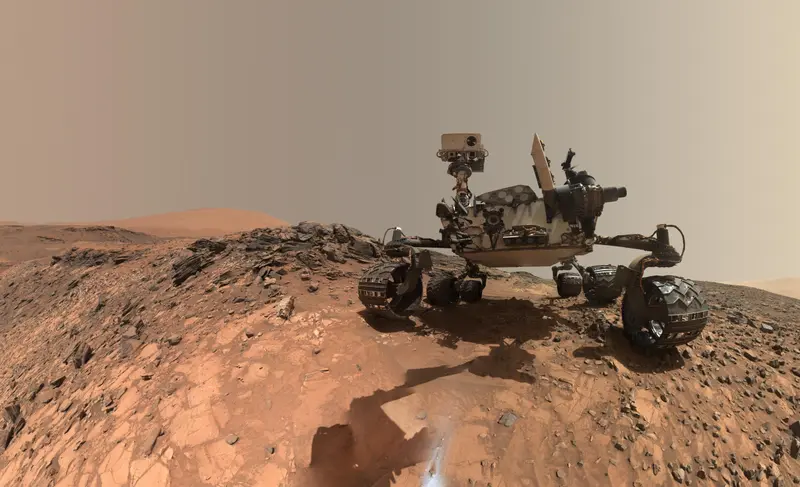
Mars is the next step, and it is an enormous one. Depending on where each planet is in its orbit around the Sun, Mars is between about 55 and about 400 million kilometers away: hundreds or even a thousand times farther than the Moon.
When to go, and how long it takes
Departures cannot happen at any time. The Earth and Mars orbit the Sun at different speeds, and only about every 26 months are they positioned so that the trip is short and efficient. These periods are called launch windows. With current rockets, the outbound journey then takes between six and nine months. The crew would then have to wait on Mars until the planets line up favorably again for the return. In total, a crewed mission would last about two and a half to three years.
What Mars is like
- Very thin, unbreathable air. Mars has an atmosphere, but it is more than a hundred times thinner than ours and almost entirely carbon dioxide, the gas we exhale. It cannot be breathed, and nobody can go outside without a pressurized suit.
- Intense cold. The average temperature is around −60 °C.
- Weak gravity. A little over a third of the Earth's. A person who weighs 60 kilos on Earth would weigh about 23 there.
- Great distance. A radio message takes between about 3 and about 22 minutes to arrive. A live conversation with the Earth is impossible, and so is immediate help.
Landing on Mars
Landing on Mars is especially difficult. Its atmosphere is too thin to slow a spacecraft with parachutes alone, but thick enough to heat it during entry. So every technique is needed: a heat shield, then a huge parachute and, finally, rockets that slow the vehicle until it touches down gently. The robotic rovers currently on Mars have landed this way, but a crewed spacecraft would be much heavier, and that problem has not yet been fully solved.
Making fuel on Mars
The key idea is not to carry the fuel for the return trip. Mars has carbon dioxide in its atmosphere and ice beneath its surface. By combining them using electricity from solar panels or a small nuclear reactor, it is possible to produce methane and oxygen, exactly the propellants used by some of the new rockets. A small device, about thirty centimeters on each side, carried aboard a NASA rover, produced oxygen from the Martian atmosphere between 2021 and 2023. It was a small-scale test, but it showed that the process works.
The asteroids: mines in the sky
Between Mars and Jupiter, and also in the Earth's neighborhood, millions of asteroids orbit the Sun: rocky bodies ranging from the size of a house to hundreds of kilometers across. They are leftovers from the formation of the solar system, and some contain water (locked inside their minerals) and metals such as iron and nickel.
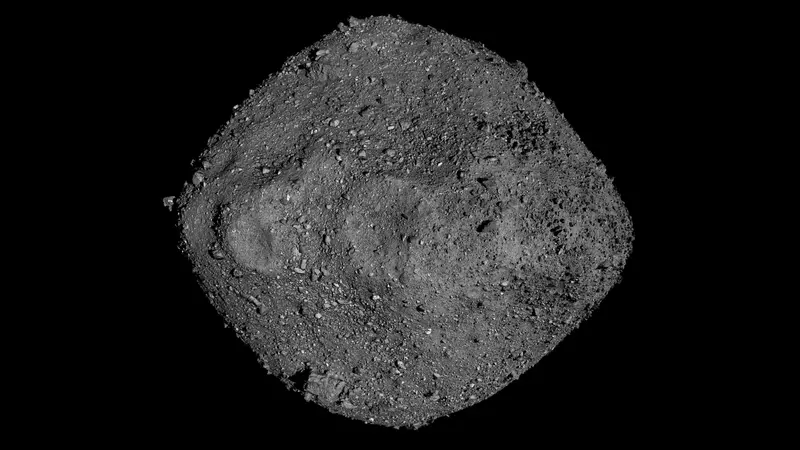
Samples from three asteroids have already been returned to Earth, some containing water-bearing minerals and carbon-rich compounds. The large asteroid Vesta, more than 500 km across, has also been studied up close by a probe in orbit around it.
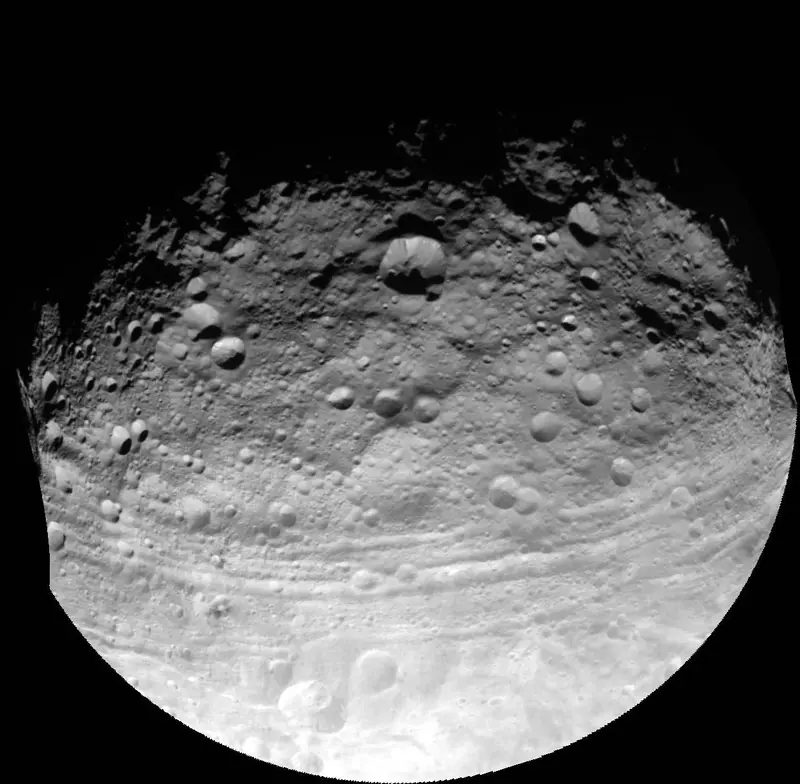
An asteroid's gravity is so weak that leaving its surface costs almost no fuel. That is why, in the long term, extracting water from an asteroid to make fuel in orbit could be cheaper than lifting that water up from the Earth. For now this remains a plan rather than a reality: no mining operation has yet been set up in space.
There is another reason to study asteroids: planetary defense. A large asteroid striking the Earth would be catastrophic. In 2022, NASA's DART spacecraft deliberately crashed into a small asteroid and changed its orbit by a measurable amount. It was the first time humanity had altered the motion of a natural body in space.
The Gamoras 3D Mission puts you in exactly this situation: on an asteroid 220 km across, searching for ice with a hopping robot and turning it into fuel to get home.
ActivityGamoras 3D MissionLand a damaged ship on a 220 km asteroid, search for water with a hopping robot, make propellant and a glass-ceramic nozzle, and fly back up to dock with your ship in orbit. With real physics.Play the mission
New engines
Today's chemical rockets are very powerful but consume their propellant quickly. For long journeys, other forms of propulsion are being developed.
- Ion engines. Instead of burning propellant, they use electricity to accelerate gas atoms to speeds about ten times higher than a chemical rocket's exhaust. Their thrust is tiny, about equal to the weight of a sheet of paper, but they can keep it up for months or years, and over time that gentle push builds up to very high speeds. They are already used on many satellites and probes.
- Nuclear engines. These would heat hydrogen using the heat of a nuclear reactor, without burning it. They would be about twice as efficient as the best chemical engines and could shorten the journey to Mars. They were tested on the ground decades ago, and there are plans to revive them.
- Solar sails. Sunlight exerts a very slight pressure. A vast, extremely thin sail can catch that pressure and travel through space without any fuel. A few have already been tested in space.
The problems of long journeys
Before people can be sent to Mars, several problems still need full solutions.
- Radiation. Far from the Earth's magnetic field, two or three years of travel would add up to a dangerous dose. Shelters surrounded by water or propellant tanks, which absorb radiation well, are being studied.
- The body. Months of weightlessness weaken bones and muscles. One possible solution is to rotate the spacecraft: the spin would press the crew against the outer wall, which would act as a floor, creating artificial gravity. The same effect pushes passengers against the side of a car taking a sharp curve.
- Recycling everything. Air, water and, ideally, food: growing plants on board, which also help to clean the air.
- The mind. Years confined with the same small group of people, far from everything, comparable to the long winters spent by research teams in Antarctica.
Game
Keep the crew alive
Why is it worth it?
It is a fair question: all of this requires a great deal of money and effort. These are the reasons most often given.
- Knowledge. Every mission has changed what we know about the origins of the Earth and of life, and exploration may reveal whether life exists, or once existed, anywhere else.
- Innovation. Many technologies came from solving the problems of spaceflight (see what space is for).
- Protecting the Earth. Monitoring asteroids, the climate and the Sun.
- Resources. Water, metals and energy beyond our planet.
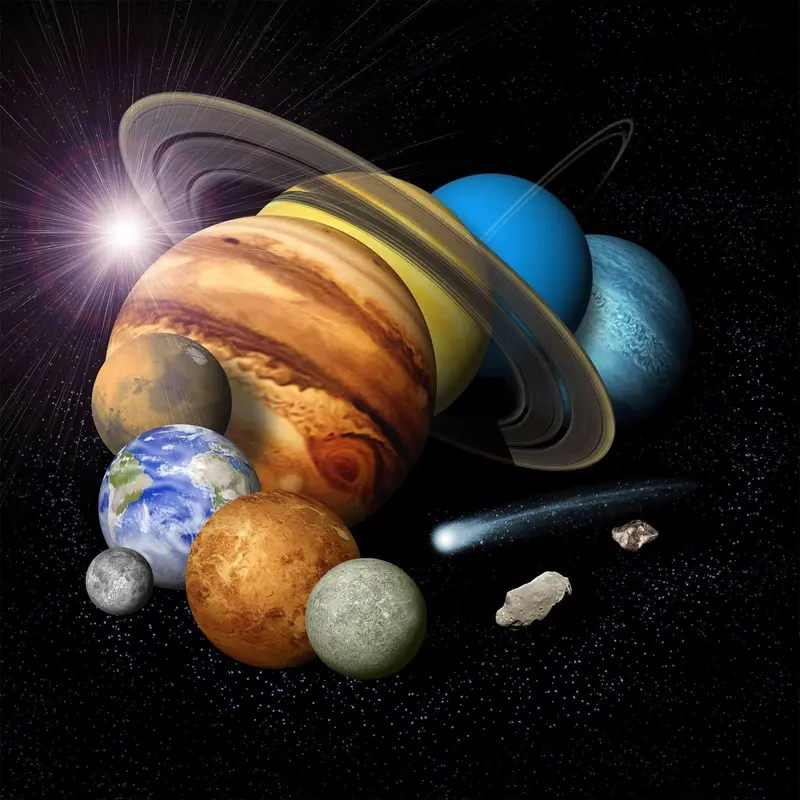
- Perspective. People who see the Earth from far away, a fragile blue sphere in the blackness, usually come back wanting to protect it.
Key points
- The future depends on using local resources instead of bringing everything from Earth.
- The Moon's south pole has water ice and almost constant sunlight: the ideal site for a base.
- Mars is six to nine months away; the fuel for the return could be produced there.
- Asteroids contain water and metals, and monitoring them helps protect the Earth.
- Ion and nuclear engines and solar sails could make long journeys more practical.
Test yourself
Why is the Moon's south pole so attractive for building a base?
How long does it take to travel to Mars with today's rockets?
What advantage does an ion engine have over a chemical rocket engine?
Why would making fuel on Mars from local materials be so useful?