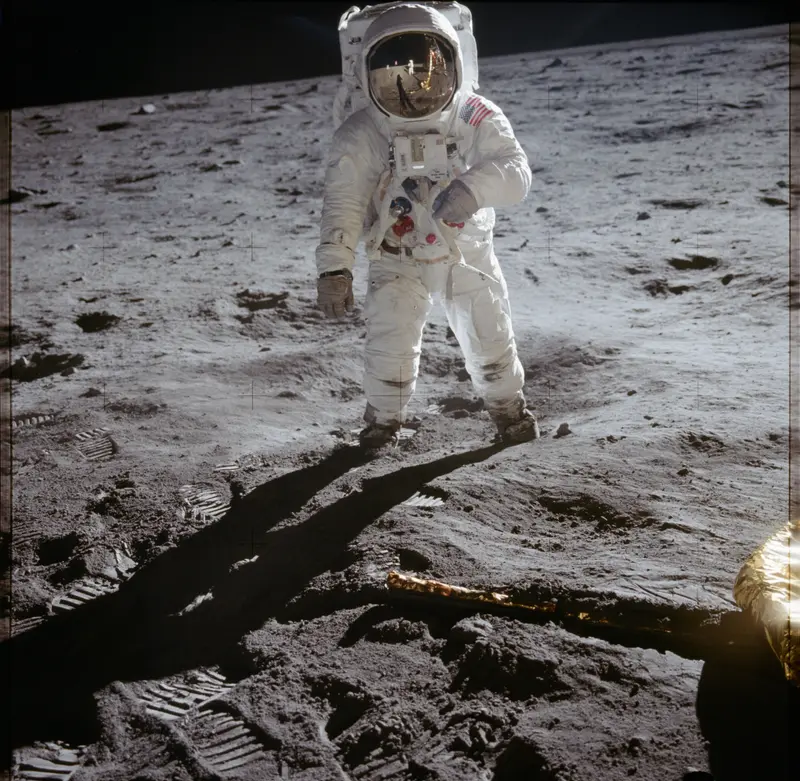
Look up on a clear night and you will see the Moon, a few planets and thousands of stars. For most of history, nobody knew what lay between us and them. More air? An invisible substance filling everything? A solid dome? Today we know quite precisely, because we have sent instruments and people up to look. This page explains where the air ends and space begins, what makes that environment so unusual (there is no air, it is extremely hot and extremely cold at the same time, and invisible particles pass through it constantly) and how vast the distances involved really are.
Air is a very thin blanket
Start with something familiar: air. It is invisible, but it has weight. Anyone who has climbed a high mountain has noticed that breathing becomes harder and that water boils at a lower temperature. Both happen for the same reason: higher up, there is less air above you pressing down.
Picture a stack of thick blankets on a bed. The bottom one is squashed flat by the weight of all the others; the top one stays loose and fluffy. Air behaves the same way. At sea level it is compressed by all the air above it, and the higher you go, the thinner and scarcer it becomes. At a height of about 5.5 km (a little higher than Mont Blanc) half of all the Earth's air is already below you. At 10 km, the cruising height of passenger jets, only about a quarter remains. And so it continues: every few kilometers the air thins further, until it practically disappears.
The consequence is striking: the layer of air that keeps us alive is extremely thin. If the Earth were the size of an orange, the entire breathable atmosphere would be thinner than its peel.
Game
Climb through the atmosphere
Where space begins: the Kármán line
If the air fades out gradually, where should the border be drawn? There is no wall and no marker. By international convention, space is said to begin at a height of about 100 kilometers. That imaginary boundary is called the Kármán line, after Theodore von Kármán, the Hungarian-American engineer whose calculations underlie it.
The reasoning is straightforward. A bird, a glider or an aeroplane stays up by pushing against the air with its wings. The thinner the air, the faster it has to fly for the wings to produce enough lift. At about 100 km the air is so sparse that a wing would need to travel as fast as a satellite circling the Earth (what that means is explained in gravity and orbits). Beyond that height, wings are useless: either you fall, or you are moving so fast that you travel around the planet without needing them.
For a sense of scale, 100 km is a little more than the straight-line distance from London to Oxford. A car driving straight upward at motorway speed would get there in about an hour. The difficult part, as later lessons show, is not the height: it is the speed needed to stay up there.
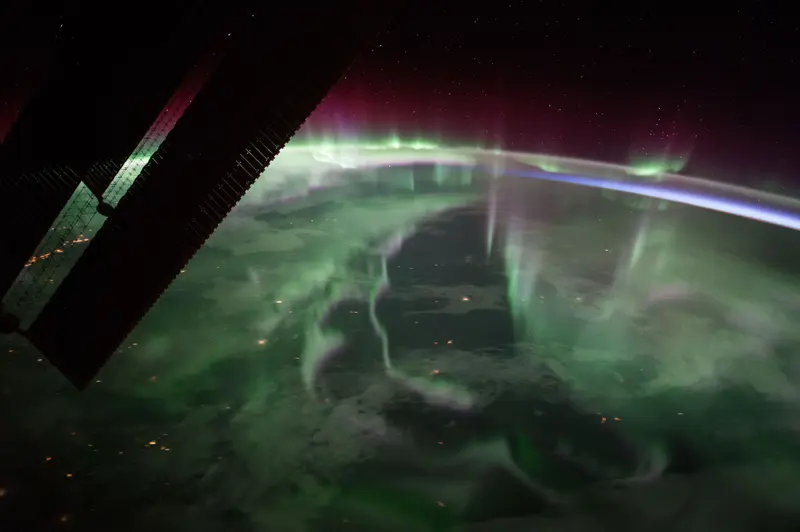
Epic moment · 2017
Earth at Night from the Space Station
A green and violet aurora borealis ripples over Canada while, below, the lights of cities across the United States switch on all the way down to Florida. They are hundreds of photos that the Expedition 53 astronauts took one after another from the Space Station, about 400 kilometers up. The Station moves so fast, about 28,000 km/h (17,500 mph), that it circles the world every hour and a half and its crew sees 16 sunrises a day.
Watch the full momentNASA (Crew Earth Observations, Johnson Space Center) · Public domainThe vacuum: a place without air
Above that boundary there is almost nothing. This is called a vacuum. It is not a perfect vacuum (a few scattered atoms remain), but it is far emptier than anything that can easily be produced on Earth.
What does it mean to be surrounded by no air at all?
- You cannot breathe. Without air, a person loses consciousness in about fifteen seconds. That is why astronauts carry their own air supply, much as a scuba diver carries a tank.
- There is no sound. Sound is a vibration travelling through air, like the ripples that spread across a pond when a stone is thrown in. Without air there is nothing to carry the ripples: an explosion in space would be completely silent.
- The sky is black, even in daytime. The blue of the sky is sunlight scattered by the air. With no air to scatter it, the sky is black even when the Sun is shining at full strength.
- Nothing slows you down. On Earth, a thrown ball eventually stops because air resistance and the ground slow it. In a vacuum, anything that is moving keeps moving. This idea is the key to almost everything else in this course.
Hot and cold at the same time
Is space cold? The accurate answer is: it depends on whether the Sun is shining on you.
On Earth, air and water spread heat around. When the Sun warms a street, the warm air moves and mixes, and at night the heat does not vanish all at once. In space there is no air to do that job. Heat arrives in only one way: as sunlight, like the warmth you feel on your face through a window on a winter day even though the glass itself is cold.
As a result, an object in space near the Earth can have its sunlit side at more than 100 °C, hotter than boiling water, and its shaded side at more than 100 °C below zero, colder than any winter on Earth. Both sides of the same object, at the same moment. It is like standing in front of a bonfire on a freezing night: your front roasts while your back freezes.
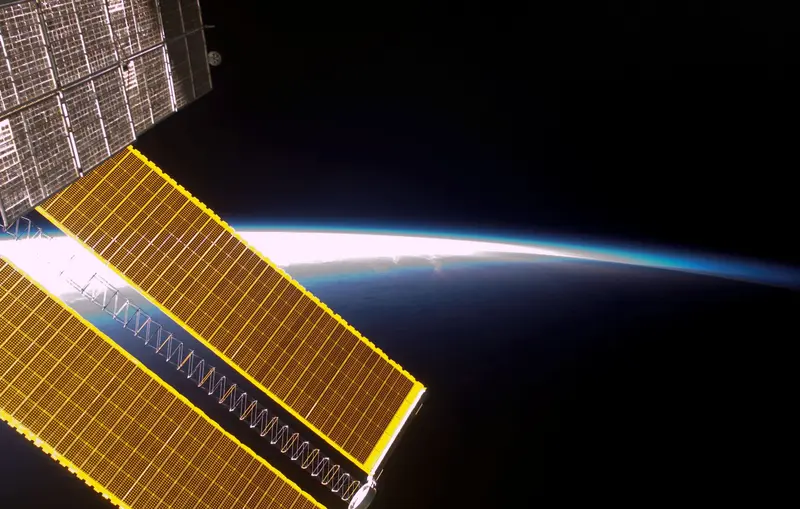
Engineers deal with this by wrapping spacecraft in shiny multi-layer blankets (the gold foil seen in photographs) and by turning them slowly, like food on a rotisserie, so that no side overheats or freezes. This is covered in materials for space.
An invisible rain: radiation
The Sun does not only emit light and heat. It also continuously throws out a stream of tiny particles, far smaller than a speck of dust, travelling at enormous speeds. From much farther away, from stars that exploded long ago, come other particles that are faster still. Together, all of this is called radiation.
Think of it as a drizzle of particles so fine that it passes through clothing, skin and even walls without being felt, but which, every so often, damages one of the tiny structures inside the body's cells. A single hit does no harm; a very large number of hits, accumulated over months, increases the risk of illness, including cancer.
On the Earth's surface we are protected by two shields. The first is the atmosphere itself, which absorbs most of those particles, much as a thick wall stops projectiles. The second is invisible: the Earth behaves like a giant magnet (which is why a compass needle points north), and its magnetic field steers many of the particles toward the poles. When they strike the upper atmosphere there, they make it glow: these are the auroras, the northern and southern lights.
How far away everything is
Now for the hardest part to picture: the size of space. Familiar distances help.
- The International Space Station, where astronauts live and work, orbits about 400 km up: a little farther than the distance from London to Paris, but straight up.
- The Moon is about 384,000 km away. That is almost ten times the distance around the Earth at the equator. A car driving non-stop at 100 km/h would need more than five months to cover it; the Apollo spacecraft took about three days. The story is told in the journey to the Moon.
- The Sun is about 150 million kilometers away: almost four hundred times farther than the Moon.
- The stars are so far away that kilometers stop being practical. Astronomers measure those distances by how long their light takes to reach us.
Light is the fastest thing there is: it travels about 300,000 kilometers every second. At that speed you would circle the Earth seven and a half times in one second. Even so, light from the Moon takes a little over a second to reach us; light from the Sun, about eight minutes; and light from the nearest star after the Sun, more than four years. When you look at a star, you see it as it was when that light left it, not as it is now.
So what is space?
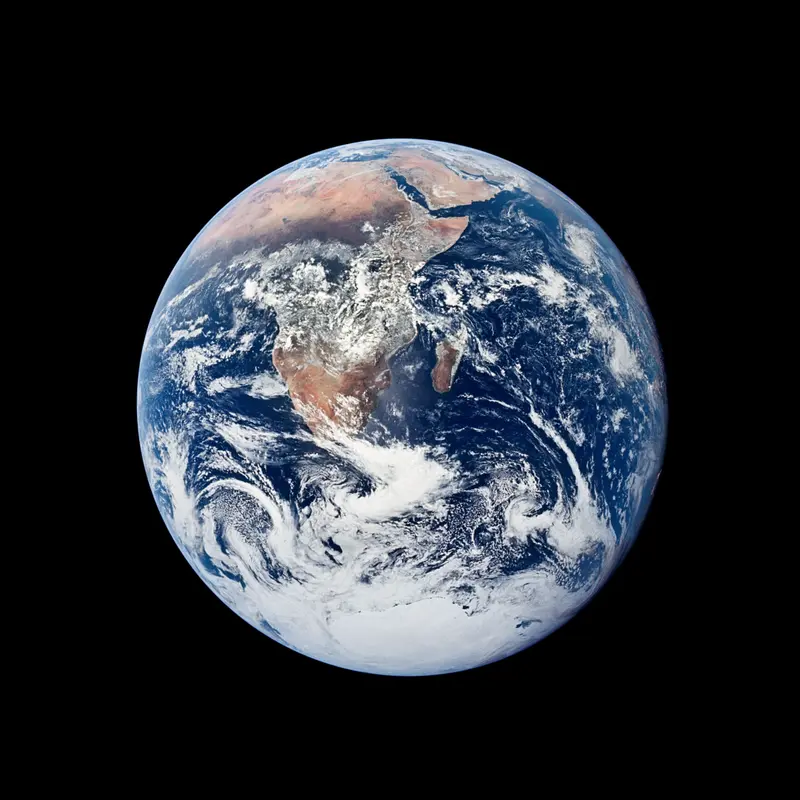
In short: space is what lies above the air. It begins quite close, about 100 km up. There is no air there to breathe or to slow things down, sunlight scorches while shade freezes, and an invisible stream of particles passes through everything. And it extends far, far beyond anything we can easily imagine.
Getting there means overcoming the force that pulls everything toward the ground, gravity, and that requires a principle and a machine. The principle is the orbit, explained in gravity and orbits; the machine is the rocket, explained in how a rocket works.
Key points
- By convention, space begins at a height of about 100 km: the Kármán line.
- Up there is a vacuum: you cannot breathe, there is no sound, and nothing slows down what is moving.
- With no air to spread the heat, whatever faces the Sun goes above 100 °C and the shade drops below 100 °C below zero.
- The atmosphere and the Earth's magnetic field protect us from radiation.
- The distances are enormous: the Moon, 384,000 km; the Sun, 150 million km; sunlight takes about eight minutes to arrive.
Test yourself
At what height is space usually said to begin?
If the Earth were an orange, how thick would the layer of air we breathe be?
Why can an object in space be above 100 °C on one side and below freezing on the other?
How long does sunlight take to reach the Earth?