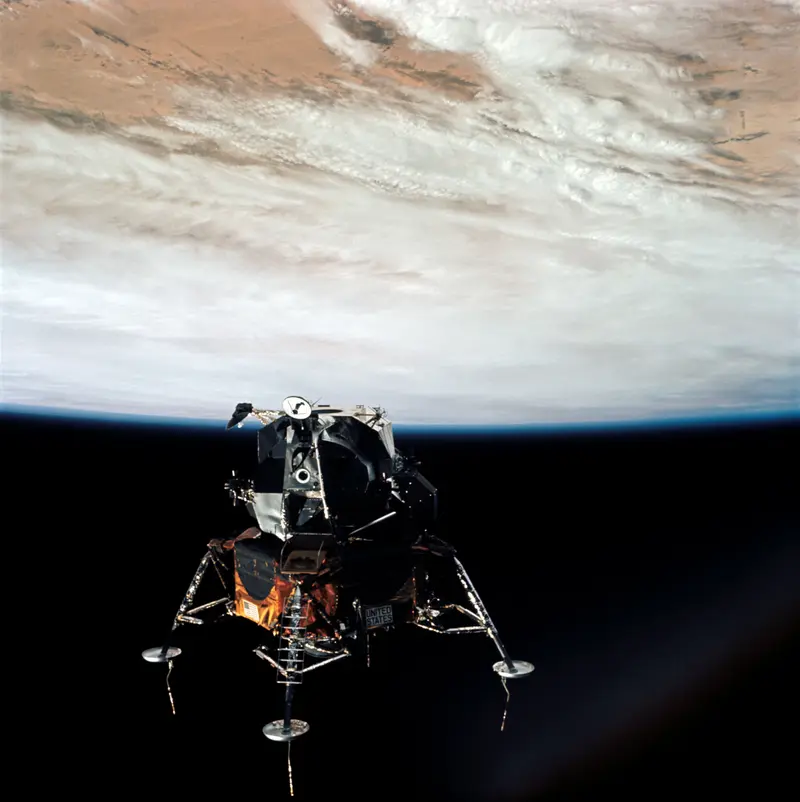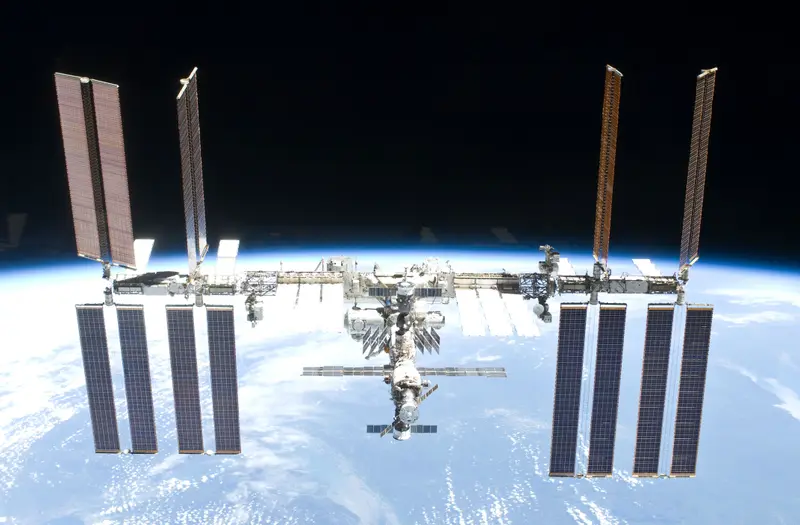
Let go of a stone and it falls. Everyone has seen it countless times. Yet that simple event holds the explanation for how the Space Station circles the Earth with its engines switched off, why the Moon does not crash into us, and how a satellite can appear to stay "still" in the sky for years. This page explains what gravity is, what exactly an orbit is (in short: falling and continually missing) and why astronauts float.
Gravity: everything pulls on everything
In 1687 the English scientist Isaac Newton published an idea that changed our understanding of the universe: the same force that makes an apple fall to the ground also keeps the Moon travelling around the Earth. That force is called gravity.
The principle is this: every object pulls on every other object. You pull on the Earth and the Earth pulls on you. The more matter an object contains, the harder it pulls. You are tiny compared with the planet, so it is you who moves toward it, not the other way round. And the farther apart two objects are, the weaker the pull between them, although it never drops to zero.
A magnet and a steel nail give a rough picture: close together, the magnet grips the nail firmly; move them apart and the pull weakens. Gravity behaves in a similar way, with two important differences: it acts on everything (rock, water, people, even light), and nothing can block it.
Mass and weight are not the same
One distinction is worth getting clear from the start:
- Mass is the amount of matter in something. It is what makes an object hard to set in motion: pushing a full shopping trolley is harder than pushing an empty one. Your mass is the same at home, on the Moon or floating in space.
- Weight is how strongly gravity pulls on that mass. It depends on where you are.
On the Moon, which is much smaller than the Earth, gravity pulls with one sixth of the force. A person who weighs 60 kilos on Earth would read about 10 on bathroom scales on the Moon, and could jump much higher. On Mars the scales would show about 23. On Jupiter, the largest planet in the solar system, about 150.
Game
How much would you weigh on other worlds?
Epic moment · August 2, 1971
The Hammer and the Feather
On the Moon, Apollo 15 commander David Scott holds a hammer in one hand and a falcon feather in the other, and drops them at the same time. With no air to slow the feather, both fall at exactly the same rate and hit the ground together. It is live proof of what Galileo had guessed almost four centuries earlier: gravity accelerates all objects equally, whatever they weigh.
Watch the full moment, with soundNASA · Public domainNewton's cannon: the key idea
Now for the most important idea in this entire course. Newton explained it with a thought experiment that is still used in physics classrooms today.
Imagine a mountain so tall that its summit rises above the atmosphere, and a cannon on top pointing horizontally, parallel to the ground.
- Fire it with a small charge: the ball flies out, curves downward and lands a few hundred meters away.
- Fire it with a larger charge: the ball goes faster and lands farther off, several kilometers away.
- Fire it harder still: it lands so far away that the curvature of the Earth starts to matter. The ground "drops away" beneath the ball because the surface keeps curving.
- Fire it fast enough and something remarkable happens: the ball keeps falling, but the ground curves away beneath it at exactly the rate it falls. It never reaches the ground. It travels all the way around the planet and passes over the cannon again, and again, and again.
That is an orbit: falling continuously while always missing the ground.
How fast does it need to go? A simple calculation answers it. Any object that is dropped falls about 5 meters in the first second. And the Earth is so large that its surface curves downward by about 5 meters for every 8 kilometers of horizontal distance. So if the ball travels 8 kilometers sideways in one second, it falls 5 meters, but the ground has also dropped 5 meters. Its height stays the same. That is orbital speed: about 8 kilometers every second. It would cover the distance from London to Oxford in about ten seconds, roughly ten times faster than a rifle bullet.
Game
Newton’s cannon
Why does it have to be above the air? Because air slows things down. A ball travelling at 8 km/s through the atmosphere heats up and loses speed within seconds, as explained in reaching orbit. Above about 200 km the air is so thin that a satellite can keep circling for months or years. The Space Station, at about 400 km, still brushes against traces of air and sinks by a couple of kilometers a month; every so often it fires its engines to regain height.
And if you fire even faster?
If the ball goes a little faster than those 8 km/s, the orbit stretches: it swings farther out on one side and comes back closer on the other, forming an oval called an ellipse. The more speed, the more elongated the ellipse.
And if it reaches about 11 kilometers per second, the ball does not come back at all: gravity keeps slowing it, but never enough to pull it home. It escapes from the Earth permanently. This is called escape velocity, and it is roughly what is needed to travel to the Moon or beyond (see the journey to the Moon).
Why astronauts float
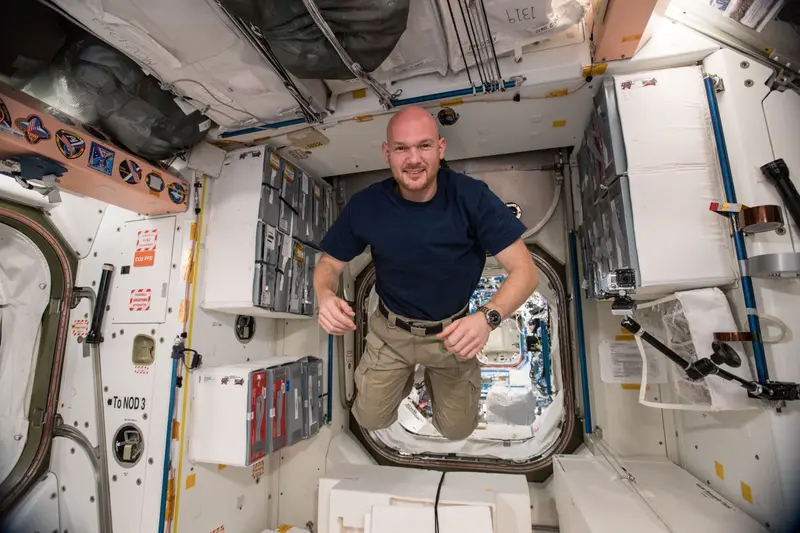
Many people believe there is no gravity on the Space Station. That is false. At a height of 400 km the Earth pulls with almost the same force as at the surface: about 90%. If you could build a tower 400 km tall and stand at the top, you would weigh almost as much as you do at home.
So why do they float? Because they are falling, exactly like the ball from Newton's cannon, and the station is falling with them, at the same speed.
Imagine being inside a lift whose cable snaps. You, the floor, your phone and your keys all fall together at the same rate. Nothing presses on anything else; the keys hang in the air in front of your face. For those few seconds you would feel exactly what an astronaut feels. The difference is that the station never reaches the bottom of the shaft, because it is falling "sideways" and the Earth keeps curving away beneath it. So the sensation lasts for months. This is called weightlessness or free fall.
The most useful kinds of orbit
Not all orbits are alike. Height determines how long one trip around takes: the farther out, the slower the satellite moves and the longer each lap lasts. These are the most widely used.
Low Earth orbit (about 200 to 2,000 km)
This is the closest orbit and the easiest to reach. The Space Station is here, circling the Earth every hour and a half: its crew sees about sixteen sunrises a day. Here too are the satellites that photograph the ground in fine detail, and thousands of small satellites that provide internet access.
Polar orbit
This is a low orbit that passes over both poles. Because the Earth rotates underneath, the satellite flies over a different strip on each lap, like a lawnmower working across a lawn row by row. Within a day it has passed over the whole planet. It is the preferred orbit for satellites that monitor weather, forests or ice (see what space is for).
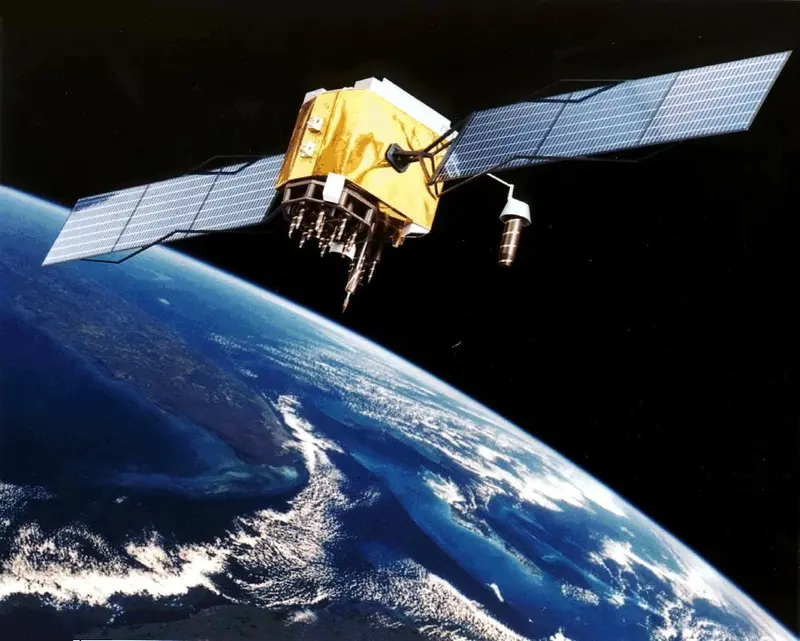
Medium Earth orbit (about 20,000 km)
This is where the GPS satellites are. They go around once every twelve hours, and mobile phones use their signals to work out where you are.
Geostationary orbit (about 36,000 km)
This is the most unusual one. At that height, directly above the equator, a satellite takes one day to complete a lap: the same time the Earth takes to rotate once. So, seen from the ground, it appears to stand still in the sky, fixed in place. That is why a satellite television dish can point at the same spot permanently without moving. It is like two cars driving side by side around a roundabout at the same speed: to each driver, the other seems not to move.
The Moon is falling too
This also explains something that puzzled astronomers for centuries. The Moon behaves exactly like the ball from Newton's cannon, only much farther away: about 384,000 km. At that distance the Earth's gravity is weaker, so the Moon moves more slowly (about 1 km per second) and takes about 27 days to go around once. It has been falling toward us for billions of years and always missing.
The Earth, in turn, is falling around the Sun, on a journey that takes one year. The whole solar system is a vast arrangement of objects falling around one another without ever colliding.
Key points
- Gravity makes everything pull on everything; the more mass and the closer, the stronger the pull.
- Mass is how much matter you have; weight is how hard gravity pulls on you. On the Moon you weigh one sixth as much.
- An orbit is falling without ever reaching the ground: you have to travel sideways at about 8 km/s, above the air.
- Astronauts float because they are falling along with their spacecraft, not because there is no gravity.
- Low orbit: once around every hour and a half. Geostationary (36,000 km): once around a day, so the satellite seems to stand still.
Test yourself
Why do astronauts float inside the Space Station?
What does it take for a cannonball to go all the way around the Earth without hitting the ground?
What is special about geostationary orbit?
If you weigh 60 kilos on Earth, how much would you weigh on the Moon?