A firework rocket is a simple device: a tube packed with powder that, once lit, shoots upward trailing sparks. Rockets of this kind were invented in China around eight hundred years ago, and in the early nineteenth century the British army used iron-cased versions in battle. The rockets that carry people into space today work on exactly the same principle. They are simply far larger, far more powerful and far more carefully engineered. This page explains how a rocket produces thrust, what it burns, why it is almost entirely fuel, and why it deliberately sheds parts of itself as it climbs.
Action and reaction: the recoil of a rifle
Anyone who has fired a rifle knows the key idea: as the bullet flies forward, the stock kicks back into the shoulder. A firefighter holding a powerful hose feels the same thing: the jet of water pushes the hose backward, and it takes real effort to hold it steady.
Newton summarized this in a law: if you push on something, it pushes back on you with the same force in the opposite direction. This is the law of action and reaction.
Imagine standing in a small rowing boat on a calm lake with a pile of heavy stones. If you throw a stone hard toward the back of the boat, the boat moves forward slightly. Throw another, and another, and another, and the boat keeps gaining speed. You have not rowed and you have not touched the water: you have only thrown things backward.
A rocket is that boat. Except that instead of stones, it throws extremely hot gas backward, countless tiny particles, at enormous speed and without pause.
What a rocket burns: fuel and oxidizer
Burning requires two things: something that burns (wood, coal, petrol) and oxygen, the part of the air that feeds a flame. Cover a lit candle with a glass jar and it goes out as soon as it has used up the oxygen inside.
There is no air in space, so there is no oxygen. How, then, does a rocket engine burn anything? By carrying its own oxygen. Gunpowder works the same way: it contains charcoal and sulfur, which burn, and potassium nitrate, which supplies the oxygen. That is why a firework burns even inside a sealed tube with no air.
Together, the two substances a rocket burns are called propellants: a fuel and an oxidizer (the substance that provides the oxygen). Modern rockets mostly use these combinations:
- Kerosene and liquid oxygen. Kerosene is a refined petroleum product, very similar to the fuel used by jet airliners. It is what most of today's rockets burn.
- Liquid hydrogen and liquid oxygen. Hydrogen is the lightest gas there is. This is the most efficient combination, but hydrogen only becomes liquid at about 253 °C below zero, so it has to be stored in very well-insulated tanks.
- Methane and liquid oxygen. Methane is the main component of the natural gas used for cooking and heating. It is the preferred choice for many new rockets, because it burns cleanly and could one day be produced on Mars (see the future in space).
- Solid propellant. A rubbery mixture with fuel and oxidizer already blended together, essentially a giant firework. It is used to provide a powerful push at liftoff, but once lit it cannot be switched off.
Why liquids, and why so cold? Because a gas takes up an enormous amount of space. Cool it until it becomes a liquid, and hundreds of times more of it fits into the same tank.
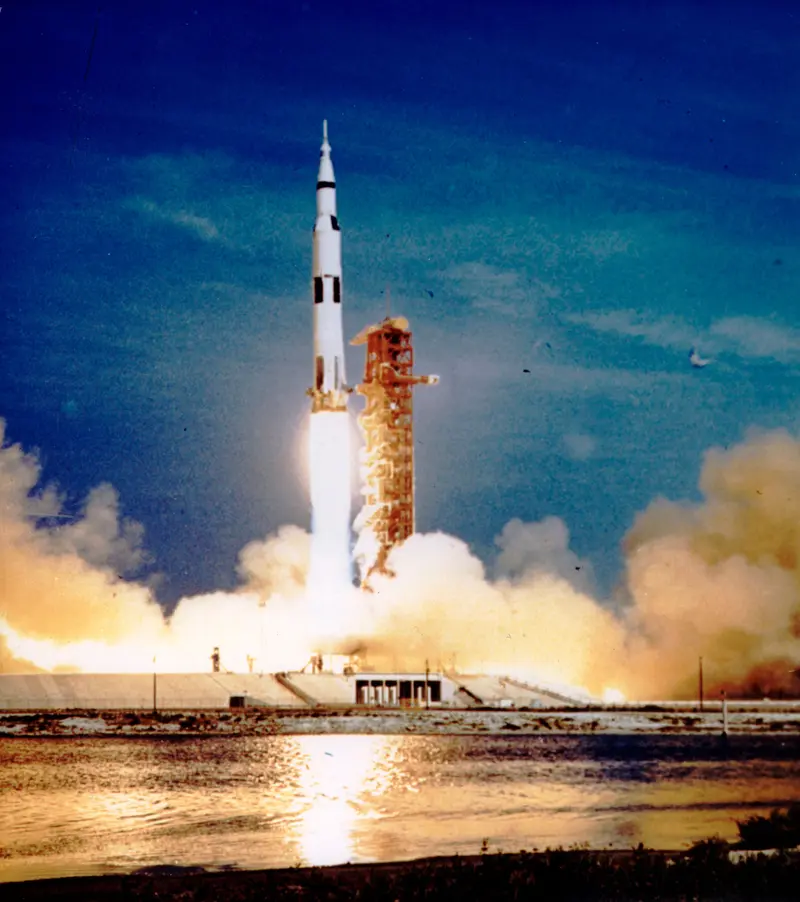
Epic moment · July 16, 1969
Saturn V Launch (Apollo 11)
High-speed cameras placed next to the launch pad filmed in slow motion as the five F-1 engines of the Saturn V ignite, while steel arms hold it down until it reaches full power. At 110 meters (363 feet) tall and almost 3,000 tonnes, it is still one of the most powerful rockets ever built. Up top, Armstrong, Aldrin and Collins were beginning a four-day journey to the Moon.
Watch the full momentNASA · Public domainThe engine: a chamber and a nozzle
A modern rocket engine has two main parts.
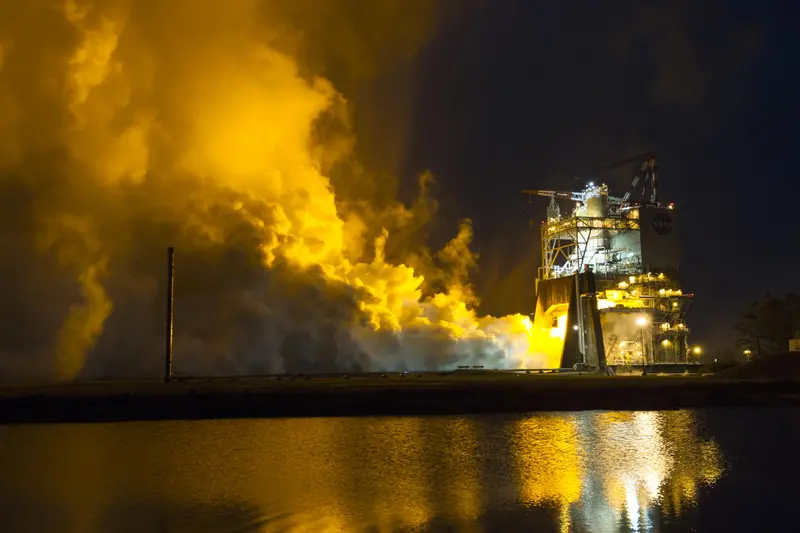
- The combustion chamber. This is where fuel and oxygen meet and burn. The gases reach more than 3,000 °C (hotter than the melting point of iron) at very high pressure, many times greater than inside a pressure cooker.
- The nozzle. This is the bell-shaped opening visible at the bottom of the rocket. The gases leave the chamber through a narrow throat and then expand through the bell. That shape is not decorative: it makes the exhaust flow out in an orderly way and much faster, just as water from a garden hose shoots out harder when you partly cover the end with your thumb.
The exhaust of a good engine leaves at about 3 or 4 kilometers per second: three to four times faster than a rifle bullet. The faster the exhaust, the more thrust each kilo of propellant provides. It is the single most important figure for any rocket engine.
To steer, a rocket has no rudder: the whole engine pivots slightly on a mounting, so that the exhaust pushes the vehicle in the desired direction. In a vacuum, fins have no effect at all.
Why so much propellant is needed
This is the central difficulty of spaceflight, and it is worth understanding properly.
The propellant does not only have to push the spacecraft: it also has to push itself, because it is carried inside the rocket. At liftoff, the engine has to accelerate the rocket plus all the propellant it has not yet burned. To go faster you need more propellant; but more propellant is heavier, and moving that extra weight requires still more propellant. It is like a truck crossing a desert with no fuel stations: it has to carry its own fuel, and the extra fuel makes it heavier, so it burns more fuel, so it needs to carry even more.
Engineers describe this with the rocket equation, published by the Russian scientist Konstantin Tsiolkovsky in 1903. Without any complicated mathematics, it says this:
- If you want the rocket to end up travelling as fast as its own exhaust, it must weigh about 3 times more at liftoff than at the end. In other words, about two thirds of it must be propellant.
- For twice the exhaust speed, multiply by 3 again: the rocket must weigh about 7 times its empty weight.
- For three times, multiply by 3 once more: about 20 times.
Reaching orbit requires, once losses are included, about 9 or 10 kilometers per second. With an exhaust speed of 3 or 4 km/s, that is between two and three times the exhaust speed. The result: about 90% of a rocket at liftoff is propellant. The rest is the structure itself (tanks, engines) and, at the top, a small payload: the spacecraft, the satellite or the crew, almost always less than 5% of the total.
A real example: the Saturn V, the rocket that took astronauts to the Moon, stood 110 meters tall (about the height of a 36-storey building) and weighed about 2,900 tonnes at liftoff. More than 90% of that was propellant. Of all that mass, a spacecraft of about 45 tonnes went on to the Moon.
Stages: shedding dead weight
Once a tank's propellant is used up, the empty tank and its engines become dead weight. Carrying them all the way up would be a waste. The solution is the same as that of a hot-air balloonist who drops ballast to climb higher: let them go.
That is why rockets are built in stages, like several rockets stacked on top of one another.
- The first stage, the largest, lifts the entire weight off the ground and carries the rocket through the densest part of the atmosphere, for two or three minutes.
- When it runs out of propellant, it separates and falls away. The second stage ignites, and it is now much lighter because it no longer carries the first.
- Some rockets have a third stage for the final push.
This way, each stage only has to accelerate what remains above it. Without staging, with current materials, reaching orbit would be almost impossible.
Game
Design your rocket
In the game you can try it yourself: add propellant, change the engine or the number of stages, and you will quickly see why a single-stage rocket almost never makes it to orbit.
What a modern rocket looks like
Putting it all together, a modern rocket consists of the following, from bottom to top: engines with their nozzles; one large tank of fuel and another of oxygen; then a smaller stage with its own engine and tanks; and at the very top, protected from the air by a pointed nose cone called the fairing, the payload. Onboard computers continuously adjust the angle of the engines to keep the rocket on its planned path.
The most advanced rockets no longer let the first stage fall into the sea: they bring it back and land it upright by firing its engine again, so it can fly another mission. This is covered in reaching orbit. To learn what metals those thin tanks are made of, see materials for space.
Key points
- A rocket works by action and reaction: it throws gases backward and the gases push it forward, like the recoil of a rifle.
- It carries its own oxidizer, because there is no air in space to burn with.
- The exhaust leaves at 3 or 4 km/s; the faster, the better the engine.
- The rocket equation means about 90% of a rocket must be propellant.
- Stages drop the empty tanks so the rocket does not carry dead weight.
Test yourself
Why can a rocket speed up in a vacuum, where there is no air to push against?
Why does a rocket carry oxygen as well as fuel?
In a large rocket heading for orbit, how much of its weight at liftoff is propellant?
Why are rockets built in stages?