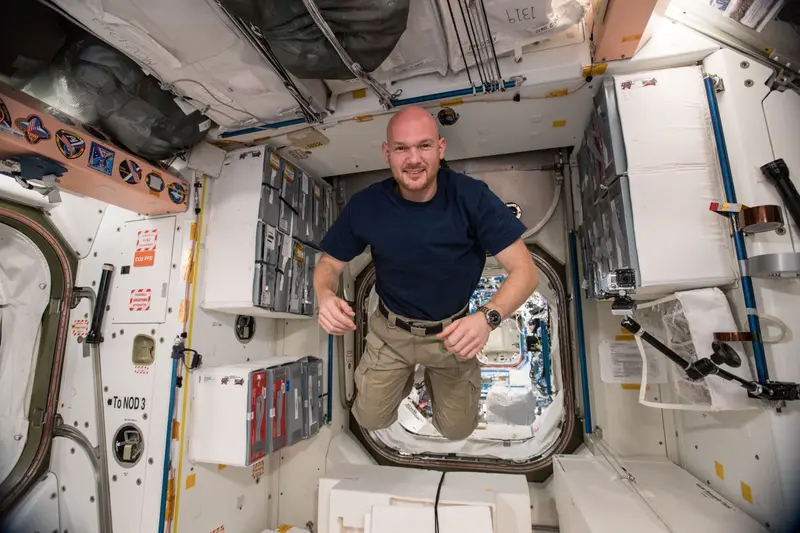
So far, astronauts have only gone on visits: a few days on the Moon, a few months on the Space Station. The big step coming next is staying: living and working away from Earth, using what's already out there, and going farther than ever before. Many of these ideas are already being built. Let's look at the most exciting ones.
A base on the Moon
The first stop is the Moon, because it's close: three days away. Space agencies want to set up bases near its south pole. Why there? Because at the bottom of some craters the Sun never shines, and ice has been hidden there for millions of years.
That ice is a treasure:
- Melted, it gives you water to drink.
- Splitting the water into its two parts, oxygen and hydrogen, gives you air to breathe.
- And oxygen and hydrogen together make rocket fuel.
Using what's already there, instead of carrying everything up from Earth, is one of the keys to the future. It's like camping next to a river instead of hauling along every bottle of water.
Heading for Mars
Mars is the big dream. But it's much, much harder than the Moon:
- It's far away. Depending on where the two planets are, it's between 55 and 400 million kilometers away. The trip takes about seven months, and you have to leave when the planets are lined up just right, which happens about every two years.
- Messages take a while. A call to Earth takes between 3 and 22 minutes to arrive. You can't get help right away.
- It's a harsh place. Its air is very thin and almost all carbon dioxide, impossible to breathe. It's very cold: about −60°C on average.
Its gravity is a little more than a third of Earth's. How much would you weigh there?
Game
How much would you weigh on other worlds?
In the meantime, robots on wheels have been exploring Mars for years, searching for clues about whether there was ever life there.
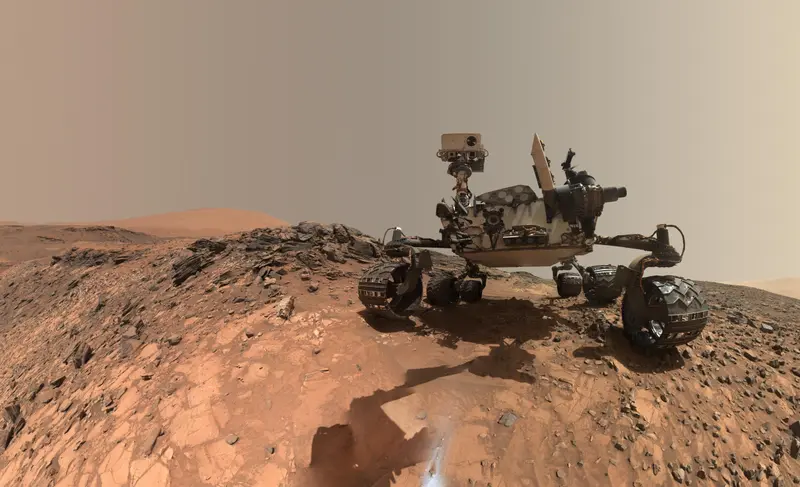
Epic moment · February 18, 2021
Perseverance Lands on Mars
For the first time we truly see how a landing on another planet happens, recorded by the rover's own cameras. The 70-foot (21.5-meter) parachute opens at supersonic speed, the heat shield drops away and, finally, a "sky crane" with rockets lowers Perseverance on cables until it touches down in Jezero Crater. It all lasts about seven minutes and happens on its own, with nobody at the controls: signals took more than eleven minutes to reach Earth.
Watch the full moment, with soundNASA/JPL-Caltech · Public domainTreasures in the asteroids
Asteroids are rocks that travel around the Sun. Some are as small as a house and others as big as a small country. Some have water hidden in their rocks, and others have metals.
We've already gone to fetch pieces of them. In 2023, the OSIRIS-REx spacecraft brought dust and pebbles from the asteroid Bennu back to Earth. Scientists found minerals that formed in water and molecules that are building blocks of life.
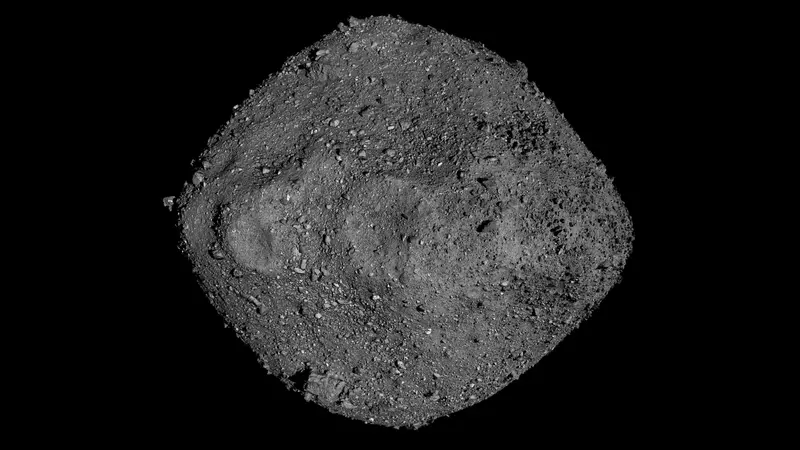
In the future, water from asteroids could become a gas station for spacecraft traveling far away.
New engines
Today's rockets are very powerful, but they burn through their fuel in a few minutes. For long journeys, other ways of pushing are being tested:
- Ion engines. They shoot out particles using electricity. Their push is super gentle, like the weight of a sheet of paper in your hand, but they can keep pushing nonstop for years. Little by little, the spacecraft ends up going incredibly fast. The Dawn spacecraft used them to visit the asteroid Vesta and the dwarf planet Ceres.
- Solar sails. Enormous, super-thin sails that are pushed by sunlight, like a sailboat by the wind. They don't need any fuel.
Why is it worth it?
Going to space takes a lot of effort. But every step has brought us something: satellites that warn us about storms, inventions we use at home and answers to huge questions. Are we alone in the universe? How was the Earth born? And learning to live in such tough places teaches us to take better care of the only planet we have.
Key points
- The next step is staying: bases on the Moon, near the ice at its south pole.
- Mars is about seven months away and is cold, dry and has no breathable air.
- Asteroids have water and metals; we've already brought back samples from Bennu.
- Ion engines and solar sails push gently, but for a very, very long time.
Test yourself
Why is the ice at the Moon's south pole so interesting?
Roughly how long does a trip to Mars take?
How does an ion engine push?