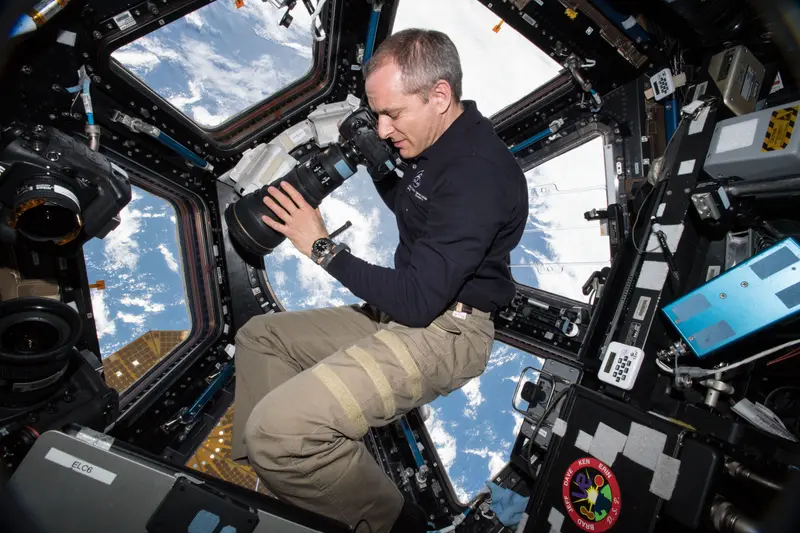
Imagine moving into a house where there's no air outside, where it's hotter than an oven in the sunshine and colder than the strongest freezer in the shade, where it never rains, there are no stores, and water doesn't pour from the tap but floats around in little blobs. That's what living in space is like. And yet, since the year 2000 there have always been people living up there, on the International Space Station. Let's see how they do it.
The Space Station: a home in orbit
The Space Station flies about 400 km up and goes around the Earth every hour and a half. Counting its huge solar panels, it's about the size of an American football field, end zones included, and inside it has as much room as a six-bedroom house. Usually seven astronauts from several countries live on board, each staying for about six months.
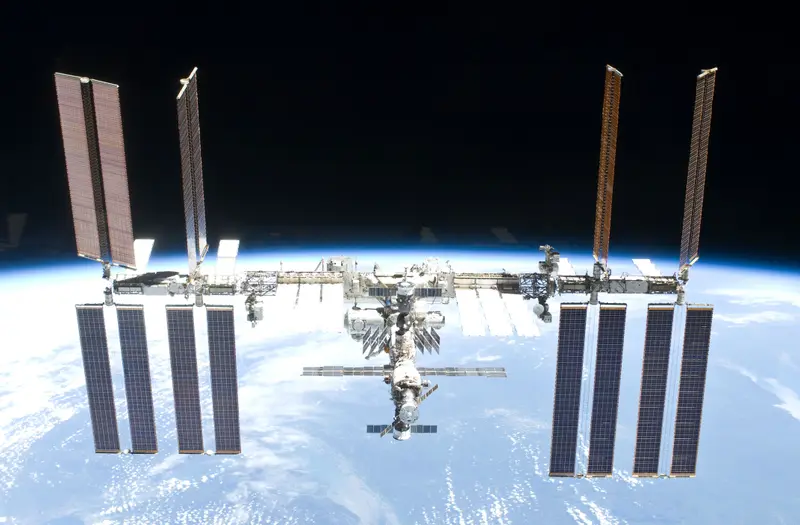
Everything they need to live is made by the station's machines or brought up by cargo ships from Earth. Try keeping track of it yourself:
Game
Keep the crew alive
Air and water: recycling almost everything
Air. Astronauts breathe in oxygen and breathe out carbon dioxide, just like you. In a closed room, that carbon dioxide would build up and eventually become dangerous. So machines remove it from the air nonstop. And they make oxygen from water: using electricity, they split water into its two parts, oxygen and hydrogen.
Water. Sending water up from Earth is hugely expensive, so almost all of it gets reused. The station collects the moisture in astronauts' breath, their sweat and even their urine, and cleans it until it's purer than a lot of tap water. That way it recovers about 98 out of every 100 drops.
Epic moment · April 4, 2026
A Floating Ball of Water
Without gravity, water doesn't fall or spill: its own surface tension pulls it into an almost perfect sphere that floats in the air. Aboard the Orion capsule, on the way to the Moon, the Artemis II astronauts play with one of these balls. Notice the detail: the sphere works like a magnifying glass and shows the astronaut's face upside down, just like the lens of an eye or a camera.
Watch the full moment, with soundNASA · Public domainEating, sleeping and washing while floating
In weightlessness everything floats, and that makes everything harder:
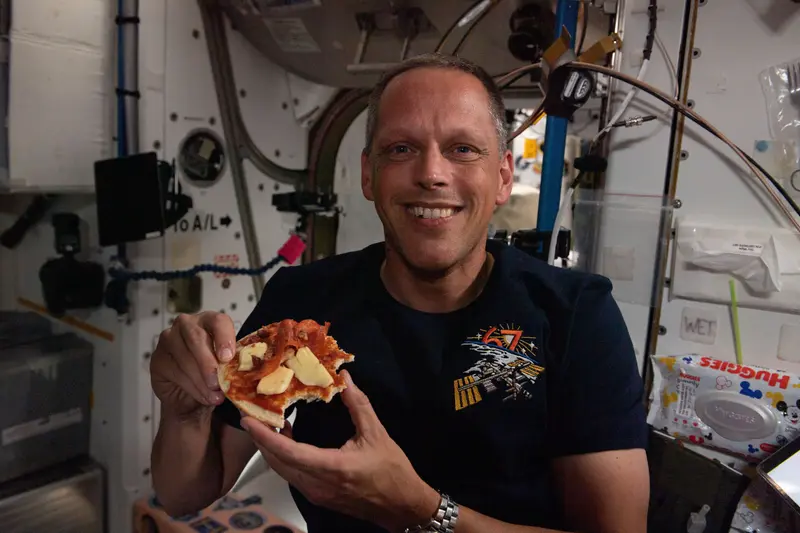
- Food. It comes in pouches and cans, and a lot of it is dried (you add hot water). Instead of bread, astronauts use tortillas, because bread makes crumbs that float around and can get into eyes or machines.
- Sleeping. In a sleeping bag tied to the wall, so they don't go drifting around the station.
- Washing. There's no shower: they clean themselves with wet wipes and no-rinse shampoo.
What happens to the body
Our bodies are made to live with gravity. When they float for months, they change:
- Muscles and bones get weaker, because they hardly have to work. That's why astronauts exercise for about two hours a day on special machines.
- They get taller. Without the weight squeezing their spine, astronauts can grow up to about 5 cm.
- Radiation. Up there, more particles from the Sun and from space reach them. The station's walls protect them partly.
The spacesuit: a spacecraft made to fit you
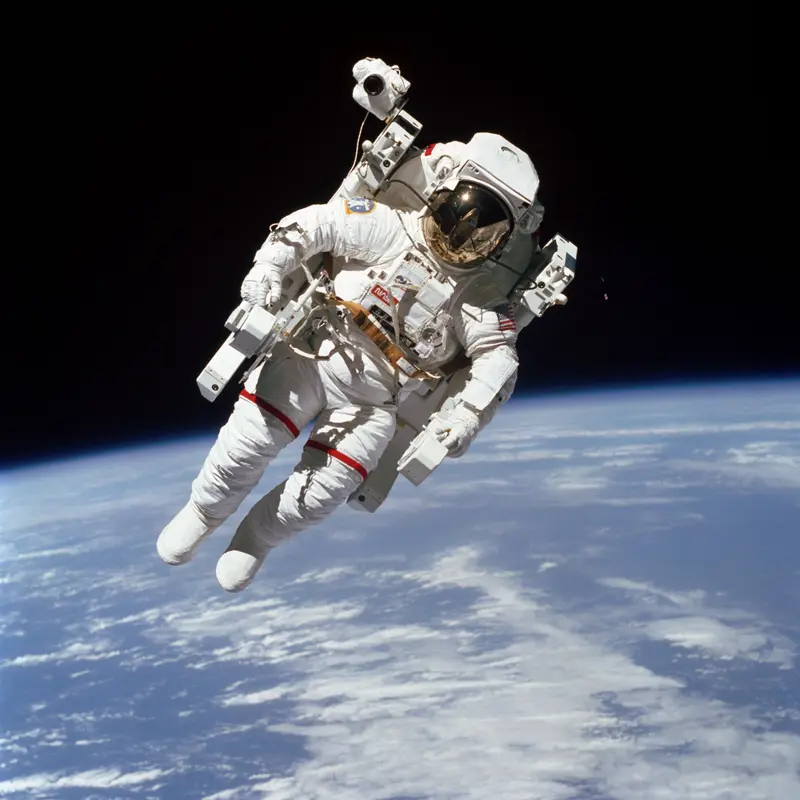
To go outside the station, astronauts put on a spacesuit. It isn't just clothing: it's a person-sized spacecraft. It gives them oxygen, removes carbon dioxide, keeps the body at the right pressure, has tiny water tubes to cool them in the Sun's heat, heating for the shade, a radio, and a helmet with a gold visor against the sunlight.
On Earth it would weigh more than 100 kilos, but floating, you don't feel the weight. The hard part is moving: the suit is so puffed up that just bending your fingers inside the gloves is exhausting.
Key points
- Machines clean the air and recycle almost all the water, including urine.
- Floating weakens muscles and bones: that's why astronauts exercise two hours a day.
- A spacesuit is a small spacecraft that provides air, the right temperature and pressure.
- And to go farther, to the Moon? Carry on with traveling to the Moon.
Test yourself
Where does much of the water that astronauts drink on the Space Station come from?
Why do astronauts exercise for about two hours a day?
Why do astronauts grow a few centimeters taller in space?