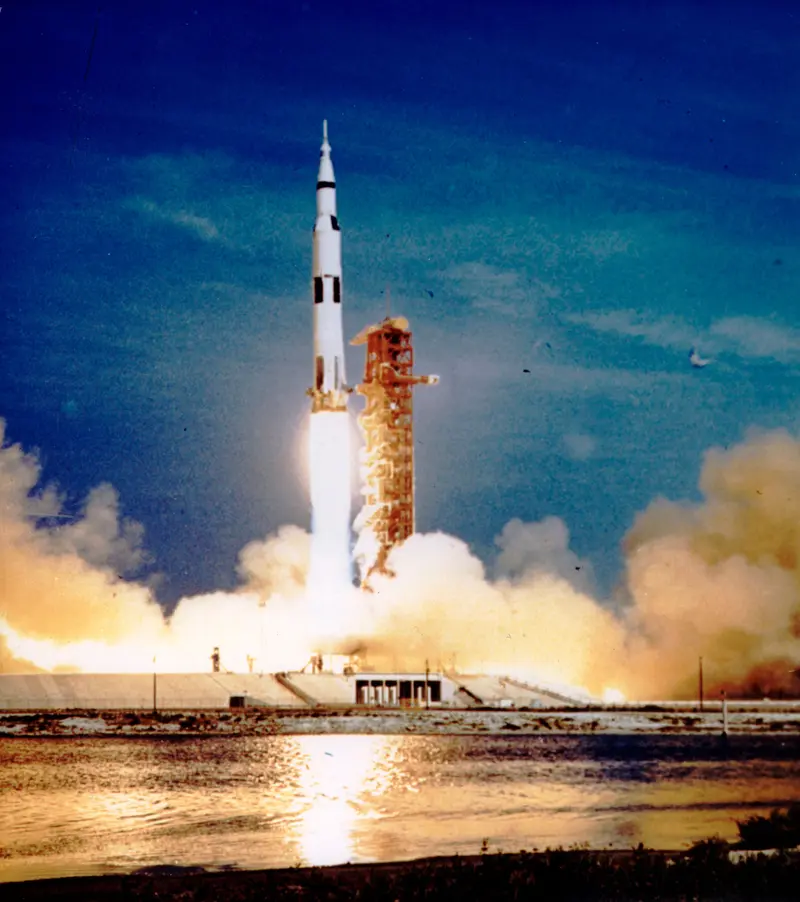
A rocket lifting off is the most powerful thing humans have ever built: a column of fire, a roar that shakes the ground kilometers away, and a tower taller than a 30-story building climbing into the sky. But the idea that makes it go is so simple you can test it with a balloon.
Action and reaction
When you push something, it pushes you back. If you're standing on a skateboard and throw a heavy ball forward, you roll backward. If you let go of a blown-up balloon without tying it, the air rushes out one way and the balloon zooms off the other way.
A rocket does exactly that: it throws a huge amount of burning gas downward, very fast, and the gas pushes the rocket upward. The gases shoot out at several kilometers per second: more than ten times faster than a passenger jet.
Fuel and oxygen
For something to burn, you need two things: something to burn (the fuel) and oxygen. A campfire takes its oxygen from the air. But there's no air in space, so a rocket has to carry its own oxygen in a tank, kept super cold so it stays liquid. Together, the two are called propellants.
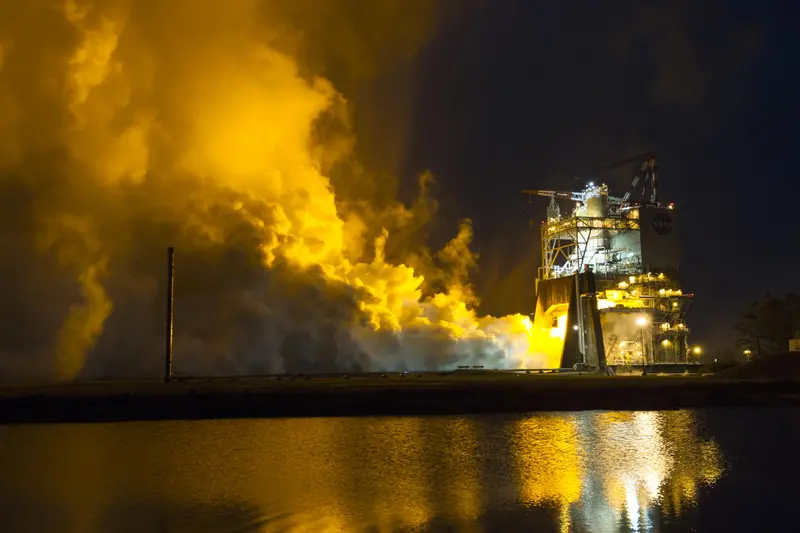
In the engine they mix and burn. The very hot gas blasts out through the nozzle, that bell you see under the rocket. The nozzle is bell-shaped so the gas comes out even faster and in the right direction.
Epic moment · July 16, 1969
Saturn V Launch (Apollo 11)
High-speed cameras placed next to the launch pad filmed in slow motion as the five F-1 engines of the Saturn V ignite, while steel arms hold it down until it reaches full power. At 110 meters (363 feet) tall and almost 3,000 tonnes, it is still one of the most powerful rockets ever built. Up top, Armstrong, Aldrin and Collins were beginning a four-day journey to the Moon.
Watch the full momentNASA · Public domainA rocket is almost all fuel tank
Here's the surprising part. The Saturn V, the rocket that took astronauts to the Moon, was about 110 meters tall, longer than a football field, and weighed almost 3,000 tonnes at liftoff. Do you know how much of that was propellant? About nine-tenths. What actually reached orbit was less than one-twentieth of the total.
Why so much? Because fuel is heavy too. To lift more cargo you need more fuel, but that extra fuel has to be lifted as well, so you need more fuel for the fuel... It's as if, to carry your backpack to school, you also had to carry the sandwich you'll eat on the way, plus another sandwich to give you the energy to carry the first sandwich.
Scientists work this out with the rocket equation. It says something very important: if you want to go twice as fast, twice as much fuel isn't enough. You need far, far more.
Stages: dropping what you don't need
So how do you actually get to space? With a trick: stages. A big rocket is really several rockets stacked one on top of the other.
- The first stage, the biggest one, fires its engines and carries the rocket up through the air.
- When it runs out of fuel, it's let go and falls away. No more hauling that empty tank around.
- The second stage lights up. It's much lighter, so it speeds up more easily.
It's like throwing off your winter coat while you run once you don't need it anymore. The less you weigh, the easier it is to speed up.
Game
Design your rocket
Today, some first stages aren't thrown away anymore: they come back and land standing up, ready to fly again. You'll see how in getting to orbit.
Key points
- A rocket throws gas backward, and the gas pushes it forward: action and reaction.
- It carries fuel and its own oxygen, because there's no air in space.
- Almost all of a rocket's weight is fuel: that's why rockets are so big.
- Stages drop empty tanks so the rest of the rocket can speed up better.
- So how fast do you need to go? Find out in gravity and orbits.
Test yourself
What does a rocket push against to move forward?
Why do rockets carry their own oxygen?
What are a rocket's stages for?