Look up on a clear day. That blue sky seems to go on forever, but it's really a super-thin layer of air wrapped around the Earth. If you could drive a car straight up, in just over an hour you'd reach a place where there's no air to breathe, the sky is black even in the daytime, and the stars don't twinkle. That's space. Here you'll find out where it begins, what's up there, and how unbelievably big it is.
Where does space begin?
The air doesn't stop all at once: it gets thinner and thinner the higher you go. So scientists agreed on a boundary: the Kármán line, about 100 kilometers (62 miles) up. That's roughly eleven times the height of Mount Everest.
Why there? Because at that height the air is so thin that a plane's wings have nothing left to push against. To stay up, you have to go as fast as a satellite. You can read about it in gravity and orbits.
Game
Climb through the atmosphere
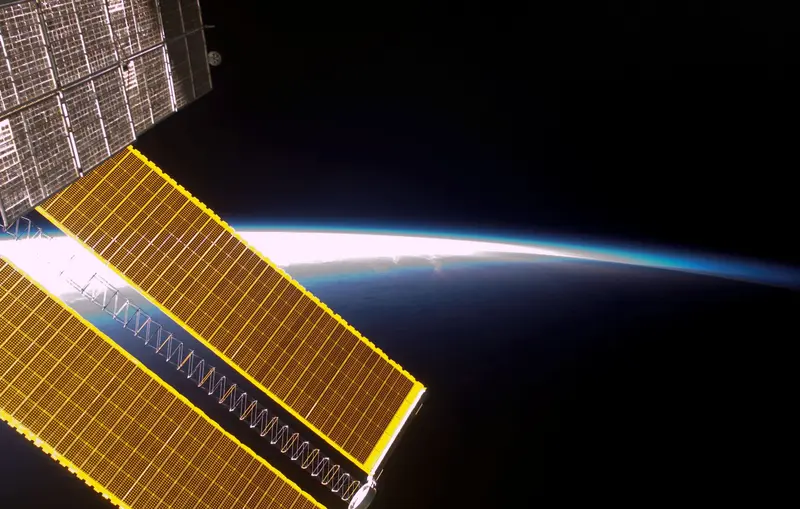
The atmosphere: a very thin skin
The layer of air around us is called the atmosphere. It gives us oxygen to breathe, shields us from heat and cold, and stops almost all the rocks that fall from space: they burn up before reaching the ground, and we see them as shooting stars.
And it's incredibly thin. Half of all the air is below 5.5 kilometers: lower than the top of Mount Everest.
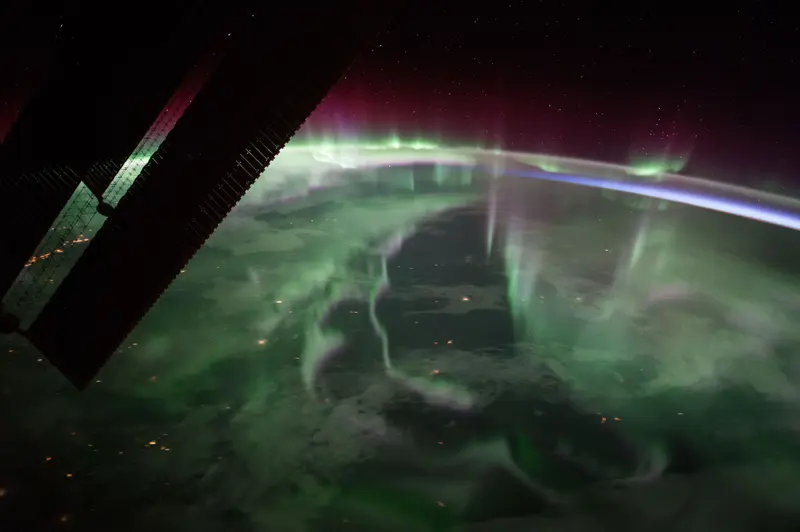
Epic moment · 2017
Earth at Night from the Space Station
A green and violet aurora borealis ripples over Canada while, below, the lights of cities across the United States switch on all the way down to Florida. They are hundreds of photos that the Expedition 53 astronauts took one after another from the Space Station, about 400 kilometers up. The Station moves so fast, about 28,000 km/h (17,500 mph), that it circles the world every hour and a half and its crew sees 16 sunrises a day.
Watch the full momentNASA (Crew Earth Observations, Johnson Space Center) · Public domainWhat is (and isn't) in space
Space is almost empty. It's not that there's nothing at all, but there's so little that we call it a vacuum.
- No sound. Sound travels by making the air vibrate. Without air, an explosion in space would be completely silent.
- A black sky. Down here the sky is blue because the air scatters sunlight. Up there, there's no air to scatter it.
- Hot and cold at the same time. An object in sunlight can get hotter than 100°C, hotter than boiling water, while its shady side drops below −100°C. Without air, heat doesn't get spread around.
- Radiation. The Sun shoots out invisible particles that can harm the body. On Earth we're protected by the atmosphere and by the planet's magnetic field, which works like an invisible shield.
How big everything is
Distances in space are so enormous that they're hard to imagine.
- The Space Station flies about 400 km up: roughly the distance from London to Newcastle, but straight up.
- The Moon is 384,400 km away. About 30 Earths lined up in a row would fit between us and it.
- The Sun is about 150 million kilometers away. Its light, the fastest thing there is, takes about 8 minutes to get here. The sunlight you see right now left the Sun eight minutes ago.
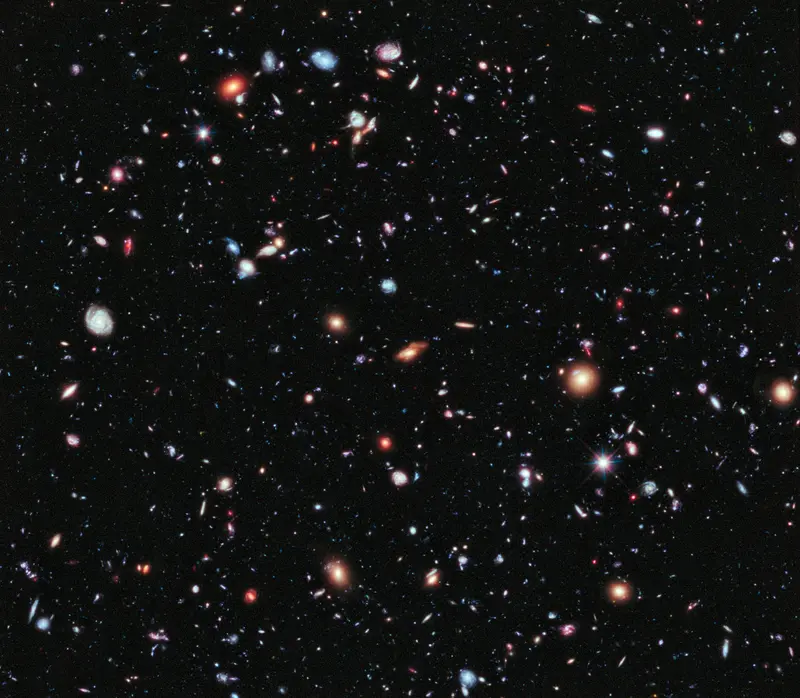
And that's just our neighborhood. Beyond it there are billions of stars and galaxies.
Key points
- Space begins at roughly 100 km up: the Kármán line.
- There's no air in space: no sound, no blue sky, and heat doesn't spread around.
- The distances are gigantic: the Moon is 30 Earths away; sunlight takes 8 minutes to reach us.
- So how do you get up there? Start with how a rocket works.
Test yourself
At what height do people usually say space begins?
Why can't you hear anything in space?
If Earth were a basketball, how far away would the Moon be?