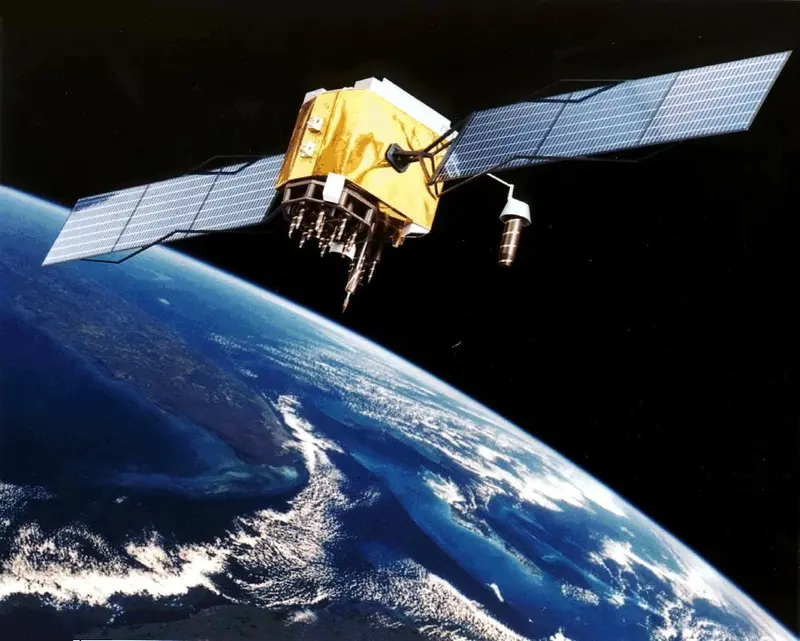
A crewed spacecraft is a small piece of Earth packed into a box: each person has to be given air at the right pressure and composition, water, food and a temperature of about 22 °C; their CO₂, heat and waste have to be removed; and they must be protected from radiation and from the effects of living without weight. This page gives the design figures for those systems —what NASA calls ECLSS, the Environmental Control and Life Support System—, how they are handled today on the International Space Station and what is still missing for long voyages.
The mass balance of one person
Design values per crew member per day, rounded, from NASA's Baseline Values and Assumptions Document (BVAD) (they depend on body mass, activity and diet):
| Input | kg/day | Output | kg/day |
|---|---|---|---|
| Oxygen | ~0.82 | Carbon dioxide | ~1.04 |
| Drinking water and water in food | ~2.5-3.5 | Urine | ~1.5 |
| Food (dry solids) | ~0.6-0.8 | Water from sweat and respiration | ~1.5-2.3 |
| Food with packaging and its water | ~1.8 | Feces (solids) | ~0.03 |
| Hygiene water | highly variable (from ~1 to several kg) | Metabolic heat | ~100-150 W |
Metabolic energy is about 11-12 MJ per day (about 2,700-2,900 kcal). Without any recycling, a crew of four for one year would need on the order of 6-10 t of water, oxygen and food alone. A station in LEO can be resupplied; a Mars mission cannot.
The cabin atmosphere
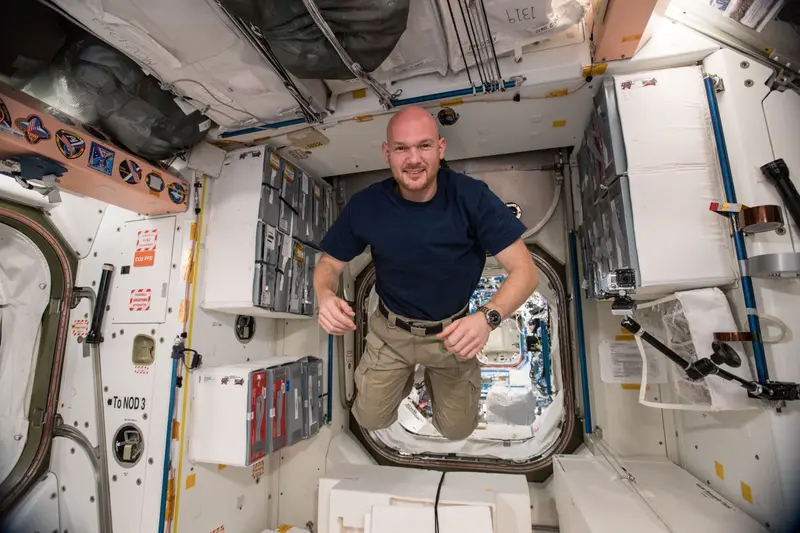
The Space Station flies with "Earth" air: 101.3 kPa, 21 % O₂ and nitrogen as diluent. This is the safest option against fire and for experiments, but it forces a long denitrogenation before every spacewalk. The Apollo 1 fire on the pad (1967), in pure oxygen at overpressure, set for good the caution about oxygen fraction.
Controlled parameters:
- O₂ partial pressure: ~19.5-23.1 kPa on the Station. Hypoxia appears below about 16 kPa equivalent.
- CO₂: at 1 atm, the terrestrial concentration is ~0.04 %; on the Station it is kept around 0.3-0.5 kPa partial pressure (2-4 mmHg). Astronauts report headaches above about 3 mmHg, and NASA has been lowering its limits.
- Temperature 18-27 °C, relative humidity 25-70 %.
- Trace contaminants (ammonia, formaldehyde, siloxanes): removed with activated charcoal and catalytic oxidation.
For exploration, atmospheres of 56.5-70 kPa with 30-34 % O₂ are being studied, which shorten the denitrogenation before EVA, at the cost of higher fire risk.
Epic moment · April 4, 2026
A Floating Ball of Water
Without gravity, water doesn't fall or spill: its own surface tension pulls it into an almost perfect sphere that floats in the air. Aboard the Orion capsule, on the way to the Moon, the Artemis II astronauts play with one of these balls. Notice the detail: the sphere works like a magnifying glass and shows the astronaut's face upside down, just like the lens of an eye or a camera.
Watch the full moment, with soundNASA · Public domainHow the loop is closed on the Station
The US segment has a regenerative ECLSS; the Russian segment has a parallel, complementary one (Elektron, Vozdukh):
| Function | System | Principle |
|---|---|---|
| Generate O₂ | Oxygen Generation Assembly (OGA); Elektron | Water electrolysis: 2 H₂O → 2 H₂ + O₂ |
| Remove CO₂ | CDRA (zeolite 5A beds); Vozdukh | Adsorption and desorption by vacuum and heat |
| Recover water from CO₂ | Sabatier reactor | CO₂ + 4 H₂ → CH₄ + 2 H₂O (ruthenium catalyst, ~300-400 °C) |
| Recycle urine | UPA (vapor compression distillation) + BPA | Low-pressure distillation; the BPA recovers water from the brine |
| Make water potable | Water Processor Assembly | Multi-filtration beds, catalytic oxidation, iodine as biocide |
| Contaminant control | TCCS | Activated charcoal, catalytic oxidation |
Since 2023 the Station has recovered about 98 % of its water (sweat, humidity, urine). The oxygen loop is less closed: the Sabatier reactor turns part of the CO₂ into water, but the methane is vented overboard with its hydrogen, and the oxygen bound up in the remaining CO₂ is lost. Full closure would require methane pyrolysis or Bosch-type systems, still experimental. Food is not recycled: all of it comes from Earth.
The design criterion is the mass break-even point: a regenerative system weighs more and consumes more electricity than a few tanks, but beyond a certain mission duration it comes out lighter. For water and oxygen that point comes after weeks or a few months of mission; for food (greenhouses), much later, because biomass demands illuminated area, power and crew time.
Game
Keep the crew alive
Heat and power
Each person contributes 100-150 W of metabolic heat, and the electronics far more. In vacuum, heat can only leave by radiation (see what is space). The Station collects it with an internal water loop and passes it through heat exchangers to two external ammonia loops, which carry it to radiators able to reject on the order of 70 kW. Sizing comes from Stefan-Boltzmann: a radiator at 280 K with ε = 0.9 emits about 320 W/m² per side, not counting what it absorbs from the Sun and the Earth. Hundreds of square meters of radiator are the norm.
Food
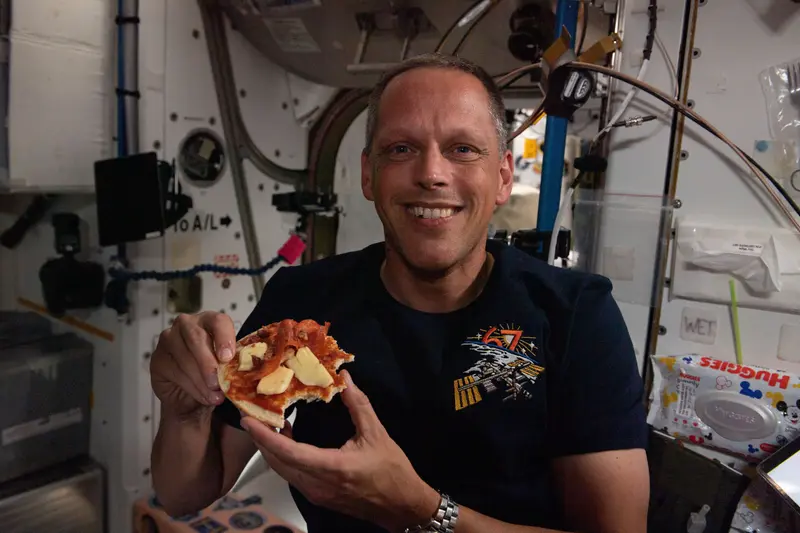
On the order of 1.8 kg per person per day with packaging. Current space food is dehydrated, thermostabilized or irradiated, with shelf lives of 1-2 years; Mars would need 3-5 years without nutrient loss (vitamins such as C, B1 and A degrade). Lettuce, radishes and chili peppers have been grown in the Veggie experiment and the Station's Advanced Plant Habitat, as a supplement, not as a main source.
Spacesuits
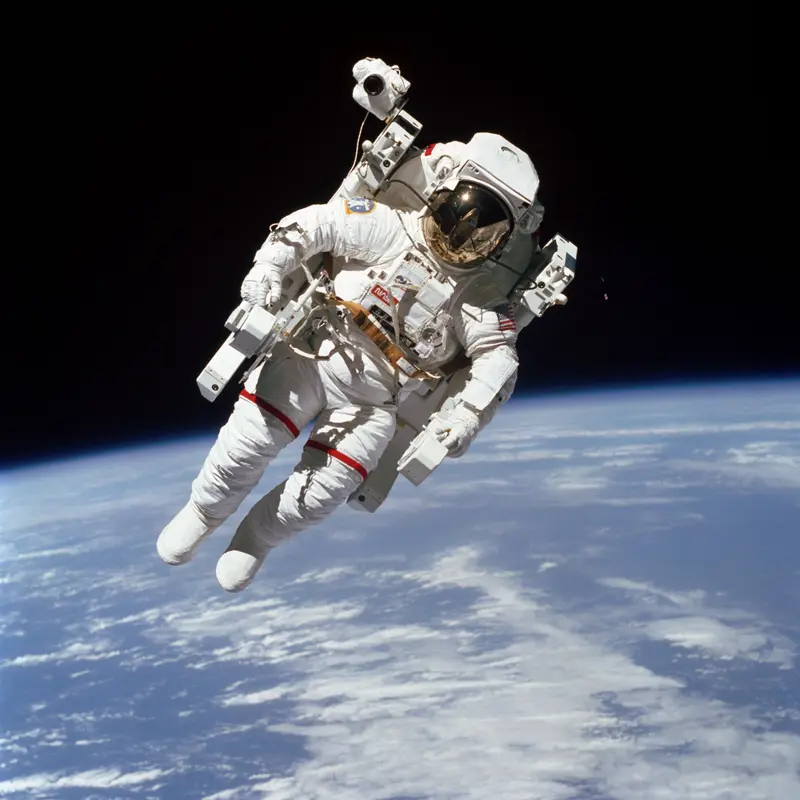
A suit is a one-person spacecraft: pressure, oxygen, CO₂ removal, thermal control and protection against micrometeoroids.
| Parameter | EMU (USA) | Orlan-MKS (Russia) |
|---|---|---|
| Operating pressure | ~29.6 kPa (4.3 psi), pure O₂ | ~40 kPa, pure O₂ |
| Typical endurance | 6.5-8 h | ~7 h |
| CO₂ removal | LiOH cartridge or regenerable metal oxide | LiOH |
| Cooling | Liquid cooling garment + sublimator | Similar |
| Prebreathe | Several protocols lasting hours (exercise, 70 kPa campout…) | ~30 min |
The suit's low pressure is a compromise: with more pressure the fabric stiffens and moving the hands is very tiring; with less, the nitrogen dissolved in the body has to be purged to avoid decompression sickness. The risk ratio R = pN₂ (tissue) / p_total (suit) must be kept below ~1.2-1.4. The Artemis lunar suits (AxEMU, by Axiom Space) improve hip and knee mobility for walking and kneeling, and must withstand lunar dust, which is abrasive and clingy.
Sublimation cooling is very elegant: water flows to a porous plate exposed to vacuum, freezes and sublimates; every kilogram of water sublimated carries away about 2.8 MJ.
Radiation: dose and shielding
Effective dose is measured in sieverts (Sv). Reference figures:
| Situation | Approximate dose |
|---|---|
| Natural background on Earth | ~2.4 mSv/year |
| Six months on the Station | on the order of 50-150 mSv |
| Round trip to Mars, cruise only (MSL/RAD) | ~0.66 Sv |
| Complete Mars mission (~2.5 years) | on the order of 1 Sv |
| NASA career limit (NASA-STD-3001, 2022) | 600 mSv |
The problem is galactic cosmic rays: heavy, high-energy nuclei that pass through any reasonable shielding and produce secondaries (neutrons, fragments). Shielding is measured in areal density (g/cm²). For the same g/cm², hydrogen-rich materials (water, polyethylene) are better than aluminum, because they fragment heavy nuclei with less secondary production. A storm shelter of about 20 g/cm² of water (20 cm) is enough against the protons of a solar particle event, but barely reduces the cosmic ray dose: against those, beyond a few tens of g/cm² very little is gained.
The effects of concern are stochastic (cancer, in the long term), cardiovascular and central nervous system effects; acute effects would only appear with a large solar event outside the magnetosphere without shelter. That is why lunar missions have shelter procedures, and Orion can improvise one with cargo bags and water.
Microgravity and the body
| System | Effect | Countermeasure |
|---|---|---|
| Fluids | ~2 L shift toward the head: puffy face, "bird legs", lower plasma volume | Adaptation; lower body negative pressure trousers under study |
| Bone | Loss of mineral density on the order of 1-1.5 % per month in hips and spine | Resistance exercise (ARED), bisphosphonates under study |
| Muscle | Atrophy, especially in postural and leg muscles | ~2 h of daily exercise: treadmill, cycle ergometer, resistance |
| Eyes | SANS: optic disc edema, choroidal folds, hyperopic shift | Under investigation; possible role of CO₂ and fluids |
| Balance | Space motion sickness in the first days; disorientation on return | Drugs, adaptation |
| Immune system and sleep | Immune changes, disrupted circadian rhythm (16 sunrises a day) | Controlled lighting, schedules |
A root solution is artificial gravity by rotation: a = ω² · r. For 1 g with a maximum of 2 rpm a radius of about 220 m is needed; with small radii, the high spin rate causes motion sickness through the Coriolis effect. No spacecraft has it yet.
The International Space Station as a testbed
The Station flies at about 400-420 km at 51.6° inclination, has a mass on the order of 420 t, about 900 m³ of pressurized volume and has been continuously inhabited since November 2000. Its life support systems are the main long-duration test of the technology that lunar bases and trips to Mars will need, as are its medical studies with stays of up to a year. It is scheduled to be retired around 2030 with a deorbit vehicle; commercial stations will succeed it. China has operated Tiangong, of about 100 t, since 2022.
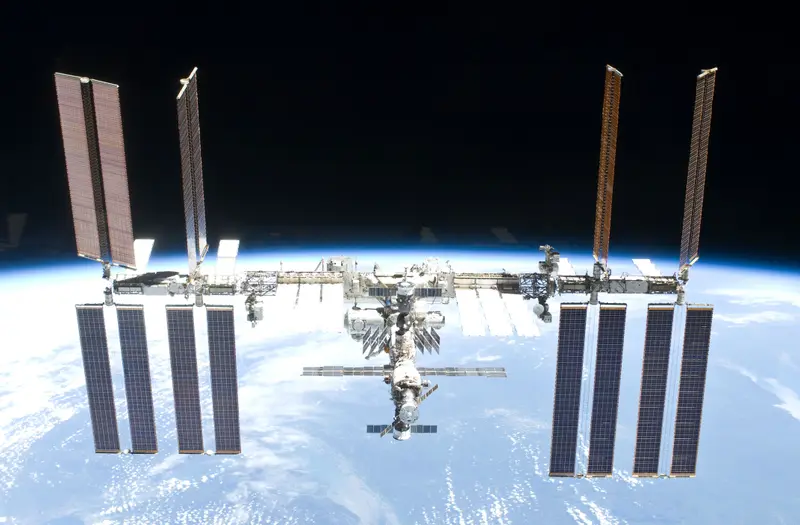
What is learned here carries over to traveling to the Moon and to the future in space. Materials for suits, windows and shielding are covered in materials for space.
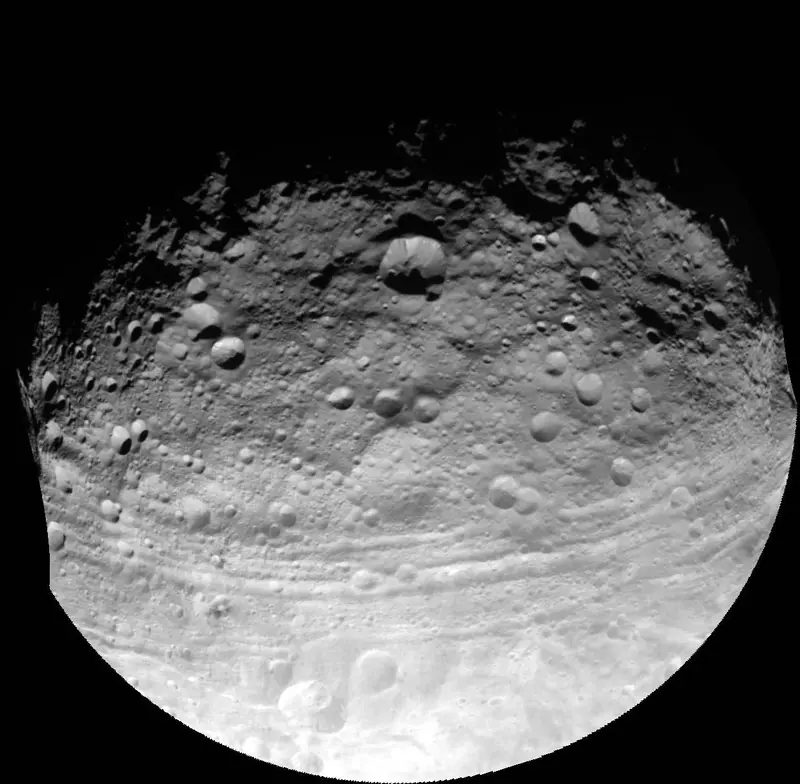 ActivityGamoras 3D MissionLand a damaged ship on a 220 km asteroid, search for water with a hopping robot, make propellant and a glass-ceramic nozzle, and fly back up to dock with your ship in orbit. With real physics.Play the mission
Key points
- Per person per day: ~0.8 kg of O₂, ~2.5-3.5 kg of water, ~1.8 kg of packaged food; out comes ~1 kg of CO₂ and 100-150 W of heat.
- The Station recycles ~98 % of its water; oxygen, partly; food, not at all.
- Suits at 29.6-40 kPa of pure O₂: less pressure, more mobility, but denitrogenation is required.
- Against cosmic rays shielding helps little; against solar storms it does (~20 g/cm² of water).
- Without weight: bone and muscle are lost, fluids shift upward, the eyes change.
Further reading
- M. S. Anderson, M. K. Ewert, J. F. Keener, Life Support Baseline Values and Assumptions Document, NASA/TP-2015-218570/REV2 (2022).
- NASA, NASA Space Flight Human-System Standard, Volume 1: Crew Health, NASA-STD-3001 Vol. 1, Rev. B (2022).
- C. Zeitlin et al., "Measurements of Energetic Particle Radiation in Transit to Mars on the Mars Science Laboratory", Science 340, 1080-1084 (2013).
- F. E. Garrett-Bakelman et al., "The NASA Twins Study: A multidimensional analysis of a year-long human spaceflight", Science 364, eaau8650 (2019).
- P. O. Wieland, Designing for Human Presence in Space: An Introduction to Environmental Control and Life Support Systems, NASA RP-1324 (1994).
Test yourself
Roughly how much oxygen does one crew member consume per day?
Which reaction does the Station use to recover water from the CO₂ removed from the air?
Why must astronauts breathe pure oxygen before going out in the US EMU suit?
What career effective dose limit has NASA-STD-3001 set since 2022?
What loss of bone mineral density is typically seen in the hips and spine in microgravity?
Go deeper: engineering subjects
If you want to go beyond this lesson, these subjects develop it at university level.